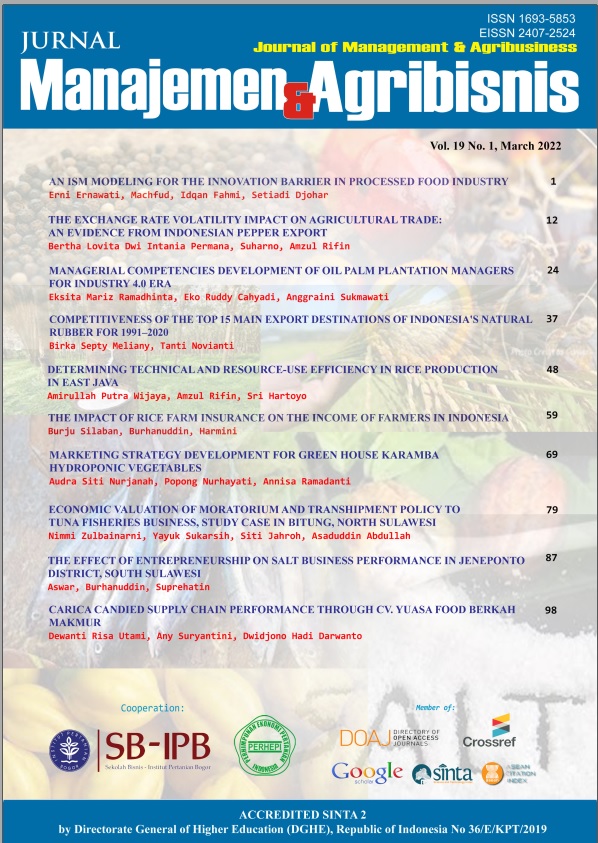
An ISM Modeling for The Innovation Barrier in Processed Food Industry
DOI:
https://doi.org/10.17358/jma.19.1.1Abstract
In Indonesia, the processed food industry is one of the strategic sectors of economic growth because rapid and massive innovation expected to accelerate the recovery of the Indonesian economy during Covid-19 pandemic. Therefore, this study aims to identify the innovation barriers as well as to understand how they interact with each other so that the decision makers can focus on to overcome these barriers. There is a presentation of hierarchy-based and the mutual relationships among these hindrances using interpretive structural modeling. Three main barriers including economic or political uncertainty, overlapping government regulations, and low organizational commitment was identified to show a high driving power with a low dependence because they have strategic importance and require great attention from stakeholders. The results become a reference for stakeholders in formulating the innovation development strategies and several formulating policies for the maintenance of political or economic stability as well as the harmonization of regulations.
Keywords: barriers, innovation, ISM, modeling, processed food industry
Downloads
Downloads
Published
Issue
Section
License
Authors who publish with this journal agree to the following terms:
- Authors retain copyright and grant the journal right of first publication with the work simultaneously licensed under a Creative Commons Attribution License that allows others to share the work with an acknowledgement of the work's authorship and initial publication in this journal.
- Authors are able to enter into separate, additional contractual arrangements for the non-exclusive distribution of the journal's published version of the work (e.g., post it to an institutional repository or publish it in a book), with an acknowledgement of its initial publication in this journal.
- Authors are permitted and encouraged to post their work online (e.g., in institutional repositories or on their website) prior to and during the submission process, as it can lead to productive exchanges, as well as earlier and greater citation of published work (See The Effect of Open Access).
.png)