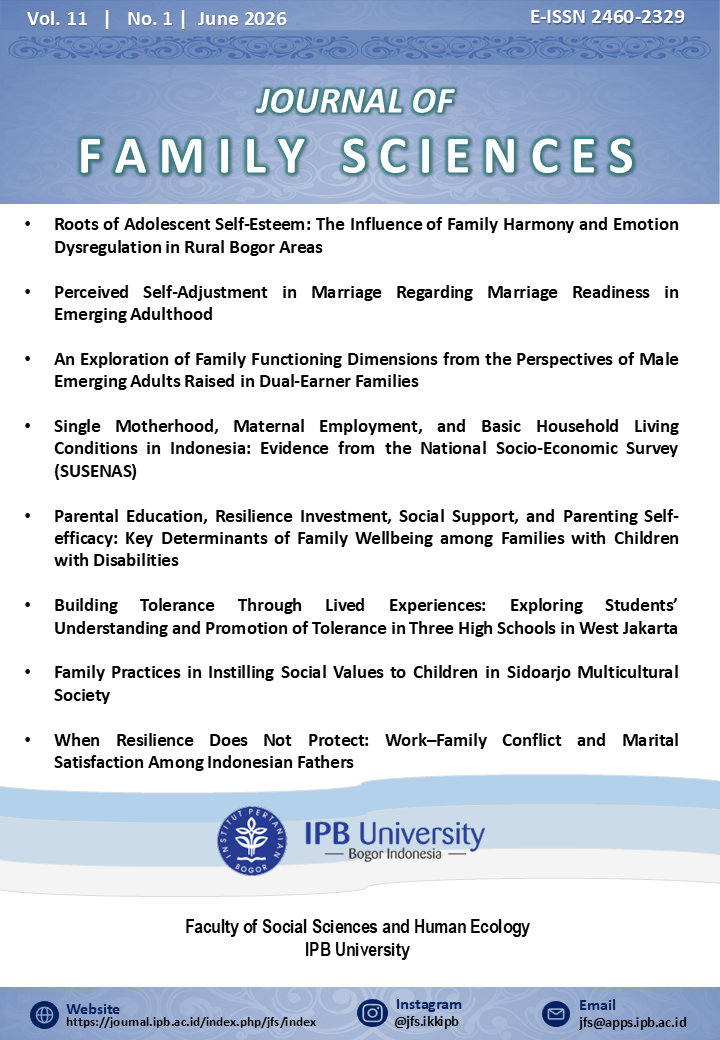
Perceived Self-Adjustment in Marriage Regarding Marriage Readiness in Emerging Adulthood
DOI:
https://doi.org/10.29244/jfs.v11i1.69738Keywords:
emerging adulthood, marriage, marriage readiness, perception, self-adjustmentAbstract
Over the past five years, Indonesia’s marriage rate has steadily declined, driven partly by widespread negative news about marriage that induces apprehension among young adults. This quantitative correlational study investigated the relationship between the perception of marital self-adjustment and marriage readiness among unmarried emerging adults. Utilizing purposive sampling, data were collected from 580 respondents residing in East Jakarta. Instruments included the Keldal Marriage Readiness Instrument (𝛼 = 0.963) and the Perception of Marriage Self-Adjustment Instrument (𝛼 = 0.845). Data were analyzed using Pearson correlation. The results demonstrated a moderate positive correlation between the perception of marital self-adjustment and marriage readiness (r = 0.447) indicating that individuals with more positive perceptions possess better readiness for marriage. These findings imply that pre-marital educators and governmental psychological services should develop targeted counseling programs focused on realistic marital adjustment. Therefore, individuals need to find out about issues prone to occurring in married life, enabling them to prepare themselves to handle these challenges properly.
References
Arnett, J. J. (2004). Emerging adulthood: the winding road from the late teens through the twenties. Oxford: Oxford University Press.
Arnett, J. J. (2007). Emerging adulthood: understanding the new way of coming of age. Emerging Adults in America: Coming of Age in the 21st Century. (pp. 3–19). American Psychological Association. https://doi.org/10.1037/11381-001
Badan Pusat Statistik. (2024). Persentase pengeluaran rata-rata per kapita sebulan menurut kelompok barang, Indonesia, 1999, 2002–2024. https://www.bps.go.id/id/statistics-table/1/OTM3IzE=/persentasepengeluaran-rata-rata-per-kapita-sebulan-menurut-kelompok-barang--indonesia--1999--2002-2024.html.
Badan Pusat Statistik. (2024). Jumlah perceraian menurut provinsi dan faktor penyebab perceraian (perkara), 2024. https://www.bps.go.id/id/statisticstable/3/YVdoU1IwVmlTM2h4YzFoV1psWkViRXhqTlZwRFVUMDkjMw==/jumlah-perceraian-menurut-provinsi-dan-faktor.html?year=2024
Brahmana, K. M. B., Simbolon, H., Ginting, A. B., Udek, T. L. H. S., & Manalu, W. S. (2023). The effect of marriage commitment and marriage adjustment toward marriage satisfaction of gbkp priest’s wife. Journal of Educational Health and Community Psychology, 12(2), 349-367. https://doi.org/10.12928/jehcp.v1i2.25957
Cevheroğlu, B. A., & Tutarel-Kışlak, Ş. (2022). Spouse and mother-in-law rejection and marital adjustment of turkish women with child and adult marriage. Journal of Social and Personal Relationships, 40(5), 1554-1578. https://doi.org/10.1177/02654075221129833
Dhuli, B. B., & Dhulı, E. (2024). Marriage and the obligations arising from it. Interdisciplinary Journal of Research and Development, 11(1), 201-203. https://doi.org/10.56345/ijrdv11n1s131
Elfira, N. (2018). Students marriage readiness based on cultural background. JOMSIGN: Journal of Multicultural Studies in Guidance and Counseling, 2(2). 126-133. https://doi.org/10.17509/jomsign.v2i2.10830
Fachrunisa, R. A., Ramadhina, R., & Cintya Dewi, S. (2023, April 1). Generasi muda Indonesia darurat kesiapan menikah, benarkah? Gerakan Indonesia Beradab. https://gerakanindonesiaberadab.org/generasi-muda-indonesia-darurat-kesiapan-menikah-benarkah/
Faradilla, S. A. I., & Sunarti, E. (2024). Marriage age preference, desire to have children, children’s value, and family readiness among undergraduate students of IPB University. Journal of Family Sciences, 9(1), 53-71. https://doi.org/10.29244/jfs.v9i1.45859
Fatma, S. H., & Sakdiyah, E. H. (2015). View of perbedaan kebahagiaan pasangan pernikahan dengan persiapan dan tanpa persiapan pada komunitas young mommy tuban. Jurnal Psikologi Tabularasa, 10(1), 103-114. Https://Jurnal.Unmer.Ac.Id/Index.Php/Jpt/Article/View/246/117.
Gündoğdu, A. H., & Bulut, S. (2022). The positive and negative effects of late marriage. Open Journal of Depression, 11(04), 63–71. https://doi.org/10.4236/ojd.2022.114005
Hakim, S. A., & Masfufah, U. (2023). Problematika kesiapan pernikahan individu dewasa awal. Jurnal Flourishing, 3(8), 345–351. https://doi.org/10.17977/10.17977/um070v3i82023p345-351 .
Hansen, P., & Vass, F. (2021). Editorial: on perception. Performance Research, 26(3), 1–8. https://doi.org/10.1080/13528165.2021.1977483
Henry, B., Lesmana, F., & Yoanita, D. (2020). Pengelolaan konflik pasangan suami istri dalam menjaga kelanggengan pernikahan pendahuluan. E-Komunikasi, 8(2), 1-12. https://publication.petra.ac.id/index.php/ilmukomunikasi/article/view/11112
Jalal, N. M. (2023). Description of perceptions about marriage adjustment in early adult individuals. International Journal of Education, Vocational and Social Science, 2(3), 191-196. https://doi.org/10.63922/ijevss.v2i03.388
Karananeethi, A., Prihadi, K. D., Ho, Y. M., Shoba, C., Nesan, G., Cahyanti, I. Y., & Surjaningrum, E. R. (2024). Achieving relationship satisfaction: household gender equality and mattering. International Journal of Public Health Science, 13(1), 376-384. https://doi.org/10.11591/ijphs.v13i1.23214
Karunia, N. E., & Rahaju, S. (2019). Marriage readiness of emerging adulthood. GUIDENA: Jurnal Ilmu Pendidikan Psikologi Bimbingan dan Konseling, 9(1), 29–34. https://doi.org/10.24127/gdn.v9i1.1338
Keldal, G., & Yıldırım, İ. (2022). Factors associated with marital readiness among Turkish young adults. Family Relations, 71(1), 307–324. https://doi.org/10.1111/fare.12619
Kemenkes RI. (2020). Profil kesehatan indonesia 2019 (B. Hardhana, F. Sibuea, & W. Widiantini, Eds.). Kementerian Kesehatan Republik Indonesia.
Kendrick, H. M., & Drentea, P. (2016). Marital Adjustment. In C. L. Shehan (Ed.), Encyclopedia of Family Studies (pp. 1–2). Wiley Blackwell. https://doi.org/10.1002/9781119085621.wbefs071
Latifah, A. S., & Wahyuni, Z. I. (2019). Faktor-faktor yang mempengaruhi penyesuaian perkawinan. TAZKIYA: Journal of Psychology, vol. 7(2), 120–135. https://doi.org/10.15408/tazkiya.v7i2.13471
Lo-oh, J. L. (2023). Conceptions of marriage readiness and marital quality indicators for future wellbeing among emerging adult students in the university of buea, cameroon. American Journal of Social Sciences and Humanities, 8(1), 16–34. https://doi.org/10.55284/ajssh.v8i1.822
Maidin, S. (2018). Keutamaan hidup bertetangga (suatu kajian hadis). Jurnal Al Qadau Peradilan dan Hukum Keluarga Islam, 4(2), 199–222. http://dx.doi.org/10.24252/al-qadau.v4i2.5691
Maulina, M. C., & Rejeki, A. (2024). Phenomenological study: women’s adjustment in early marriage decisions. Philanthropy: Journal of Psychology, 8(1), 86-104. https://doi.org/10.26623/philanthropy.v8i1.8861
Milkie, M. A., Sayer, L. C., Nomaguchi, K., & Yan, H. X. (2025). Who’s doing the housework and childcare in america now? differential convergence in twenty-first-century gender gaps in home tasks. Socius: Sociological Research for a Dynamic World, 11, 1-29. https://doi.org/10.1177/23780231251314667
Murniati, C., Pujihasvuty, R., Nasution, S. L., Oktriyanto, O., & Amrullah, H. (2024). Marriage readiness of adolescents aged 20-24 in Indonesia. Jurnal Biometrika Dan Kependudukan, 13(1), 1–11. https://doi.org/10.20473/jbk.v13i1.2024.1-11
Mohammadi, E. M., Borghei, N. S. and Mehrbakhsh, Z. (2023). Comparison of the outcomes of pregnancy and childbirth in married adolescents and young women. The Iranian Journal of Obstetrics, Gynecology and Infertility, 26(3), 78-89. https://doi.org/10.22038/ijogi.2023.22602
Nabilla, P., & Ramadhona, S. (2025). Gen z’s perception of marriage and the reasons behind it waithood case study: subdistrict hero, district north binjai, binjai city. Fox Justi : Jurnal Ilmu Hukum, 15(03), 839–844. https://ejournal.seaninstitute.or.id/index.php/Justi/article/view/7167
Ningrum, D. N. F., Latifah, M., Krisnatuti, D. (2021). Marital readiness: exploring the key factors among university students. Humanitas: Indonesian Psychological Journal, 18(1), 65-74. https://doi.org/10.26555/humanitas.v18i1.17912
Piechota, A., Ali, T., Tomlinson, J. M., & Monin, J. K. (2022). Social participation and marital satisfaction in mid to late life marriage. Journal of social and personal relationships, 39(4), 1175–1188. https://doi.org/10.1177/02654075211056289
Purba, W. G. M., & Kusumiati, R. Y. E. (2024). Emotional maturity as a predictor of marriage readiness in early adult women from Batak Ethnic groups. Jurnal Bimbingan Dan Konseling Terapan, 8(2), 158-171. https://doi.org/10.30598/jbkt.v8i2.2010
Rahmah, N., & Kurniawati, W. (2021). Relationship between marriage readiness and pregnancy planning among prospective brides. Journal of Public Health Research, 10(1), 2405-2411 . https://doi.org/10.4081/jphr.2021.2405
Ramdani, R., & Husaini, A. (2024). Manajemen konflik sebelum menikah sebagai upaya mempertahankan hubungan keluarga. Seminar Nasional Festival Tafaqquh 2024, 41–56. https://prosiding.stdiis.ac.id/index.php/hki/article/view/49
Riska, H., & Khasanah, N. (2023). Faktor yang memengaruhi fenomena menunda pernikahan pada generasi Z. Indonesian Health Issue, 2(1), 48–53. https://doi.org/https://doi.org/10.47134/inhis.v2i1.44
Shi, X., Impett, E. A., & Zheng, Y. (2025). The impact of sexual consent on sexual and relationship well-being in chinese romantic relationships. The Journal of Sex Research. 62(8), 1514-1531. https://doi.org/10.1080/00224499.2024.2445059
Scales, P. C., Benson, P. L., Oesterle, S., Hill, K. G., Hawkins, J. D., & Pashak, T. J. (2016). The dimensions of successful young adult development: A conceptual and measurement framework. Applied developmental science, 20(3), 150–174. https://doi.org/10.1080/10888691.2015.1082429
Sunarti, E., Zammi, M., Kusumaningrum, W. D., & Fuadah, R. S. (2023). Family physical economic strength of Bank Emok customer: An analysis the influence of debt behavior, lifestyle, economic pressure, and family financial conditions. Journal of Family Sciences, 8(2), 157-169. https://doi.org/10.29244/jfs.v8i2.49718.
Susanti, A. Y., Yusuf, A. M., Firman, F. (2021). Self-adjustment and social conflict of multicultural students. International Journal of Applied Counseling and Social Sciences. 1(1), 48-53. https://doi.org/10.24036/005302ijaccs
Vaishnavi, P., & Shalini, A. (2020). Development and standardization of marital adjustment questionnaire. International Journal of Humanities and Social Science Invention, 9(1), 34-39. https://ir.psgcas.ac.in/id/eprint/117/.
Yılmaz, C. D., Lajunen, T., & Sullman, M. J. M. (2023). Trust in relationships: a preliminary investigation of the influence of parental divorce, breakup experiences, adult attachment style, and close relationship beliefs on dyadic trust. Frontiers in Psychology, 14. 1-9. https://doi.org/10.3389/fpsyg.2023.1260480
Zulfa, V., Hasanah, U., & Kusaini, F. (2024). The phenomenon of early marriage and its impact on family resilience. Journal of Family Sciences, 48-58. https://doi.org/10.29244/jfs.vi.49929
Downloads
Published
Issue
Section
License
Copyright (c) 2026 Journal of Family Sciences

This work is licensed under a Creative Commons Attribution 4.0 International License.
Authors who publish with this journal agree to the following terms:
- Authors retain copyright and grant the journal right of first publication with the work simultaneously licensed under

This work is licensed under a Creative Commons Attribution 4.0 International License. that allows others to share the work with an acknowledgement of the work's authorship and initial publication in this journal. - Authors are able to enter into separate, additional contractual arrangements for the non-exclusive distribution of the journal's published version of the work (e.g., post it to an institutional repository or publish it in a book), with an acknowledgement of its initial publication in this journal.
- Authors are permitted and encouraged to post their work online (e.g., in institutional repositories or on their website) prior to and during the submission process, as it can lead to productive exchanges, as well as earlier and greater citation of published work (See The Effect of Open Access).