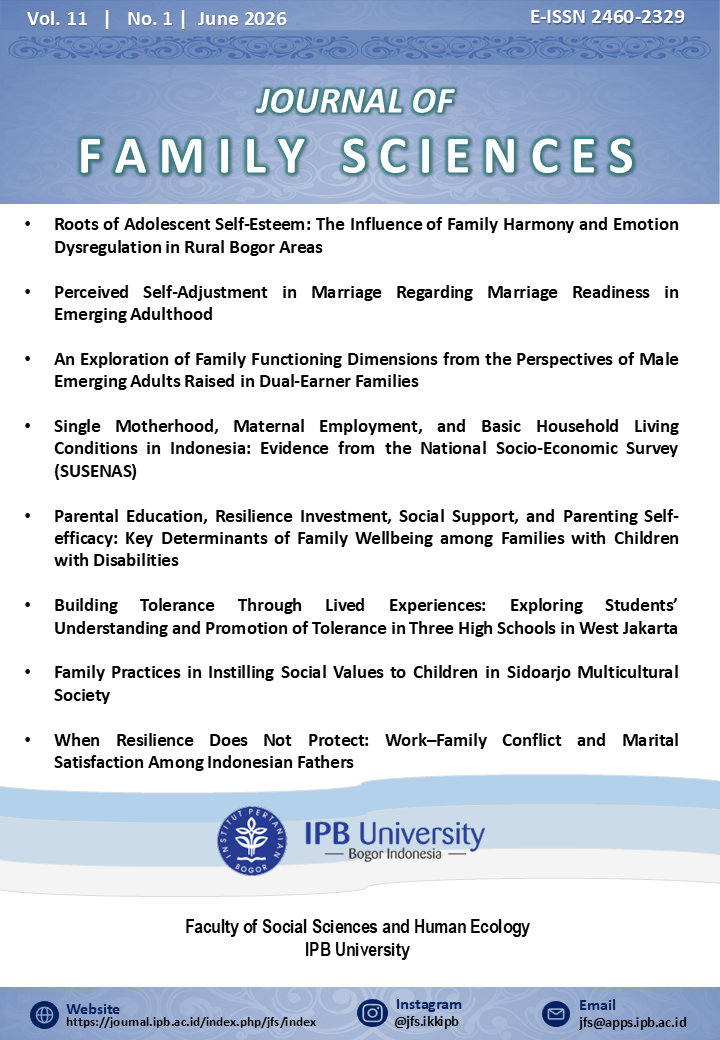
Building Tolerance Through Lived Experiences: Exploring Students’ Understanding and Promotion of Tolerance in Three High Schools in West Jakarta
DOI:
https://doi.org/10.29244/jfs.v11i1.68777Keywords:
character education, family communication, multicultural schools, student experiences, tolerance agencyAbstract
Tolerance plays an important role in reducing cases of discrimination and potential radicalism that originate from social prejudice in a pluralistic society such as Indonesia. However, studies exploring how students’ concrete experiences shape their understanding and agency in applying tolerance are still limited. This study aims to describe the process of shaping students’ understanding and actions towards tolerance based on their life experiences. A qualitative approach was used through in-depth interviews with ten students selected purposively from three secondary schools in West Jakarta. The three schools have different educational contexts: a religiously homogeneous school, an inclusive private school, and a heterogeneous public school. The data were analysed using Braun and Clarke”s thematic analysis. The results show that the family is the main source of internalisation of tolerance values; schools function as arenas for social practice that reinforce acceptance of differences; and experiences of intolerance actually encourage critical reflection that fosters students’ ability to reject discrimination. These findings emphasise the importance of open family communication, experience-based learning, and spaces for dialogue in schools as the foundation for the formation of young agents of tolerance.
References
Aharoni, M., Te’eni-Harari, T., & Eyal, K. (2024). Integrating values into the social learning process. Journal of Children and Media, 18(4), 489–507. https://doi.org/10.1080/17482798.2024.2358948
Aminah, R. S., Lubis, D. P., Hastuti, D., & Muljono, P. (2023). Family communication and school environment as a cause of bullying behavior in adolescents. Journal of Family Sciences, 8(2), 236–248. https://doi.org/10.29244/jfs.v8i2.50421
Bandura, A. (1977). Social Learning Theory. Prentice-Hall. https://psycnet.apa.org/record/1977-27399-000
Beyer, C., & Brese, F. (2024). Secondary school students’ attitudes of tolerance towards minorities. Large-Scale Assessments in Education, 12(1). https://doi.org/10.1186/s40536-024-00217-8
Bronfenbrenner, U. (1979). The Ecology of Human Development. Simply Psychology. https://www.simplypsychology.org/bronfenbrenner.html
Byrne, D. (2022). A worked example of Braun and Clarke’s approach to reflexive thematic analysis. Quality and Quantity, 56(3), 1391–1412. https://doi.org/10.1007/s11135-021-01182-y
Cresswell, J. W. (2007). Five Qualitative Approaches to Inquiry. In J. W.. Creswell (Eds.), Qualitative Inquiry and Research Design: Choosing among five Approaches (pp. 53-84).Thousands Oaks: Sage Publication
Freire, P. (1970). Pedagogy of the Oppressed. Continuum. https://www.routledge.com/Pedagogy-of-the Oppressed/Freire/p/book/9780827014121
Fristyarini, A., & Raihana, S. N. (2025). Dynamics of moral and ethical development in children through religious-based education. Journal of Family Sciences, 10(1), 99–113. https://doi.org/10.29244/jfs.v10i1.63071
Jayadi, K., Abduh, A., & Basri, M. (2022). A meta-analysis of multicultural education paradigm in Indonesia. Heliyon, 8(1), e08828. https://doi.org/10.1016/j.heliyon.2022.e08828
Kishani, N. (2024). Hope amid violence: youths’ agency and learning experiences to transform social conflicts in non-democratic settings. International Journal of Social Pedagogy, 13(1). https://doi.org/10.14324/111.444.ijsp.2024.v13.x.003
Laelah, N. A., Insiyah, S., Halili, & Hasani, I. (2023). Laporan Survei Toleransi Siswa Sekolah Menengah Atas (SMA) (B. T. Naipospos (ed.)). Pustaka Masyarakat Setara.
Lee, S. (2024). Education as a Determinant of Tolerance. Social Sciences, 13(11). https://doi.org/10.3390/socsci13110627
Mariyono, D. (2024). Indonesian mosaic: the essential need for multicultural education. Quality Education for All, 1(1), 301–325. https://doi.org/10.1108/QEA-05-2024-0042
Mitchell, C., Lussier, K., & Keita, F. (2022). Youth agency in times of crisis: Exploring education and conflict in Mali through participatory visual approaches with youth. Frontiers in Education, 7, 1–15. https://doi.org/10.3389/feduc.2022.959225
Nada, C. I., & Legutko, J. (2022a). International Journal of Intercultural Relations “ Maybe we did not learn that much academically , but we learn more from experience ” – Erasmus mobility and its potential for transformative learning. International Journal of Intercultural Relations, 87, 183–192. https://doi.org/10.1016/j.ijintrel.2022.03.002
Nada, C. I., & Legutko, J. (2022b). “Maybe we did not learn that much academically, but we learn more from experience” – Erasmus mobility and its potential for transformative learning. International Journal of Intercultural Relations, 87, 183–192. https://doi.org/10.1016/j.ijintrel.2022.03.002
Ngulandari, P. R., Oktaviani, M., & Elmanora, E. (2024). Digital parenting and school climate to improve discipline character in students. Journal of Family Sciences, 117–131. https://doi.org/10.29244/jfs.vi.49888
Pramono, F., & Lubis, D. P. (2023). A typology of family functioning at the beginning of the COVID-19 pandemic. Journal of Family Sciences, 94–107. https://doi.org/10.29244/jfs.vi.50097
Ramadhana, M. R., Karsidi, R., Utari, P., & Kartono, D. T. (2019). Role of family communications in adolescent personal and social identity. Journal of Family Sciences, 4(1), 1-11. https://doi.org/10.29244/jfs.4.1.1-11
Sakallı, Ö., Tlili, A., Altınay, F., Karaatmaca, C., Altınay, Z., & Dağlı, G. (2021). The role of tolerance education in diversity management: a cultural historical activity theory perspective. SAGE Open, 11(4). https://doi.org/10.1177/21582440211060831
Scott, D., & Duncan, T. (2016). Symbolic interactionism. Encyclopedia of Tourism, December 2015, 922–923. https://doi.org/10.1007/978-3-319-01384-8_629
Sirry, M., Suyanto, B., Sugihartati, R., Tri Kartono, D., & Yani, M. T. (2024). Teachers’ perspectives on tolerance education in Indonesian high schools. British Journal of Religious Education, 46(4), 505–519. https://doi.org/10.1080/01416200.2024.2345213
Sitanggang, A. O., Lubis, D. P., Muljono, P., & Pramono, F. (2025). A systematic literature review: Character education to build tolerance. Multidisciplinary Reviews, 8(10). https://doi.org/10.31893/multirev.2025201
Sumadi, T., Abdillah, F., & Casmana, A. R. (2021). A Pattern of Tolerance Values Transformation by Parents Towards Early Childhood. Frontiers in Education, 6(October), 1–13. https://doi.org/10.3389/feduc.2021.626680
Wijayanti, A. T., Dwiningrum, S. I. A., & Saliman, S. (2024). Communication patterns in Javanese families to build family resilience in the digital era. Informasi, 54(1), 19–32. https://doi.org/10.21831/informasi.v54i1.71431
Zakiah, L., Sarkadi, & Marini, A. (2023). Teachers’ strategies in teaching social tolerance to elementary school students in Jakarta, Indonesia. Issues in Educational Research, 33(2), 839–855.
Downloads
Published
Issue
Section
License
Copyright (c) 2026 Journal of Family Sciences

This work is licensed under a Creative Commons Attribution 4.0 International License.
Authors who publish with this journal agree to the following terms:
- Authors retain copyright and grant the journal right of first publication with the work simultaneously licensed under

This work is licensed under a Creative Commons Attribution 4.0 International License. that allows others to share the work with an acknowledgement of the work's authorship and initial publication in this journal. - Authors are able to enter into separate, additional contractual arrangements for the non-exclusive distribution of the journal's published version of the work (e.g., post it to an institutional repository or publish it in a book), with an acknowledgement of its initial publication in this journal.
- Authors are permitted and encouraged to post their work online (e.g., in institutional repositories or on their website) prior to and during the submission process, as it can lead to productive exchanges, as well as earlier and greater citation of published work (See The Effect of Open Access).