
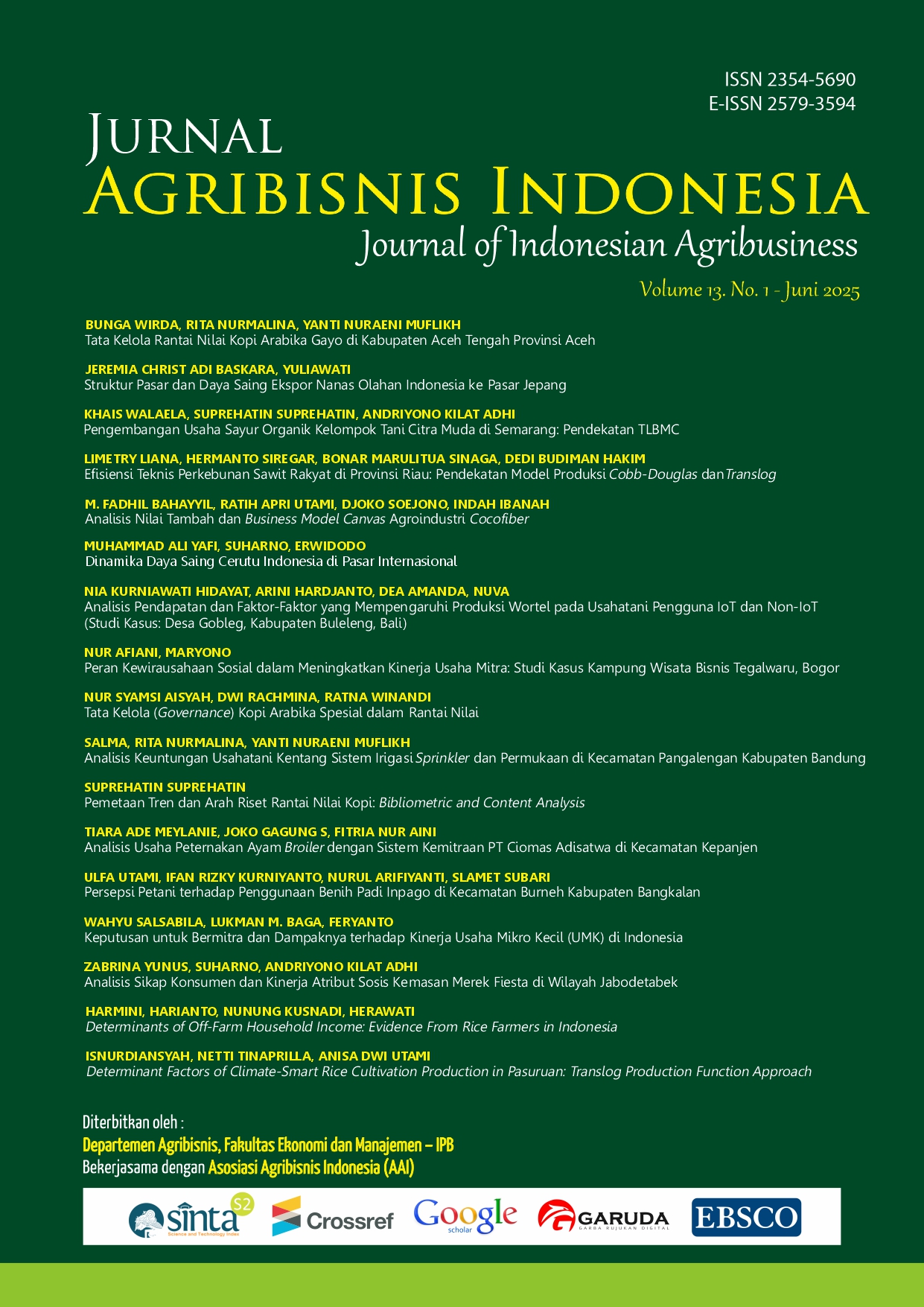
Analisis Pendapatan dan Faktor-Faktor Yang Mempengaruhi Produksi Wortel Pada Usahatani Pengguna IoT dan Non-IoT (Studi Kasus: Desa Gobleg, Kabupaten Buleleng, Bali)
Article Sidebar
Main Article Content
Abstract
The decline in production of various agricultural commodities is caused by climate change. Mitigation programs in the agricultural sector continue to be carried out by both the government and farmers such as utilizing digital technology known as the Internet of Things (IoT). The use of IoT aims to simplify the work of farmers and make time and labor efficient. The use of IoT has been carried out by the “Kelompok Petani Muda Keren” (Farmers Group) in Gobleg Village, Buleleng Regency, Bali Province by building an application called Blynk. The purpose of this study is to analyze the income of IoT and non-IoT farmers with R/C ratio and identify factors that affect carrot production with multiple regression analysis. The results show that the income of IoT farmers is more profitable than non-IoT farmers and the factors that affect production are land area, seed and the adoption of IoT. Based on the results, it can be concluded that the use of IoT technology can increase income so that the government can make policies for the use of internet-based technology for farmers so that climate change can be mitigated and ensure food security.
Article Details
Section
Jurnal Agribisnis Indonesia (JAI) is an Open Access Journal. The authors who publish the manuscript in this journal agree to the following terms:
Creative Commons License
JAI is licensed under a Creative Commons Attribution 4.0 International License. This permits anyone to copy, redistribute, remix, transmit, and adapt the work provided the original work and source are appropriately cited.
This means:
(1) Under the CC-BY license, authors retain ownership of the copyright for their article, but authors grant others permission to use the content of publications in Jurnal Agribisnis Indonesia in whole or in part provided that the original work is properly cited. Users (redistributors) of JAI are required to cite the original source, including the author's name, JAI as the initial source of publication, year of publication, volume number, issue, and Digital Object Identifier (DOI); (2) Authors grant JAI the right of first publication. Although authors remain the copyright owner.
How to Cite
References
Abrar, A. and Tukino, T. (2023). Pengembangan sistem pengontrolan irigasi cerdas dengan teknologi internet of things (iot). SNISTEK, 5, 286-293. https://doi.org/10.33884/psnistek.v5i.8096 DOI: https://doi.org/10.33884/psnistek.v5i.8096
Ap, S. and Devadiga, S. (2023). Iot-based smart irrigation management system: design and implementation for efficient water use in agriculture. International Research Journal of Modernization in Engineering Technology and Science. https://doi.org/10.56726/irjmets40131 DOI: https://doi.org/10.56726/IRJMETS40131
Al-Jufri, H., Novianti, O., Muhammad, G., Adytya, R., & Pramudhita, A. (2023). Otomatisasi pertanian dengan sensor soil moisture, sensor cahaya, led grow lamps, dan pompa air untuk pertumbuhan tanaman optimal. Jurnal Informatika Dan Teknik Elektro Terapan, 11(3). https://doi.org/10.23960/jitet.v11i3.3192 DOI: https://doi.org/10.23960/jitet.v11i3.3192
Arifin, A. S. and Millaty, M. (2024). Analisis faktor-faktor yang mempengaruhi produksi kopi robusta (coffea canephora) di kecamatan kandangan kabupaten temanggung. Mimbar Agribisnis : Jurnal Pemikiran Masyarakat Ilmiah Berwawasan Agribisnis, 10(2), 2501. https://doi.org/10.25157/ma.v10i2.14223 DOI: https://doi.org/10.25157/ma.v10i2.14223
Asir. T, R. G., & Manohar, H. L. (2023). Variations on Internet of Things adoption factors between India and the USA. South African Journal of Business Management, 54(1), 3810. DOI: https://doi.org/10.4102/sajbm.v54i1.3810
Diarty, M., Haryanto, J. ‘., Izzuddin, K. H., Manganti, M. D., Rahman, M. R., & Budiasih, B. (2023). Total factor productivity growth (tfpg) dan determinan produksi tebu indonesia. Seminar Nasional Official Statistics, 2023(1), 643-652. https://doi.org/10.34123/semnasoffstat.v2023i1.1747 DOI: https://doi.org/10.34123/semnasoffstat.v2023i1.1747
Dong, Y., Werling, B. P., Cao, Z., & Li, G. (2024). Implementation of an in-field iot system for precision irrigation management. Frontiers in Water, 6. https://doi.org/10.3389/frwa.2024.1353597 DOI: https://doi.org/10.3389/frwa.2024.1353597
Firly, F. R. R. (2024). Pengaruh modal, luas lahan, pupuk, dan tenaga kerja terhadap produksi kopi robusta bsip-tri. Jurnal Agribisnis Dan Pembangunan Pertanian (JAPP), 2(1), 48-56. https://doi.org/10.37150/japp.v2i1.2536 DOI: https://doi.org/10.37150/japp.v2i1.2536
Gupta, P. (2023). Smart irrigation systems using (iot) – a survey. International Journal of Scientific Research in Engineering and Management, 07(08). https://doi.org/10.55041/ijsrem24900 DOI: https://doi.org/10.55041/IJSREM24900
Harsanto, B. (2020). Inovasi internet of things pada sektor pertanian: pendekatan analisis scientometrics. Informatika Pertanian, 29(2), 111. https://doi.org/10.21082/ip.v29n2.2020.p111-122 DOI: https://doi.org/10.21082/ip.v29n2.2020.p111-122
Irvandika, F., Suciati L. P. (2024). Tingkat Penerapan Materi dan Partisipasi Petani pada Sekolah Lapang Climate Smart Agriculture di Kabupaten Jember. Jurnal Agribisnis Indonesia, 12(2): 231-245. https://doi.org/10.29244/jai.2024.12.2.231-245 DOI: https://doi.org/10.29244/jai.2024.12.2.231-245
Jayaraman, P. P., Yavari, A., Georgakopoulos, D., Morshed, A., & Zaslavsky, A. (2016). Internet of things platform for smart farming: Experiences and lessons learnt. Sensors, 16(11), 1884. DOI: https://doi.org/10.3390/s16111884
Köksal, Ö. and Teki̇nerdoğan, B. (2018). Architecture design approach for iot-based farm management information systems. Precision Agriculture, 20(5), 926-958. https://doi.org/10.1007/s11119-018-09624-8 DOI: https://doi.org/10.1007/s11119-018-09624-8
Lamasigi, Z., Haba, A., Jafar, M., Syamsir, S., & Hulukati, S. (2024). Automated drip irrigation system based on iot for chili plants using solar panel energy. Jurnal Pengabdian Masyarakat, 5(1), 183-191. https://doi.org/10.32815/jpm.v5i1.2006 DOI: https://doi.org/10.32815/jpm.v5i1.2006
Padriya, N. and Patel, N. (2023). Predicting yield of crop type and water requirement for a given plot of land using machine learning techniques. International Journal of Reconfigurable and Embedded Systems (IJRES), 12(3), 503. https://doi.org/10.11591/ijres.v12.i3.pp503-508 DOI: https://doi.org/10.11591/ijres.v12.i3.pp503-508
Pillai, R. and Sivathanu, B. (2020). Adoption of internet of things (IoT) in the agriculture industry deploying the brt framework. Benchmarking: An International Journal, 27(4), 1341-1368. https://doi.org/10.1108/bij-08-2019-0361 DOI: https://doi.org/10.1108/BIJ-08-2019-0361
[P2MAL] Pusat Peningkatan Mutu dan Aktivitas Laboratorium Universitas Medan Area. 2022. Panduan Teknis Budidaya Wortel. https://p2mal.uma.ac.id/2022/04/23/panduan-teknis-budidaya-wortel/
Putri, A. D. and Fitri, F. (2024). Sistem pengendalian aliran air laut pada alat pembuat garam menggunakan kontrol pid. Jurnal Rekayasa Energi, 3(1), 24-32. https://doi.org/10.31884/jre.v3i1.52 DOI: https://doi.org/10.31884/jre.v3i1.52
Putri, S. A., Maesyaroh, W. U., Tanjung, I. R., Aprilliana, R., & Wijayanto, B. (2022). Analisis fungsi produksi cobb douglas: usaha pakan ternak rumput ternak studi kasus di kabupaten semarang. Jurnal Dinamika Ekonomi Rakyat, 1(2), 1-21. https://doi.org/10.24246/dekat.v1i2.10122 DOI: https://doi.org/10.24246/dekat.v1i2.10122
Rallabandi, G., Pavani, S., Gulhare, K. K., & Mishra, P. K. (2022). Smart Advanced Agriculture System in India Using IoT Technology. International Journal of Health Sciences. 6(S2): 10120-10126. 10.53730/ijhs.v6nS2.7645 DOI: https://doi.org/10.53730/ijhs.v6nS2.7645
Ramadani, R. (2023). Potensi internet of things (iot) sebagai sumber official statistics bidang pertanian. Seminar Nasional Official Statistics, 2023(1), 161-166. https://doi.org/10.34123/semnasoffstat.v2023i1.1900 DOI: https://doi.org/10.34123/semnasoffstat.v2023i1.1900
Raxbaroy, Y. (2024). Optimizing irrigation and soil moisture management in Uzbekistan's agricultural sector through modern technologies. American Journal of Applied Science and Technology, 4(10), 26-28. https://doi.org/10.37547/ajast/volume04issue10-04 DOI: https://doi.org/10.37547/ajast/Volume04Issue10-04
Sandi, G. and Fatma, Y. (2023). Pemanfaatan teknologi internet of things (iot) pada bidang pertanian. Jati (Jurnal Mahasiswa Teknik Informatika), 7(1), 1-5. https://doi.org/10.36040/jati.v7i1.5892 DOI: https://doi.org/10.36040/jati.v7i1.5892
Suprehatin, S. (2021). Determinants of agricultural technology adoption by smallholder farmers in developing countries: perspective and prospect for indonesia. Jurnal Penelitian Dan Pengembangan Pertanian, 40(1), 21. https://doi.org/10.21082/jp3.v40n1.2021.p21-30 DOI: https://doi.org/10.21082/jp3.v40n1.2021.p21-30
Wijayanto, H., Riyanto, D., Triyono, B., & Estu, H. P. W. (2019). Pemberdayaan Kelompok Tani Desa Jatimalang, Kabupaten Pacitan melalui Pelatihana Pembuatan Pupuk Organik. Agrokreatif, 5(2): 109- 114. https://doi.org/10.29244/agrokreatif.5.2.109-114 DOI: https://doi.org/10.29244/agrokreatif.5.2.109-114
World Bank. (2024). Climate Smart Agriculture. diakses pada https://www.worldbank.org/en/topic/climate-smart-agriculture#:~:text=Climate%2Dsmart%20agriculture%20(CSA),development%20challenges%20of%20our%20time
Rehman, A., Saba, T., Kashif, M., Fati, S. M., Bahaj, S. A., & Chaudhry, H. (2022). A revisit of internet of things technologies for monitoring and control strategies in smart agriculture. Agronomy, 12(1), 127. https://doi.org/10.3390/agronomy12010127 DOI: https://doi.org/10.3390/agronomy12010127