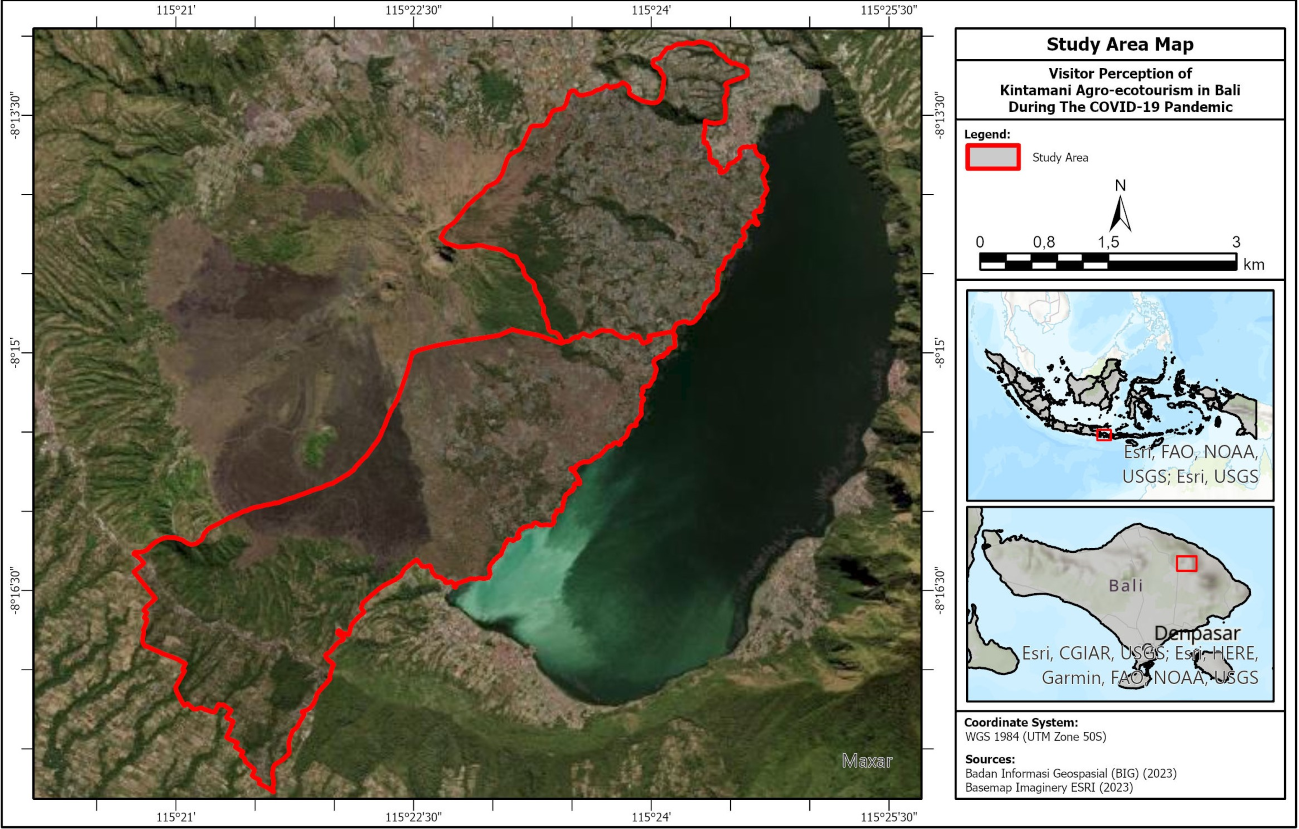
Visitor Perception of Kintamani Agro-ecotourism in Bali During The COVID-19 Pandemic
DOI:
https://doi.org/10.29244/medkon.28.3.273-287Keywords:
visitor perceptionAbstract
The COVID-19 pandemic has hampered agro-ecotourism's economic, social, and environmental benefits. Previous studies have ignored visitor experiences, sustainability, and secondary data. A pandemic-era field assessment of Kintamani agro-ecotourism fills this gap. Purposive sampling was used to select 100 local visitors for the survey. Perceptual class intervals and WarpPLS 7.0 were used to analyze the data. Kintamani agro-ecotourism destination services and guest loyalty scored the highest. Attributes and service quality affected visitor satisfaction and loyalty, whereas the CHSE program measures did not. These findings include improving attributes and service quality, encouraging sustainability, collaborating with local communities and stakeholders, and developing innovative products and services for Kintamani agro ecotourism. Diverse market segments may be immersed in a region's culture and nature. Kintamani agro-ecotourism requires strong branding, marketing, and data-driven decision-making. Crisis management plans and sustainable infrastructure can help agro-ecotourism to survive unexpected disasters. Agro-ecotourism in Kintamani depends on the adaptation, innovation, and preservation of a region's natural and cultural legacy.
Downloads
Published
Issue
Section
Categories
License
Media Konservasi is an open access journal, meaning that all content is freely available without charge to the user or their institution. Users are allowed to read, download, copy, distribute, print, search, or link to the full texts of the articles in this journal without needing to request prior permission from the publisher or the author.
All articles published by Media Konservasi are licensed under the Creative Commons Attribution 4.0 International License. This allows for unrestricted use, distribution, and reproduction in any medium, provided proper credit is given to the original authors.
Authors submitting manuscripts should understand and agree that the copyright of published manuscripts is retained by the authors. Copyright encompasses the exclusive rights of authors to reproduce, distribute, and sell any part of the journal articles in all forms and media. Reproduction of any part of this journal, its storage in databases, and its transmission by any form or media is allowed without written permission from Media Konservasi.



.png)

