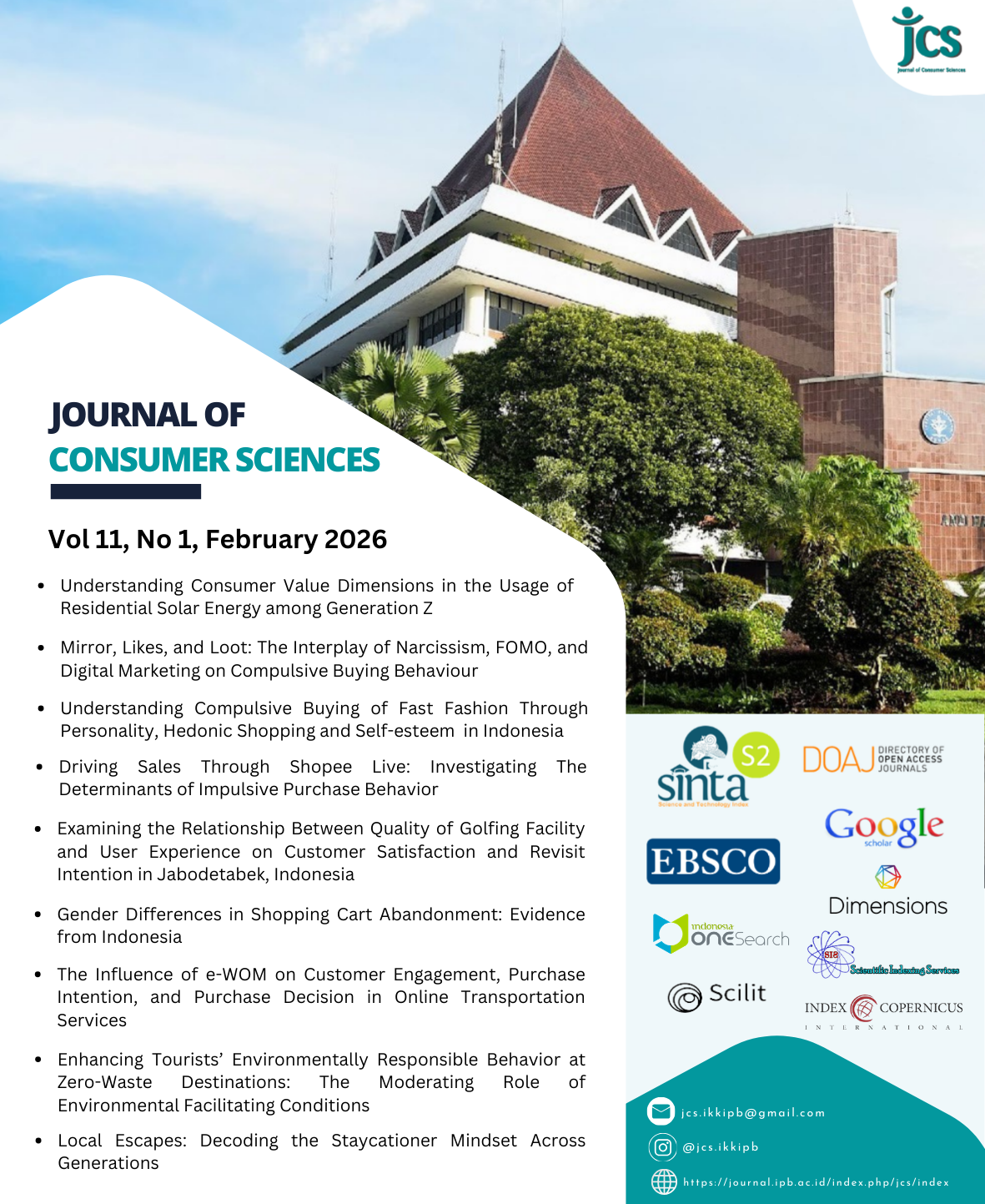
Understanding Compulsive Buying of Fast-fashion Through Personality, Hedonic Shopping, and Self-Esteem in Indonesia
DOI:
https://doi.org/10.29244/jcs.11.1.50-74Keywords:
big five personality traits , compulsive buying, fast-fashion, hedonic shopping experience, self-esteemAbstract
Background: The rapid growth of fast-fashion in Indonesia is fueled by easy consumer access and constantly updating trends. This accessibility, combined with emotional and psychological factors such as personality and self-esteem, has contributed to the rise of compulsive buying behavior, particularly through hedonic shopping experiences.
Purpose: This study examines the influence of the Big Five Personality Traits on compulsive buying, with hedonic shopping experience and self-esteem as potential mediators.
Method: A quantitative descriptive approach was used to survey 462 respondents who purchased fast-fashion items in the past 2 months. Purposive sampling and PLS-SEM with SmartPLS 4 were used for analysis.
Findings: The study reveals that neuroticism, openness to experience, and conscientiousness significantly influence compulsive buying, while extraversion and agreeableness do not. Hedonic shopping experience mediates the relationship between personality traits and compulsive buying for neuroticism, openness, and conscientiousness, but not agreeableness. Self-esteem does not mediate this relationship, suggesting that other factors have a stronger influence on compulsive buying.
Conclusions: The study highlights the critical role of hedonic shopping in mediating the influence of personality on compulsive buying, whereas self-esteem serves primarily as a protective factor rather than a mediator. Individuals with high neuroticism or openness are particularly susceptible to hedonic-driven compulsive consumption in the fast-fashion context.
Research implication: This study underscores the importance of hedonic shopping in driving compulsive buying in fast-fashion. It suggests that businesses should focus on emotional marketing while promoting responsible consumption. For consumers, the findings highlight the need for mindful consumption to mitigate the negative impacts of compulsive buying.
References
Ali, A., Li, C., Hussain, A., Bakhtawar. (2021). Hedonic shopping motivations and obsessive–compulsive buying on the internet. Journal of Psychosocial Research, 25(1), 123–135. https://doi.org/10.1177/0972150920937535
Anggita, A. D., Noviasari, H., Wildah, S. W., & Siregar, P. A. (2023). The impact of hedonic shopping value and shopping lifestyle on impulsive buying mediated by positive emotion among online marketplace users in Pekanbaru. West Science Interdisciplinary Studies, 1(10), 977–989. https://doi.org/10.58812/wsis.v1i10.287
Aquino, R., & Lins, S. (2023). Exploring personality traits and compulsive buying behavior in fast-fashion. Journal of Consumer Psychology, 33(2), 210–225. https://doi.org/10.1002/jcpy.1356
Aquino, S. D., et al. (2023). The personality puzzle: A comprehensive analysis of its impact on three buying behaviors. Frontiers in Psychiatry, 14, Article 1179257. https://doi.org/10.3389/fpsyt.2023.1179257
Badgaiyan, A. J., & Verma, A. (2015). Does urge to buy impulsively differ from impulsive buying behaviour? Journal of Retailing and Consumer Services, 22, 145–157. https://doi.org/10.1016/j.jretconser.2014.10.002
Babin, B. J., Darden, W. R., & Griffin, M. (1994). Work and/or fun: Measuring hedonic and utilitarian shopping value. Journal of Consumer Research, 20(4), 644–656. https://doi.org/10.1086/209376
Biolcati, R. (2017). The role of self-esteem and fear of negative evaluation in compulsive buying. Frontiers in Psychiatry, 8, 74. https://doi.org/10.3389/fpsyt.2017.00074
Black, D. W. (2007). A review of compulsive buying disorder. World Psychiatry, 6(1), 14–18. https://www.ncbi.nlm.nih.gov/pmc/articles/PMC1810431/
Black, D. W. (2022). Compulsive shopping: A review and update. Current Opinion in Psychology, 46, 101321. https://doi.org/10.1016/j.copsyc.2022.101321
Cachón-Rodríguez, G., García-Soto, M., & Cao, M. T. (2025). The effect of religiosity, materialism, and self-esteem on compulsive and impulsive buying behavior. Journal of Islamic Marketing. Advance online publication. https://doi.org/10.1108/EJMBE-06-2023-0172
Caesalpinia, N. S., & Suryawardani, B. (2025). Utilitarian vs. hedonic value: Which is more influential for Indonesian consumers in increasing purchase intention in e-commerce? Journal of Consumer Sciences, 10(2), 376–393. https://doi.org/10.29244/jcs.10.2.376-393
Chugani, S. K., & Irwin, J. R. (2020). Extraversion, materialism, and compulsive buying: The social pathway to excessive consumption. Journal of Consumer Behaviour, 19(6), 589–601. https://doi.org/10.1002/cb.1841
Costa, P. T., Jr., & McCrae, R. R. (1992). NEO Personality Inventory–Revised (NEO-PI-R) and NEO Five-Factor Inventory (NEO-FFI) professional manual. Psychological Assessment Resources.
Costa, P. T., Jr., McCrae, R. R., & Dye, D. A. (2012). The NEO Personality Inventory–Revised (NEO-PI-R). In T. A. Widiger (Ed.), The Oxford handbook of personality disorders (pp. 179–198). Oxford University Press.
Duan, X. (2025). Mental simulation and compulsive buying: A multiple mediation model through impulse buying and self-control. Frontiers in Psychology, 16, Article 1507031. https://doi.org/10.3389/fpsyg.2025.1507031
Granero, R., Fernández-Aranda, F., Mestre-Bach, G., Steward, T., Baño, M., del Pino-Gutiérrez, A., & Jiménez-Murcia, S. (2017). Compulsive buying disorder clustering based on sex, age, onset, and personality traits. Comprehensive Psychiatry, 74, 118–125. https://doi.org/10.1016/j.comppsych.2017.01.011
Hahn, E., Gottschling, J., & Spinath, F. M. (2012). Short measurements of personality: Validity and reliability of the GSOEP Big Five Inventory (BFI-S). Journal of Research in Personality, 46(3), 355–359. https://doi.org/10.1016/j.jrp.2012.03.008
Henseler, Jörg, Christian M. Ringle, and Marko Sarstedt. "A New Criterion for Assessing Discriminant Validity in Variance-Based Structural Equation Modeling." Journal of the Academy of Marketing Science, vol. 43, no. 1, 2015, pp. 115-135.
Huang, S. C. (2024). Understanding impulse buying in e-commerce: The Big Five traits and online behavior. Journal of Retailing and Consumer Services, 75, 102562. https://doi.org/10.1016/j.jretconser.2024.102562
Hutapea, A. V., Lubis, A. N., & Fadli. (2025). The effect of price discount and shopping lifestyle on impulsive buying with positive emotion as an intervening variable on e-commerce Shopee users. Journal of Business Management, 3(1), 45–51. https://doi.org/10.47134/jobm.v3i1.152
Kharisma, A. A. G. G., & Panasea, I. G. N. O. (2023). The effect of fashion involvement, peer pressure, and self-esteem on compulsive buying: A study on Generation Z as consumers of H&M stores in Badung Regency, Bali. Asian Journal of Entrepreneurship and Management, 3(8), 254–271. https://doi.org/10.58631/ajemb.v3i8.103
Kementerian Lingkungan Hidup dan Kehutanan. (2021). Statistik lingkungan hidup Indonesia 2021. KLHK. https://www.menlhk.go.id/
Lala Hu, H., Zhang, Y., & Li, X. (2022). The effect of utilitarian and hedonic motivations on mobile shopping outcomes: A cross-cultural analysis. Journal of Retailing and Consumer Services, 66, 102994. https://doi.org/10.1016/j.jretconser.2022.102994
Lee, S., & Kim, J. (2025). How conscientiousness mitigates impulse buying tendencies in e-commerce. Young Consumers, 26(1), 43–59. https://doi.org/10.1108/yc-01-2025-2388
Maula, T. S., Kurniati, R. R., & Deka, R. E. (2025). Buy or bye: Exploring the trigger of impulse buying behavior among Gen Z in lifestyle retail. Indonesian Journal of Business and Entrepreneurship, 11(1), 121–131. https://doi.org/10.17358/IJBE.11.1.121
Majeed, M., Hameed, W. U., & Dawood, A. (2022). Social media, sales promotions, and compulsive buying: Evidence from fast-fashion consumers. Journal of Fashion Marketing and Management, 26(3), 429–445. https://doi.org/10.1108/JFMM-09-2021-0225
Müller, A., Meissner, M., & Trenkwalder, K. (2021). Compulsive buying: Psychological antecedents, comorbidity, and assessment. Journal of Behavioral Addictions, 10(2), 320–330. https://doi.org/10.1556/2006.2021.00018
Niinimäki, K., Peters, G., Dahlbo, H., Perry, P., Rissanen, T., & Gwilt, A. (2020). The environmental price of fast-fashion. Nature Reviews Earth & Environment, 1(4), 189–200. https://doi.org/10.1038/s43017-020-0039-9
Olsen, S. O., Khoi, N. H., & Tuu, H. H. (2022). The “well-being” and “ill-being” of online impulsive and compulsive buying on life satisfaction: The role of self-esteem and harmony in life. Journal of Macromarketing, 42(4), 553–573. https://doi.org/10.1177/02761467211048751
Otero-López, J. M., Santiago, M. J., & Castro, M. C. (2024). Big Five personality traits and compulsive buying: The mediating role of self-esteem. European Journal of Investigation in Health, Psychology and Education, 14(1), 103–116. https://doi.org/10.3390/ejihpe14010007
Otero-López, J. M., Santiago, M. J., & Castro, M. C. (2021). Personal projects’ appraisals and compulsive buying among university students: Evidence from Galicia, Spain. Sustainability, 13(24), 13509. https://doi.org/10.3390/su132413509
Panjaitan, R., Rosyidi, U., Rurung, F., Simorangkir, C., & Rangkuti, H. (2025). Improving obsessive-compulsive buying through brand attachment and hedonic value: Customer-based brand value. Business: Theory and Practice, 26(1), 80–98. https://journals.vilniustech.lt/index.php/BTP/article/view/20636
Parsad, D., Prashar, S., & Vijay, T. S. (2021). Hedonic shopping motivations and compulsive buying: The role of self-image and social acceptance. Journal of Retailing and Consumer Services, 61, 102527. https://doi.org/10.1016/j.jretconser.2021.102527
Populix. (2023). Online shopping behavior in Indonesia 2023. Populix Research. https://www.populix.co
Ridgway, N. M., Kukar-Kinney, M., & Monroe, K. B. (1990). An expanded conceptualization and a new measure of compulsive buying. Journal of Consumer Research, 17(4), 453–464. https://doi.org/10.1086/208549
Ridgway, N. M., Kukar-Kinney, M., & Monroe, K. B. (2008). An expanded conceptualization and a new measure of compulsive buying. Journal of Consumer Research, 35(4), 622–639. https://doi.org/10.1086/591097
Saputra, R. N. M., & Kuswati, R. (2024). The effect of hedonic motivation and positive affect on impulsive buying behavior mediated by shopping lifestyle. Eduvest: Journal of Universal Studies, 4(12), 11186–11199. https://doi.org/10.59188/eduvest.v4i12.43133
Sari, T. I., Hartoyo, H., & Muflikhati, I. (2025). Exploring the impact of perceived justice and complaint handling satisfaction on trust and commitment in Indonesia’s e-commerce fashion sector. Journal of Consumer Sciences, 10(1), 145–172. https://doi.org/10.29244/jcs.10.1.145-172
Sharif, S. P., & Khanekharab, J. (2017). Identity confusion and materialism mediate the relationship between excessive social network site usage and online compulsive buying. Cyberpsychology, Behavior, and Social Networking, 20(8), 494–500. https://doi.org/10.1089/cyber.2017.0162
Shabbir, H., et al. (2024). Role of self-control in the relationship between online shopping addiction and compulsive buying behavior among young adults. Qlantic Journal of Social Sciences and Humanities, 5(4), 149–162.
Sumajaya, I. G. (2025). The role of subjective norm and self-esteem in impulsive buying behavior on social commerce platform TikTok. Journal of Behavioral Studies, 10(1), 45–61.
Tarka, P., Kukar-Kinney, M., & Harnish, R. J. (2022). Consumers’ personality and compulsive buying behavior: The role of hedonistic shopping experiences and gender in mediating–moderating relationships. Journal of Retailing and Consumer Services, 64, 102802. https://doi.org/10.1016/j.jretconser.2021.102802
Tarka, P., & Harnish, R. J. (2023). Toward better understanding the materialism–hedonism and the Big Five personality–compulsive buying relationships: A new consumer cultural perspective. Journal of Marketing for Higher Education. Advance online publication. https://doi.org/10.1080/08911762.2023.2188509
Tessy, C. N., & Setiasih, D. (2024). Self-esteem and compulsive buying behavior among Gen Z consumers in Indonesia. Journal of Consumer Sciences, 9(1), 122–141. https://doi.org/10.29244/jcs.9.1.122-141
We Are Social. (2024). Digital 2024: Indonesia. We Are Social and Meltwater. https://wearesocial.com
Workman, J. E., & Lee, S. H. (2011). Materialism, fashion consumers and gender: A cross-cultural study. International Journal of Consumer Studies, 35(1), 50–57. https://doi.org/10.1111/j.1470-6431.2010.00935.x
Zafar, A., Ahmad, W., & Khan, S. (2023). The impact of personality traits on compulsive buying: The mediating role of social validation. Journal of Consumer Behaviour, 22(1), 34–48. https://doi.org/10.1002/cb.2098
Zafar, A. U., Qiu, J., Li, Y., Wang, J., & Shahzad, M. (2023). Hedonic shopping motivations and online compulsive buying: The moderating role of digital marketing. Journal of Retailing and Consumer Services, 72, 103241. https://doi.org/10.1016/j.jretconser.2023.103241
Zeigler-Hill, V., Holden, C. J., Enjaian, B., Southard, A. C., Besser, A., Li, H., & Zhang, Q. (2015). Self-esteem instability and personality. Personality and Social Psychology Bulletin, 41(1), 183–198. https://doi.org/10.1177/0146167214559719
Zhang, T., Wang, Y., & Li, X. (2025). Mental simulation and compulsive buying: A multiple mediation analysis. Frontiers in Psychology, 16, Article 1507031. https://doi.org/10.3389/fpsyg.2025.1507031
Zhang, X., Zhao, K., & Xu, X. (2017). Compulsive buying in China: The role of materialism, self-esteem, and money attitudes. Personality and Individual Differences, 105, 63–68. https://doi.org/10.1016/j.paid.2016.09.033
Downloads
Published
Issue
Section
License
Copyright (c) 2026 Journal of Consumer Sciences

This work is licensed under a Creative Commons Attribution 4.0 International License.
Authors who publish with this journal agree to the following terms:
- Authors retain copyright and grant the journal right of first publication with the work simultaneously licensed under a

This work is licensed under a Creative Commons Attribution 4.0 International License. that allows others to share the work with an acknowledgement of the work's authorship and initial publication in this journal. - Authors are able to enter into separate, additional contractual arrangements for the non-exclusive distribution of the journal's published version of the work (e.g., post it to an institutional repository or publish it in a book), with an acknowledgement of its initial publication in this journal.
- Authors are permitted and encouraged to post their work online (e.g., in institutional repositories or on their website) prior to and during the submission process, as it can lead to productive exchanges, as well as earlier and greater citation of published work (See The Effect of Open Access).