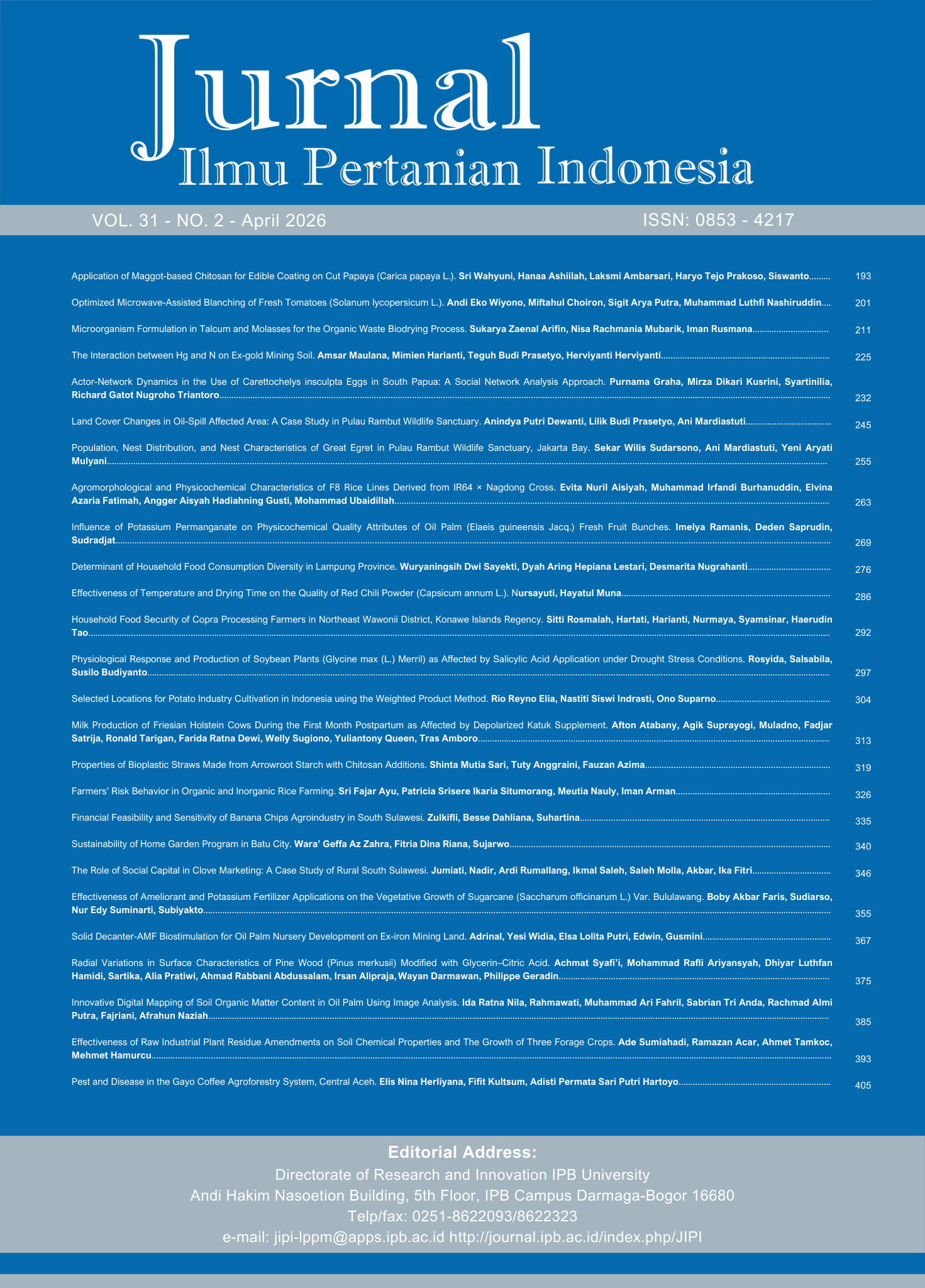
Effectiveness of Temperature and Drying Time on the Quality of Red Chili Powder (Capsicum annum L.)
DOI:
https://doi.org/10.18343/jipi.31.2.286Keywords:
chili powder, drying time, red chili, temperatureAbstract
The purpose of this study was to examine how temperature and drying time affect the quality of red chili powder. This study took place from December 6 to 21, 2023, at Almuslim Peusangan-Bireuen University's Mathematics and Natural Sciences Laboratory. This study used factorial RAL. There were two factors studied: temperature (S1 = 50°C, S2 = 60°C, and S3 = 70°C) and drying time (P1 = 5 h, P2 = 6 h, and P3 = 7 h). This study's findings include organoleptic tests, moisture content, and yield. The results showed that the temperature treatment at 70°C had a very significant effect on the moisture content of red chili powder, with a moisture of 7.91% and meeting the SNI requirements for dried chili moisture of 11%, but the treatment had no significant effect on the moisture of red chili, yield, or organoleptic test. The drying time treatment had no significant effect on the moisture content of red chili, the moisture content, the yield, and the organoleptic test; however, the 7-h drying time treatment had the highest percentage of the moisture content of red chili and red chili powder, as well as the lowest yield. The organoleptic test on red chili powder treated at 500°C with a drying time of 7 h had the highest color score, namely 3.68 an average score, and the highest aroma score, namely 3.58 with the category of quite like.
Keywords: chili powder, drying time, red chili, temperature
Downloads
References
Arifin I. 2010. The Effect of Storage Method and Duration on the Quality of Chili Peppers (Capsicum frutescens L. var. Cengek) [master’s thesis]. Malang (ID): Faculty of Science and Technology, UIN
Central Statistics Agency of Bireuen Regency. 2022. Total red chili consumption. https://www.bps.go.id/indicator/5/2100/1/rata-rata-konsumsi-perkapita-seminggu-menurut-grup-sayur-sayuran-per-kabupaten-kota.html. Accessed on May 21, 2023.
Endrasari R, Qanytah, Prayudi B. 2018. The Effect of Drying on the Quality of Curcuma Simplex in Tembalang District, Semarang City. Semarang (ID): Central Java Center for Agricultural Technology Assessment.
Hasrayanti. 2013. Study of Making Chili Core Seasoning (Campsicum sp.) in Powder Form. [master’s thesis]. Makassar (ID): Food Science and Technology Study Program, Hasanuddin University.
Hidayat, Syaiful KM, Dewi KH. 2013. Study of the Dry Processing of Chilies into Chili Blocks. Bengkulu (ID): Department of Agricultural Technology, Faculty of Agriculture, University of Bengkulu
Irfan AM, Lestari N, Arimansyah, Rasyid AR 2021. Kinetics of chili drying with low temperature-long time blanching treatment. Agritekno: Journal of Agricultural Technology. 10(1): 24−35. https://doi.org/10.30598/jagritekno.2021.10.1.24 DOI: https://doi.org/10.30598/jagritekno.2021.10.1.24
Khairina R, Khotimah IK, Yazid M, Fadliani R. 2021.Chemical and organoleptic characteristics of sambal ronto. International Journal of Advance Tropical Food. 2(2): 43–50. https://doi.org/10.26877/ijatf.v2i2.7262 DOI: https://doi.org/10.26877/ijatf.v2i2.7262
Kusumaningtyas RS, Martosupono M. 2018. The occurrence of isomerization and oxidation of carotene during the process of CPO processing. Journal of Food Technology and Nutrition. 17(1): 23–30.
Lubis IH. 2018. The Effect of Drying Time and Temperature on the Quality of Pandan Flour [master’s thesis]. Medan (ID): Faculty of Agriculture, University of North Sumatra.
Maflahah I. 2010. Feasibility study of chili powder industry in Cianjur Regency. Jurnal Agrointek. 4(2): 82–87.
Mahanom H, Azizah AH, Dzulkifli MH. 1999. Effect of different drying methods on concentrations of several phytochemicals in herbal preparation of eight medicinal plant leaves. Malaysian Journal of Nutrition. 5(1): 47–54.
Muchtadi TR, Sugiyono, Ayustaningwarno F. 2019. Food Science. Bogor (ID): Alfabeta.
Ramanda MR, Putri AT, Wahyuningtyas A. 2023. Effects of processing on curly red chili (Capsicum annuum L.). AGRITEPA: Jurnal Ilmu dan Teknologi Pertanian. 10(1): 45–52 DOI: https://doi.org/10.37676/agritepa.v10i1.3569
Renate D, Pratama F, Yuliati K, Priyanto G. (2014). Kinetic model of capsaicin degradation of ground red chili pepper at various storage temperature conditions. Agritech. 34(3): 330−336. https://doi.org/10.22146/agritech.9462 DOI: https://doi.org/10.22146/agritech.9462
Rindani M. 2015. Land suitability for red chili plants in Jorong Land, Lubuak Batingkok Subdistrict, Harau District, Lima Puluh Kota Regency, Payakumbuh. National Ecopedon. 2(2): 28−33.
Riansyah A, Supriadi A, Nopianti R. 2013. The effect of temperature and drying time differences on the characteristics of salted Siamese goat fish (Trichogaster pectoralis) using an oven. Fishtech Journal. 2(1): 53−68. https://doi.org/10.36706/fishtech.v2i1.1103. DOI: https://doi.org/10.36706/fishtech.v2i1.1103
Setiawan E. 2014. Performance Test of Greenhouse Effect Type Dryer with the Addition of Fan (Blade Fan) for Drying Red Chili (Capsicum annum L.) [master’s thesis]. Banda Aceh (ID): Agricultural Engineering Study Program. Syah Kuala Darrusalam University.
Sudaryati, L., & Donny, E.H. (2011). Making red chili powder using various chili types and drying methods. Food Technology Study Program, Faculty of Industrial Technology, UPN “Veteran” East Java.
Susinggih W., Sucipto, dan Lia M.S. 2015. Pengaruh Suhu dan Waktu Pengeringan terhadap Aktivitas Antioksidan pada Bubuk Kulit Manggis (Garcinia Mangostana L.). Jurnal Fakultas Teknologi Pertanian. Universitas Brawijaya. Malang.
Suyanti. 2017. Making Various Chili Dishes. Jakarta (ID): Penebar Swadaya.
Taufiq M. 2014. The Effect of Temperature on Corn Drying Rate in Conventional and Fluidized Bed Drying [master’s thesis]. Surakarta (ID): Faculty of Engineering. Sebelas Maret University.
Widodo WD. 2016. Extending the Productive Life of Chili Peppers (60 Pickings). Jakarta (ID): Penebar Swadaya.
Winarno FG, Wirakartakusumah MA. 2018. Post-Harvest Physiology. Jakarta (ID): Sastra Hudaya.
Yuliana N, Hanum T, Karyono. 2019. The Effect of Chili Fruit Splitting on Oleoresin Yield and Quality. Horticultural Journal. 1(4): 35−39.
Downloads
Published
Issue
Section
License
Copyright (c) 2025 nursayuti nursayuti

This work is licensed under a Creative Commons Attribution-NonCommercial 4.0 International License.
This journal is published under the terms of the Creative Commons Attribution-NonCommercial 4.0 International License. Authors who publish with this journal agree to the following terms: Authors retain copyright and grant the journal right of first publication with the work simultaneously licensed under a Creative Commons Attribution-NonCommercial 4.0 International License. Attribution — You must give appropriate credit, provide a link to the license, and indicate if changes were made. You may do so in any reasonable manner, but not in any way that suggests the licensor endorses you or your use. NonCommercial — You may not use the material for commercial purposes.
How to Cite
























 View JIPI StatsCounter