Perception of business actors toward the transition from LPPOM-MUI to BPJPH in halal certification governance
DOI:
https://doi.org/10.29244/hass.2.3.5-10Keywords:
BPJPH, Business actors, Halal regulation, Halal certification performance, LPPOM-MUIAbstract
The enforcement of the mandatory halal certification policy by the Government became effective from October17, 2019. However, proper implementation requires thorough evaluation to understand how business actorsrespond to and use services previously provided by Halal Certification Institution. Therefore, this study aims toexamine the effectiveness of the institution in delivering advisory services, level of competence, and the extentto which the associated costs motivate business to pursue certification in accordance with the quality of servicesprovided. The three aspects provide valuable advice for the next designated authority to emulate the performanceexperience. The survey method was used, and the samples comprised 91 individuals from large, medium, andsmall business across 11 provincial cities in Indonesia. The field survey data were analyzed using descriptivestatistics with justification. The results showed that 81.4% of business expressed satisfaction with the performanceof the halal certification body, 80.3% recognized the institution commitment to service quality, and 59.4% supportedthe certification requirements.
1. Introduction
The halal certification policy was implemented on October 17, 2019, in accordance with the provision in Law No. 33 of 2014, stipulating that the law would take effect five years after promulgation. The regulation mandates that all products entering, circulating, and traded within the territory of Indonesia must be halal-certified. Aside from ensuring protection and legal certainty for consumers, business must also be concerned about the marketability of products (Prayuti, 2020). The enactment of the law transformed halal product certificates from facultative to imperative. Initially, the state did not give orders or recommendations to certify halal products, but this changed after the introduction of Law No. 33 of 2014 (Aminuddin, 2016). Business actors have become the main element and object of the policy focus. Every business entity is required to obtain halal certificate for each product produced and must include a halal mark on the packaging. On the contrary, when the product being sold is not halal, Article 29 Paragraph (2) of the Law obliges business actors to include an unlawful mark on the packaging (Indonesia. Law No, 2014).
Before the regulations were fully implemented, all certification processes were carried out by the LPPOM-MUI, tasked with the examination of products or issuing halal certification. Based on the Decree of the Minister of Religion (KMA) 518 of 2001 and KMA 519 of 2001, the MUI was appointed as a halal certification body tasked with conducting an examination or audit, a stipulation of fatwas, and issuing certificates. The certification activity is an effort to offer halal product guarantee through an in-depth search to ensure the ingredients used and the production process are safe. According to (Akim et al., 2019), halal certification has the benefit of eliminating consumer doubts about the halal nature of food products (Khotimah, 2012). Aside from consumers, halal certification, as outlined in the label, also has a role for producers (Khotimah, 2012).
The government plays a crucial role in providing guarantees for supervising products circulating in Indonesia. For example, the Halal Product Guarantee Agency (BPJPH) was established and given the authority to organize the JPH. The establishment of BPJPH marks the transfer of certification responsibilities from LPPOM-MUI to move to this newly designated body. Therefore, this study aims to analyze the response of business actors to the LPPOM-MUI halal certification performance head of halal regulations.
2. Literature Review
2.1 Business actors
Business actors refer to any individual or entity that is established, domiciled, or engaged in business activities within the territory of Indonesia, either independently or in cooperation with others through agreements across various economic fields. The definition and explanation of business actors are also contained in the Law of the Republic of Indonesia Number 8 of 1999 about Consumer Protection (Indonesia. Law No, 1999).
Referring to Law Number 33 Year 2014 Chapter IV about business actors, several Articles explain the rights and obligations of business actors on the halal product guarantee system. Article 23 explains that business actors have the right to gain information and education about the JPH system, guidance in producing halal products, and services to obtain Halal Certificates quickly, efficiently, affordably, and non-discriminatory. Article 24 describes obligations for business actors applying for Halal Certificates, and Article 25 outlines obligations for those who have obtained the certificate (Indonesia. Law No, 2014).
In general, the rights and obligations of business actors are explained in Law of the Republic of Indonesia Number 8 of 1999. These rights include the ability to receive payments by agreement about the conditions and exchange rates of traded goods and/or services, gain legal protection from acts of consumers in bad faith, and conduct self-defense as proper in consumer dispute law. Business actors also have the right to a good reputation rehabilitation when the loss of consumers is not caused by the goods and services traded. Other rights are regulated in statutory provisions.
The obligations of business actors include carrying out business activities, offering true, clear, and honest information about the conditions and guarantees of goods and services, as well as instructions for the use, repair, and maintenance, treating or serving consumers properly and honestly without discrimination, guaranteeing goods and services produced or traded based on the quality standards. Other obligations include allowing consumers to test and try certain goods and services, offering guarantees and compensation for losses, as well as replacement when the goods and services received do not conform to the terms of the agreement.
2.2 Halal Certification Performance
Before the enactment of Law Number 33 of 2014, the halal certification process was carried out by the LPPOM-MUI. (Maryati et al., 2016) stated that to apply for halal product certification, the individual must meet various requirements and attend training in the halal guarantee system. Applicants are also required to submit supporting documents, including product list, material list, product matrix, halal guarantee system manual, process flow chart, and a list of production facilities. Other required documents include proof of halal policy socialization, evidence of internal training and evidence of internal audit, register for halal certification, monitor pre-audit and certification contract payments, conduct audits, and conduct post-audit monitoring.
The PIRT/MD and an MD distribution permit are required for high-risk products. To acquire halal certificates, business actors must first prepare a Halal Guarantee System that refers to the Guidance Book for Preparation of Halal Assurance Systems issued by LPPOM-MUI. Subsequently, a halal auditor or team is appointed to conduct an inspection and ensure lawful product implementation. When the auditing team checks, the company must produce certified products, and when necessary, a laboratory examination will be carried out. LPPOM-MUI conducts examination and scientific reviews of certified products, which will then be taken to the Fatwa commission in accordance with Islamic sharia law.¯
The results obtained from the scientific examination and Islamic sharia¯ are used as the basis for determining the halal status by the Fatwa Commission, which is then formalized into a certificate. A halal certificate is required to obtain a halal label on the product. The halal certificate issued by the LPPOM-MUI affirms that a product is under Islamic law. Based on¯ Article 58, halal certificates previously issued by MUI before the enactment of this law remain valid until the expiration date. (Majid et al., 2015) stated that the halal certificate confirms that a product is safe, nutritious, and of high quality. In addition, a logo, which may be shown on certified products, serves as a public assurance that the product being circulated is halal (Majid et al., 2015).
2.3 Halal Regulation
In Law 33 of 2014, Article 4 explains that products being circulated and traded within the territory of Indonesia must be halal-certified based on Islamic law. The existence of regulations on the Halal Product Guarantee System means that the government is responsible for carrying out the Halal Product Guarantee (JPH). In accordance with the state in the Act, halal inspection is carried out by the Halal Product Guarantee Agency (BPJPH). According to Article 6, BPJPH has the authority to formulate and establish JPH policies, set up norms, standards, processes, and JPH criteria, issue and revoke Halal Certificates and Labels on products, as well as register foreign products.
In line with regulations set by the government, business that certify products can apply for certificates in writing to BPJPH. The application must be submitted together with business data documents, product names, product types, lists, materials used, and processing. Regarding inspection, BPJPH established the Halal Examination Institution (LPH), which is in charge of carrying out the inspection and/or testing of the halal product. During inspection, business actors are obliged to offer the information needed to the auditor. Subsequently, the LPH submits the results to BPJPH and then LPPOM-MUI to determine the halal product. The rules about this certification activity have changed since the enactment of Law Number 33 of 2014.
3. Methodology
3.1 Study Method
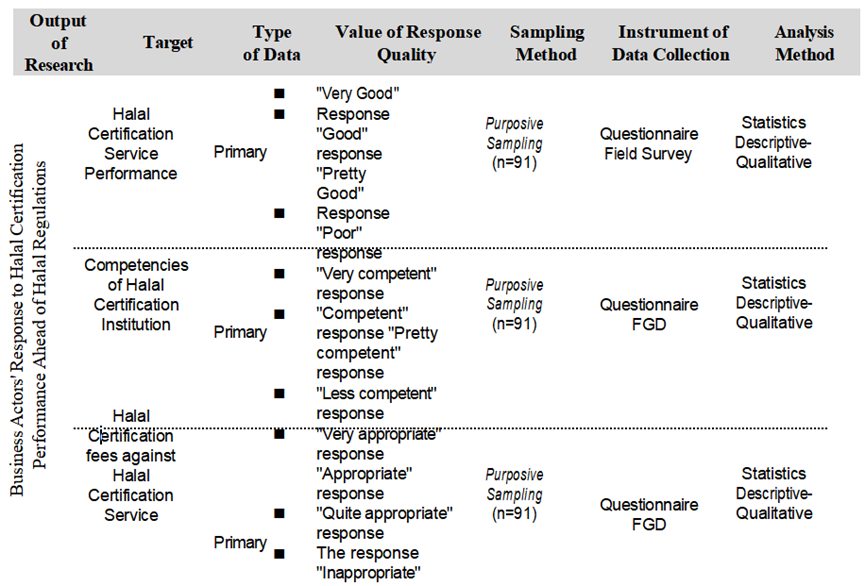
This study used a descriptive qualitative statistical analysis method by focusing on three aspects, namely 1) Response to halal certification services, 2) Response to Halal Certification Institution Competencies (LPPOM-MUI), and 3) Response to certification costs towards Halal Certification Services.
The response to Halal Certification Services examined the perception of business actors of the services carried out by LPPOM-MUI. This evaluation provided an overview regarding the performance of LPPOM-MUI towards halal certification mandate using a scaling level of "Very good", "Good", "Just moderate", and "Not good". When the total number of good percent is greater than the total "Not good" and "just average," this implies that LPPOM service must be improved, and the method can be adopted as learning for BPJPH.
Another aspect, namely the response to Halal Certification Institute competency, determined the perception of business actors towards LPPOM-MUI. A general description will be obtained on the competency of LPPOM-MUI as a halal certification body. Assessments are categorized on a scale as "Very Competent", "Competent", "Just moderate", and "Less competent". When the total number of percent "competent" is greater than the total "less competent" and "moderate, " then LPPOM competence will continue to be improved, and the method can be adopted as learning for BPJPH.
Figure 1:Design study methods
Finally, the response to the cost of halal certification examined the correlation between the service received by business actors and the price set by LPPOM-MUI. The objective is to determine the extent of customer satisfaction with the certification services provided. Assessments were scored qualitatively with a scale, ranging from "Very appropriate", "In accordance", "Just ordinary", to "Not suitable".
3.2 Types of respondents and Locus
This study used 91 respondents of business actors, with 51.6% dominance of micro-small companies and 27.5% of medium-sized companies. From the perspective of business groups, the sample was dominated by the food-beverage (51.6%) and the cosmetics industry (23.5%). This is because micro-small business can provide a more balanced perspective regarding the cost of certification. In addition, micro-small business show the performance and competence of halal certification services by the real Halal Certification Institute. The services provided are an indicator of the professionalism provided by the Halal Certification Institute. When certification services are extended to micro and small business actors, who typically incur the lowest certification costs, it shows a high level of professionalism. This implies that the standards would be maintained or exceeded for larger-scale enterprises (Crisp, 2007). According to a previous study, Small and Medium-Sized Enterprises (SME) play an important role in country development through trade and increasing competitiveness (Siaw & Rani, 2012).
In terms of business ownership, the majority of the respondents (65.9%) were private companies (65.9%). This group was selected because the private sector would be able to offer more independent opinions than others.
The business actors selected were those who have obtained halal certification from LPPOM-MUI. Data and information about the respondents were obtained from the March-April Edition of Halal Product Shopping List book published by the Global Halal Center LPPOM-MUI, supplemented with additional information obtained from relevant internet sources. The respondents were selected based on the ability to answer the questionnaire questions properly, such as company owners, personnel from the halal certification department, and other authorized representatives.
Figure 2:Scale type of business actors
Figure 3:Type of business actors (n=91)
Figure 4:Capital ownership of business
3.3 Data Collection Method
Primary data collection was carried out in 11 cities in Indonesia using the Google Doc-based online questionnaire instrument. These cities include Banda Aceh, Bandung, Bogor, Denpasar, surrounding Jakarta, Makassar,
Pekanbaru, Pontianak, Semarang-Yogyakarta, Surabaya, and surrounding Tangerang. The data were collected through direct field surveys (visits in) to the destination city by randomly selecting the types of companies according to the type of business actors. For each city, 1-2 surveyors were educated on technical issues. Survey aids were in the form of cell phone to guide respondents to fill out online questionnaires with the link: http://bit.ly/ResearchHalal2019. Questionnaires were sent or distributed through WhatsApp.
3.4 Method of Analysis
This study has three outputs, namely 1) Response to Halal Certification Service Performance, 2) Response to Halal Auditing Agency Competencies, and 3) Response to Certification Costs Compliance with Halal Certification Services. The results of business actors responses are shown in the form of pie diagrams with assessment options, namely: "very good", "good", "moderate", and "not good". Each assessment result is shown as a percentage (%). The results were classified as a good response according to the criteria in (Table 1).
| No | Output | Rating of Quality inQuestionnaire | IfCombinedValue | Justification ofResponse |
|---|---|---|---|---|
| 1 | Halal certification service performance | Very good (X1) | 81-100 | “Very Good”Response |
| Good (X2) | 71-80 | "Good" response | ||
| 51-70 | “Pretty Good” response | |||
| 0-50 | “Poor” response | |||
| 2 | Competencies ofHalal CertificationInstitution | Very competent (X1) | 81-100 | “Very competent” response |
| Competent (X2) | 71-80 | “Competent” response | ||
| 51-70 | “Pretty competent” | |||
| 0-50 | “Less competent” | |||
| 3 | Halal certification fees againstHalal CertificationService | Very appropriate (X1) | 81-100 | “Very appropriate” |
| Appropriate (X2) | 71-80 | "Appropriate" response | ||
| 51-70 | “Quite appropriate” | |||
| 0-50 | “Inappropriate response” |
4. Results and Discussion
Halal certification is a mandatory requirement for business intending to market products, necessitating the inclusion of a halal label on product packaging. The existence of a halal label guarantees food safety for Muslims (Sulistyowati et al., 2018). In general, the willingness of business actors to implement halal certification is influenced by several factors, namely consumer awareness, government initiatives, and supplier readiness to support production processes (Muhamed et al., 2019).
Knowledge about halal plays a crucial role in running business. As stated in a previous study, business activities must be managed properly and in accordance with halal guidelines across every aspect (Ahmad et al., n.d.). According to a study conducted in the food industry, halal certification can be considered a factor determining business growth (Yusuf et al., 2016). To acquire halal certification, a series of processes must be carried out by business actors. In line with the enactment of Law No. 33 of 2014, the performance of the Halal Examination Institution is of particular concern, and the obstacles encountered have centered around the halal certification process.
4.1 Halal Certification Service Performance
Based on the survey results, most business operators (49.5%) stated that the level of performance of halal certification services (LPPOM-MUI) was very good, and 31.9% stated "good.” The majority of all business operators (81.4%) stated that LPPOM-MUI provided the best service related to the duties and authority to certify products as halal.
The survey data show that halal certification registration procedures and compliance with requirements are not obstacles for business operators. The quality of services provided by the authority of certification bodies to business operators is very good. Quality of service is an effort to meet the needs and desires of consumers, as well as the accuracy of delivery in offsetting consumer expectations. Some service criteria that must be considered in providing good service include timeliness, accuracy, ease of getting service, as well as courtesy and friendliness in providing services (Tjiptono, 2009). In general, the quality of services provided by halal certifying institution directly impacts the image of the institution. Every institution or company must emphasize customer satisfaction as the main goal (Fikri, 2016). A well-satisfied client will offer positive feedback and may even become a permanent customer who uses the services provided by the institution.
As shown in (Table 2), most business operators feel very satisfied (81.4%) with the performance of halal certification services provided. The opportunity for business actors to recertify after the validity period ends is high, but it is necessary to identify the obstacles in conducting halal certification because 9.9% of business operators stated that the services were moderate, and 3.3% reported not good (Figure 5). The survey results also show obstacles faced in halal certification, including issues of costs (16%), micro-small concerns (5%), age of certification (3%), and transparency of the cost (1%)
According to (Hosana & Nugroho, 2018), in the past, the halal certification registration system was still manual, making it difficult for many SME. However, this is no longer an obstacle because registration is already online. Changes in the registration system from manual to online still have shortcomings, such as Internet signal quality constraints or website interference.
Other obstacles are the costs that are considered quite expensive and the short-lived validity of halal certificates. SME face obstacles of certification cost and the short validity of certificates, as well as the quitecomplicated requirements (Sulistyaningsih et al., 2019).This causesbusiness actors to be reluctant to conduct halal certification of products.Before the enactment of Law No. 33 of 2014, the validity period of halalcertificates was two years, after which the product had to be recertified toobtain halal certificates for the next two years (Ramlan, 2014).Under the JPH Law, Section Seven about Renewal of Halal Certificates,the validity is set at four years from the issuance of BPJPH, unless thereis a change in the composition of components. With the longer life of halalcertificates, this is beneficial for business actors. The task for BPJPH isto design a scheme package that can guarantee the consistency of halalcertification quality.
Figure 5:Halal Certification Service Performance (n = 91)
Figure 6:
The character of micro-small business actors can be divided into two types in facing halal certification policies: 1) business with halal certification expect to gain increased profits due to the existence of a wider sales market, attributed to the orientation of customers towards ever-increasing halal products. 2) Business actors do not require halal certification at all because the area of business is non-halal products, with the majority of consumers being non-Muslims (Viverita & R, 2017). This divergence in responses reflects differences in market orientation, where certain business actors remain unresponsive to halal certification due to the continued existence of profitable non-halal market demand. A relevant example can be observed in the European cosmetics industry, where halal-certified cosmetic products tend to be less attractive to consumers. This condition is partly attributed to the tension between fulfilling halal raw material requirements and complying with international cosmetic standards, which are often difficult to reconcile and demand substantial research and innovation efforts (Annabi & Ibidapo-Obe, 2017).
(Hidayat, 2018) showed that there is a positive and supportive response to the implementation of halal certification for micro-small entrepreneurs, including the "Surabaya Penyet Surabaya & Yogyakarta" food business (Annabi & Ibidapo-Obe, 2017). According to (Ahmad et al., 2017), the performance of LPPOM-MUI, which was well-received by business actors, was inseparable from the successful implementation of the halal management system, namely: the performance of top management, halal executives, employees, and packaging of halal knowledge information, teamwork, support, policies, and training procedures and systems (Ahmad et al., 2017). From a different point of view, a good response from public and business actors towards halal implementation is due to the integrity of the logo. The consistent use and supervision of halal logos increases Muslim awareness of halal food and products. This is a reciprocal relationship, indirectly giving a positive response to the halal certification authority in Indonesia (Ambali & Bakar, 2014).
Public satisfaction with the performance of LPPOM-MUI is a reflection of the integrity, dedication, and professionalism shown. Professionalism ensures the traceability process of the entire supply chain of raw materials for a halal product by an auditor with full dedication and responsibility. According to (Al-Qudsi, 2014), public trust and satisfaction with halal certification is built on five factors, namely: 1) company engagement is different at each stage of production for halal products and services, 2) constant monitoring of the entire supply chain of halal products, 3) the application of halal rules is applied equally from upstream to downstream and 4) the development of a professional halal auditor (Al-Qudsi, 2014). This is proven by the large number of Standard Operating Procedures (SOPs).
4.2 Competencies of Halal Certification Institution
Before the enactment of Law No. 33 of 2014, business operators certified products to the Halal Certification Institute (LSH) by LPPOM-MUI. LSH competence is very important because it is related to the implementation of halal products. LPPOM MUI conducts studies and scientific reviews of products to be certified. After clarity has been obtained in the scientific review, the results are taken to the MUI Fatwa Commission to be discussed from the perspective of Islamic Sharia.
The meeting between the two elements is the basic foundation for issuing halal certificates by the MUI. According to (Ilyas, 2017), certification and labeling must meet stipulated Sharia rules related to the competence of institution that issue halal standard certificates, personnel in certification and auditing, as well as certification mechanisms Halal itself (Ilyas, 2017).
Figure 7.Competencies of Halal Certification Institution (n = 91)
Based on the survey results, 44% of respondents stated that the Halal Certification Institute (LSH) was "very competent", 36.30% selected "competent", and 14.30% selected moderate, while the rest was 5.40%. (Table 2) shows that 80.3% of business operators feel the competency of LPPOM-MUI is very good. These competencies are generally related to the certification process carried out, ranging from services, product audits, and certificate issuance. The inspection of a product is critical for determining the halal nature. The critical point refers to the guidelines that have been made covering the materials used, as well as the stages of production affecting the blackness of the product. In this regard, product flow charts are needed and must be verified and analyzed for opportunities for contamination that cause products to be non-halal (Hasan, 2014).
The competency of halal auditor in conducting examinations must meet several requirements. Law No. 33 about the JPH states that one of the requirements for halal auditors is to understand and have broad insight regarding products according to Islamic law. Auditor competency indirectly reflects the ability of the LPPOM MUI to conduct product inspection. Furthermore, the ability of Halal Certification Bodies is also reviewed from the perspective of laboratory examinations.
In this context, BPJPH, which is tasked with driving and coordinating the halal certification process, must increase competence, as exemplified by the LPPOM-MUI. According to (Razalli et al., 2013), to achieve success in implementing halal certification, three types of HR competencies are needed, namely: 1) need to develop management responsibilities, 2) increase halal awareness among employees and ensure all BPJPH personnel understand halal processes, principles and policies and 3) Every personnel needs to apply ISO 9001 as the basis for good Management (Razalli et al., 2013). (Al-Qudsi, 2014) also mentioned that the competency of halal auditor personality is an influential factor. The selection of halal auditors who are dedicated and have high job integrity fosters honest service quality (Al-Qudsi, 2014). Based on the survey results, more than 14% of business operators reported that the competency of the ’Halal Certification Institution’ needs attention. These business operators include three restaurant/catering, four cosmetic, and three food-beverage business operators, as well as two RPHs, two distributors, and one hotelier. The first problem faced is related to the integrity of logos and halal products, which need to be seriously considered by the LSH. Emphasis should be placed on the pre-certification process when the auditor conducts a raw material traceability audit, and must be provided with a companion database about all suppliers of raw materials in Indonesia and the halal status. From the post-certification perspective, there is a need for market surveillance in the form of quotation tests. This is a cross-check function used to obtain objectivity and consistency in audit performance. According to (A et al., 2017), the traceability system of raw materials and products released to the market is needed to strengthen the integrity of logos and halal products owned by a national halal certification authority (A et al., 2017).
The second problem is the dilemma of the restaurant business in star hotels, which, for the most part, does not require halal certification because the majority of consumers are foreign tourists who are mostly non-Muslim. This was confirmed by (Zailani et al., 2011), who stated that a wrong perception of halal certification by hotel business managers can be one of the factors discouraging application (Zailani et al., 2011). Therefore, special human resource competencies are needed to promote persuasive socialization and encourage hoteliers to understand the concept of halalness in relation to food hygiene and health.
The third challenge is that some SME demonstrate lower engagement with halal certification due to the complexities in producing halal-compliant products. This is particularly evident in the cosmetics sector, where sourcing halal raw materials is often difficult and costly. Certain factors also affect the optimization of the chemical functions of halal materials in cosmetics, creating technical gaps that businesses must address through innovation. However, given that budgetary resources for such innovation are typically accessible only to medium and large enterprises, micro- and small-scale businesses face greater constraints in developing halal-compliant products (Madrid‐Guijarro et al., 2009). Understanding these obstacles is crucial to remaining competitive and resilient despite the challenges posed by the mandatory halal certification policy (Madrid‐Guijarro et al., 2009).
The fourth problem is the lack of socialization and information regarding the processing and serving of halal food for restaurants and catering owners. According to (Mashitoh et al., 2013), socialization carried out by the Government related to haram increased people awareness about halal food. The more people recognize the goodness of halal certification, the higher the awareness, and this will drive the need for certification among consumers (Mashitoh et al., 2013).
4.3 Certification fees as per Halal Certification Services
Based on the results, 45.10% of respondents stated the cost of certification as per the certification services was appropriate, followed by 19.80% who stated normal, 16.50% who felt not suitable, 14.30% who felt very appropriate, and 4.30% who had never been certified. Most respondents stated that certification services were appropriate, but only 14.30% selected very appropriate. This implies that 14.30% of respondents felt that the costs incurred to carry out certification corresponded with the services provided by LSH. As shown in (Table 2), most business operators (59.4%) stated that the competence of halal certification institution was in the "sufficient" category.
The cost of halal certification affects the ability of business actors to certify products. Based on the results, most business operators state that the cost of certification is very appropriate for the services obtained. However, 19.8% were in the normal category, and 16.5% mentioned that the certification fees were not in accordance with the services. This implies that two factors are the focus of attention, namely service and certification costs. According to (Viverita & R, 2017), costs serve as one of the obstacles influencing the acquisition of certification. This is because the costs incurred by LPPOM MUI vary and are considered to be relatively too expensive for small, medium-sized business actors.
Similar to the results of a study conducted by (Anwar et al., 2018), one of the obstacles in conducting certification is the existence of a false perception of costs. This perception arises because of incorrect information from other companies or third parties that provide services. Halal certification appears to be more expensive compared to other permits. However, compared to other quality certification, such as ISO, HACCP, SNI, the costs for halal certification are far more affordable (Anwar et al., 2018).
According to (Anwar et al., 2018), the cost of certification stands as an obstacle in certifying halal products in the food industry. Besides, this industry still views halal certification as a license (Anwar et al., 2018). A shift in the certification system from non-governmental LPPOM-MUI to BPJPH is expected to provide more affordable costs because the government can set aside a budget or cooperate with related parties (Anwar et al., 2018).
Aside from certification costs, services received by business operators are also very important. The service provided by LSH is a series of activities in the examination of halal, starting from document checking, conducting audits from the intended location, to issuing halal certificates. When the inspector works, business actors are obliged to provide true, clear, and honest information about the condition of the goods or services, as well as explain the use, repair, and maintenance of the product. This is to facilitate the inspection process.
Based on (Figure 6), the next problem that needs the attention of the Government is the age of halal certificates. The policy of BPJPH has accommodated the requests of the community, which is to extend the halal certificate period from 2 years to 4 years. The concession given is a logical consequence of the government to draw up a certification scheme that can still ensure the consistency of halal products circulating in the field (Sayekti, 2014).
The problem of cost has always been an obstacle for the development of halal product market among micro-small business. However, this problem is not always generalized, as (Marzuki et al., 2014) proved that the costs incurred in the food and restaurant sector are not the main reason. Even with awareness, these individuals believe that having a halal certificate will bring huge benefits because there are demands from consumers to choose halal restaurants and restaurants (Marzuki et al., 2014). This condition suggests that cost constraints will have no effect when most consumers are aware of halal food.
In practice, the standard costs incurred by the LPPOM-MUI have not been fully transparent. Business operators complain that certification fee information is not publicly announced (not partially) through the website, leading to variation in prices between regions (provincial capital ). Some representatives in the regions are very transparent (open to the public), while some services are not. This experience can certainly be the best lesson for BPJPH as the future manager (Sayekti, 2014).
A study conducted in Malaysia by Hayat et al. (2013) found that the cost of halal certification has the potential to reduce the high transaction costs associated with the supply of halal products as raw materials for industrial processes. In practice, these costs will be reimbursed with those associated with the certification.
Figure 8:Percentage of respondents’ opinions regarding the cost of halal certification on the quality of service provided (n = 91)
The problem in this context is the provision of very strong incentives from the Government for certification. This implies that some micro-small business actors are classified as being given cost relief but are behaving in a way considered to be disobedient, inconsistent, and violent. The positive response from business actors must be followed by anticipative strategic steps by the Government (Hayat et al., 2013).
Based on the discussion above, the major factor to be addressed by the Government and institution holding halal certification authority is the cost of certification. The current classification of certification costs needs to be reviewed by engaging business actors as a source of information.
Engaging business actors is essential for the following reasons. First, the parties directly affected by the costs associated with halal certification are the business actors themselves. Second, halal certification costs represent a significant operational burden for business. Therefore, it is important to determine the optimal balance between the certification fee and the benefits gained, as well as the alignment of certification costs with income. In other words, the price of halal certification should correspond with the perception of affordability. A detailed article is needed to discuss this issue.
| No | No Output | If Combined Value (x1 + x2) | Justification of Response |
|---|---|---|---|
| 1 | Halal certification service performance | 81.4% of business operators stated that they were very satisfied with the performance of halal certification services provided by ’halal certification institution’ so far | “Very Good” |
| 2 | Competencies ofHalal CertificationInstitution | 80.3% of business operators stated that the ’halal certification agency’ had provided very competent services related to halalcertification | “Competent” |
| 3 | Halal certification fees againstHalal CertificationService | 59.4% of business operators stated that the cost of halal certification incurred so far has been comparable to the quality of services provided | “Quite appropriate” |
5 Conclusion and Recommendations
Based on the results of the study, it can be concluded that the majority of business actors expressed a high level of satisfaction with halal certification services. Approximately 81.4% of respondents were very satisfied with the performance of the halal certification services provided, indicating a “Very Good” overall response. In addition, around 80.3% of business actors perceived the services delivered by the halal certification agency as highly competent, which was reflected in a “Competent” assessment. However, only 59.4% of respondents considered the cost of halal certification to be proportional to the quality of services received, suggesting that the cost aspect was viewed as only “quite appropriate.” Based on these findings, this study recommends that the Government (BPJPH) consider adopting the performance standards of LPPOM-MUI as a benchmark for the implementation of halal certification services, with necessary adjustments to work systems, certification procedures, principles, and codes of ethics in accordance with current conditions. Furthermore, LPPOM-MUI may also serve as a reference model for enhancing the competence of halal certification agencies, particularly in terms of auditor qualifications, education, skills, and adherence to ethical principles. Lastly, it is recommended that the Government conduct a comprehensive review of halal certification cost classifications to better accommodate micro and small enterprises, supported by further studies to determine more affordable and equitable certification fees.
Acknowledgments
The authors are grateful to the International Institute of Halal Research and Training (INHART) and, International Islamic University Malaysia for the support in completing this work.
Conflict of Interest
The authors declare no conflictt of interest.
References
- A Abd Rahman, HB Singhry, MH Hanafiah, M Abdul. Influence of perceived benefits and traceability on readiness for halal assurance system implementation among food manufacturers. Food Control. 2017; 73(B):1318-1326. DOI
- Ahmad A., Rahman R.A., Othman M., Abidin U.F.U.Z.. Critical success factors affect the implementation of halal food management systems: Perspectives of halal executives, consultants and auditors. Food Control. 2017; 74:70-78. DOI
- Ahmad H., Fazullah A., Borham A.J., h Hashim, Razak M.A.. Halal studies in universities: A way forward to manage halal business. International Journal of Art and Science Conference. 2011:1-9.
- Akim A., Konety N., Purnama C., Korina L.C.. The shifting of halal certification system in Indonesia: From society-centric to state-centric. MIMBAR : Jurnal Sosial dan Pembangunan. 2019; 15(1):115-126. DOI
- Al-Qudsi S.G.. Awareness and demand for 100% halal supply chain meat products. Procedia - Social and Behavioral Sciences. 2014; 130:167-178. DOI
- Ambali A.R., Bakar A.N.. Public awareness about halal food and products: Potential problems for policy makers. Procedia - Social and Behavioral Sciences. 2014; 121:3-25. DOI
- Aminuddin M.Z.. Halal product certification: Comparative study of Indonesia and Thailand. Jurnal Saheeh. 2016; 1(1):27-39. DOI
- Annabi C.A., Ibidapo-Obe O.O.. Halal certification organizations in the United Kingdom: An exploration of halal cosmetic certification. Journal of Islamic Marketing. 2017; 8(1):107-126. DOI
- Anwar M., Fahrullah A., Ridlwan A.A.. The problems of halal certification for food industry in Indonesia. International Journal of Civil Engineering and Technology. 2018; 9(8):1625-1632.
- Crisp R.. Sage Publications Ltd: London; 2007.
- Fikri S.. Effect of service quality on student satisfaction and loyalty. Journal of Business and Management. 2016; 3(1)
- Hasan K.S.. Legal certainty certification and labeling of halal food products. Journal of Legal Dynamics. 2014; 14(2)
- Hayat R., Den Butter F., Kock U.. Halal certification for financial products: A transaction cost perspective. Journal of Business Ethics. 2013; 117:601-613. DOI
- Hidayat E.. Business response to the obligation of halal certification in Surabaya and Super Geprek Chicken Sleman Yogyakarta. 2018.
- Hosana M.A., Nugroho S.A.. Pelaksanaan Undang-Undang nomor 33 tahun 2014 tentang jaminan produk halal terhadap pendaftaran sertifikat halal pada produk makanan. Jurnal Hukum Adigama. 2018; 1(1):511-534. DOI
- Ilyas M.. Certification and labeling of maslahat halal product perspectives. Al-Qadau Journal: Islamic Family Justice and Law. 2017; 4(2)DOI
- Khotimah U.. Halal labeling in the middle of consumptive culture. Journal of Sociology of Religion. 2012; 12(2):283-296. DOI
- Madrid‐Guijarro A., Garcia D., Auken H.. Barriers to innovation among Spanish manufacturing SMEs. Journal of Small Business Management. 2009; 47(4):465-488. DOI
- Majid M.A.A., Abidin I.H.Z., Majid H., Chik C.T.. Issues of halal food implementation in Malaysia. Journal of Applied Environmental and Biological Sciences. 2015; 5:50-56.
- Maryati T., Syarief R., Hasbullah R.. Analisis Faktor Kendala dalam Pengajuan Sertifikat Halal (Studi Kasus: Pelaku Usaha Mikro, Kecil dan Menengah Makanan Beku di Jabodetabek. Jurnal Ilmu Produksi dan Teknologi Hasil Peternakan. 2016; 4(3):364-371. DOI
- Marzuki S.Z.S., Hall C.M., Ballantine P.W.. Measurement of restaurant manager expectations toward halal certification using factor and cluster analysis. Procedia - Social and Behavioral Sciences. 2014; 121:291-303. DOI
- Mashitoh A.S., Rafida A.R.N., Alina A.R.. Perception Towards Halal Awareness and its Correlation with Halal Certification among Muslims. Middle-East Journal of Scientific Research. 2013; 16(Special Issue):1-9.
- Muhamed A.A., Ab Rahman M.N., Zain C.. Drivers for willingness of small and medium enterprises in implementing halal supply chain management. International Journal of Engineering and Technology. 2019; 8:146-152. DOI
- Prayuti Y.. Muslim food consumer protection through the regulation of halal labels in Indonesia. Jurnal IUS Kajian Hukum dan Keadilan. 2020; 8(1)DOI
- Ramlan Nahrowi. Halal certification as application of Islamic business ethics in protecting Muslim consumers. Ahkam. 2014; 14(1):159-174. DOI
- Razalli M.R., Abdullah S., Yusoff R.Z.. The influence of human factors in the halal certification process on organizational performance. World Review of Business Research. 2013; 3(3):157-166.
- Sayekti N.W.. Guarantee of halal products in institutional perspective. Journal of Economics and Public Policy. 2014; 5(2)
- Siaw C., Rani N.S.A.. A critical review on regulatory and legislation challenges faced by halal start-up SME food manufacturers in Malaysia. Social and Behavioral Sciences. 2012; 57:541-548. DOI
- Sulistyaningsih P., Praja C.B.E., Heniyatun Kurniaty, Y.. Halal certification obligations in 2019: Is it possible to be applied in Indonesia?. Journal of Law, Policy and Globalization. 2019; 82:38-45.
- Sulistyowati E., Hikmah N., Melo I.J.. Obligations of business actors to publish halal labels in food as a form of legal protection for Muslim consumers. Advances in Social Science, Education and Humanities Research. 2018; 26:98-100. DOI
- Tjiptono F.. Maksnesis: Yogyakarta; 2009.
- Indonesia. Law No Republic. State Secretariat: Jakarta; 1999.
- Indonesia. Law No Republic. Ministry of Law and Human Rights: Jakarta; 2014.
- Viverita Kusumastuti R.D., R Rachmawati. Motives and challenges of small businesses for halal certification: The case of Indonesia. World Journal of Social Sciences. 2017; 7(1):136-146.
- Yusuf A.H., Shukor S.A., Bustaman U.S.A.. Halal certification vs business growth of food industry in Malaysia. Journal of Economics, Business and Management. 2016; 4(3):247-251. DOI
- Zailani S., Omar A., Kopong S.. An exploratory study on the factors influencing non-compliance to halal among hoteliers in Malaysia. International Business Management. 2011; 5(1):1-12. DOI
Copyright & License
© 2025 Endi Hari Purwanto, Widia Citra Anggundari.
This work is licensed under a Creative Commons Attribution-ShareAlike 4.0 International License.

References
Abd Rahman A, Singhry HB, Hanafiah MH, Abdul M. Influence of perceived benefits and traceability on readiness for halal assurance system implementation among food manufacturers. Food Control. 2017;73(B):1318-1326. https://doi.org/10.1016/j.foodcont.2016.10.058 DOI: https://doi.org/10.1016/j.foodcont.2016.10.058
Ahmad A, Rahman RA, Othman M, Abidin UFUZ. Critical success factors affect the implementation of halal food management systems: Perspectives of halal executives, consultants and auditors. Food Control. 2017;74:70-78. https://doi.org/10.1016/j.foodcont.2016.11.031 DOI: https://doi.org/10.1016/j.foodcont.2016.11.031
Ahmad H, Fazullah A, Borham AJ, Hashim h, Razak MA. Halal studies in universities: A way forward to manage halal business. International Journal of Art and Science Conference. 2011:1-9.
Akim A, Konety N, Purnama C, Korina LC. The shifting of halal certification system in Indonesia: From society-centric to state-centric. MIMBAR : Jurnal Sosial dan Pembangunan. 2019;15(1):115-126. https://doi.org/10.29313/mimbar.v35i1.4223 DOI: https://doi.org/10.29313/mimbar.v35i1.4223
Al-Qudsi SG. Awareness and demand for 100% halal supply chain meat products. Procedia - Social and Behavioral Sciences. 2014;130:167-178. https://doi.org/10.1016/j.sbspro.2014.04.021 DOI: https://doi.org/10.1016/j.sbspro.2014.04.021
Ambali AR, Bakar AN. Public awareness about halal food and products: Potential problems for policy makers. Procedia - Social and Behavioral Sciences. 2014;121:3-25. https://doi.org/10.1016/j.sbspro.2014.01.1104 DOI: https://doi.org/10.1016/j.sbspro.2014.01.1104
Aminuddin MZ. Halal product certification: Comparative study of Indonesia and Thailand. Jurnal Saheeh. 2016;1(1):27-39. https://doi.org/10.22515/shahih.v1i1.52 DOI: https://doi.org/10.22515/shahih.v1i1.52
Annabi CA, Ibidapo-Obe OO. Halal certification organizations in the United Kingdom: An exploration of halal cosmetic certification. Journal of Islamic Marketing. 2017;8(1):107-126. https://doi.org/10.1108/JIMA-06-2015-0045 DOI: https://doi.org/10.1108/JIMA-06-2015-0045
Anwar M, Fahrullah A, Ridlwan AA. The problems of halal certification for food industry in Indonesia. International Journal of Civil Engineering and Technology. 2018;9(8):1625-1632.
Crisp R. Essential social psychology. London: Sage Publications Ltd; 2007.
Fikri S. Effect of service quality on student satisfaction and loyalty. Journal of Business and Management. 2016;3(1).
Hasan KS. Legal certainty certification and labeling of halal food products. Journal of Legal Dynamics. 2014;14(2).
Hayat R, Den Butter F, Kock U. Halal certification for financial products: A transaction cost perspective. Journal of Business Ethics. 2013;117:601-613. https://doi.org/10.1007/s10551-012-1534-9 DOI: https://doi.org/10.1007/s10551-012-1534-9
Hidayat E. Business response to the obligation of halal certification in Surabaya and Super Geprek Chicken Sleman Yogyakarta. Bachelor thesis. 2018.
Hosana MA, Nugroho SA. Pelaksanaan Undang-Undang nomor 33 tahun 2014 tentang jaminan produk halal terhadap pendaftaran sertifikat halal pada produk makanan. Jurnal Hukum Adigama. 2018;1(1):511-534. https://doi.org/10.24912/adigama.v1i1.2155 DOI: https://doi.org/10.24912/adigama.v1i1.2155
Ilyas M. Certification and labeling of maslahat halal product perspectives. Al-Qadau Journal: Islamic Family Justice and Law. 2017;4(2). https://doi.org/10.24252/al-qadau.v4i2.5682 DOI: https://doi.org/10.24252/al-qadau.v4i2.5682
Khotimah U. Halal labeling in the middle of consumptive culture. Journal of Sociology of Religion. 2012;12(2):283-296. https://doi.org/10.14421/jsa.2018.122-06 DOI: https://doi.org/10.14421/jsa.2018.122-06
Madrid‐Guijarro A, Garcia D, Van Auken H. Barriers to innovation among Spanish manufacturing SMEs. Journal of Small Business Management. 2009;47(4):465-488. https://doi.org/10.1111/j.1540-627X.2009.00279.x DOI: https://doi.org/10.1111/j.1540-627X.2009.00279.x
Majid MAA, Abidin IHZ, Majid H, Chik CT. Issues of halal food implementation in Malaysia. Journal of Applied Environmental and Biological Sciences. 2015;5:50-56.
Maryati T, Syarief R, Hasbullah R. Analisis Faktor Kendala dalam Pengajuan Sertifikat Halal (Studi Kasus: Pelaku Usaha Mikro, Kecil dan Menengah Makanan Beku di Jabodetabek). Jurnal Ilmu Produksi dan Teknologi Hasil Peternakan. 2016;4(3):364-371. https://doi.org/10.29244/jipthp.4.3.364-371 DOI: https://doi.org/10.29244/jipthp.4.3.364-371
Marzuki SZS, Hall CM, Ballantine PW. Measurement of restaurant manager expectations toward halal certification using factor and cluster analysis. Procedia - Social and Behavioral Sciences. 2014;121:291-303. https://doi.org/10.1016/j.sbspro.2014.01.1130 DOI: https://doi.org/10.1016/j.sbspro.2014.01.1130
Mashitoh AS, Rafida ARN, Alina AR. Perception Towards Halal Awareness and its Correlation with Halal Certification among Muslims. Middle-East Journal of Scientific Research. 2013;16(Special Issue):1-9.
Muhamed AA, Ab Rahman MN, Zain C. Drivers for willingness of small and medium enterprises in implementing halal supply chain management. International Journal of Engineering and Technology. 2019;8:146-152. https://doi.org/10.14419/ijet.v8i1.2.24892 DOI: https://doi.org/10.14419/ijet.v8i1.2.24892
Prayuti Y. Muslim food consumer protection through the regulation of halal labels in Indonesia. Jurnal IUS Kajian Hukum dan Keadilan. 2020;8(1):17. https://doi.org/10.29303/ius.v8i1.716 DOI: https://doi.org/10.29303/ius.v8i1.716
Ramlan, Nahrowi. Halal certification as application of Islamic business ethics in protecting Muslim consumers. Ahkam. 2014;14(1):159-174. https://doi.org/10.15408/ajis.v17i1.1251 DOI: https://doi.org/10.15408/ajis.v17i1.1251
Razalli MR, Abdullah S, Yusoff RZ. The influence of human factors in the halal certification process on organizational performance. World Review of Business Research. 2013;3(3):157-166.
Sayekti NW. Guarantee of halal products in institutional perspective. Journal of Economics and Public Policy. 2014;5(2).
Siaw C, Rani NSA. A critical review on regulatory and legislation challenges faced by halal start-up SME food manufacturers in Malaysia. Social and Behavioral Sciences. 2012;57:541-548. https://doi.org/10.1016/j.sbspro.2012.09.1222 DOI: https://doi.org/10.1016/j.sbspro.2012.09.1222
Sulistyaningsih P, Praja CBE, Heniyatun, Kurniaty Y. Halal certification obligations in 2019: Is it possible to be applied in Indonesia? Journal of Law, Policy and Globalization. 2019;82:38-45.
Sulistyowati E, Hikmah N, Melo IJ. Obligations of business actors to publish halal labels in food as a form of legal protection for Muslim consumers. Advances in Social Science, Education and Humanities Research. 2018;26:98-100. https://doi.org/10.2991/icss-18.2018.23 DOI: https://doi.org/10.2991/icss-18.2018.23
Tjiptono F. Service marketing: Essence and application. Yogyakarta: Maksnesis; 2009.
Republic of Indonesia. Law No. 8 of 1999 on consumer protection. Jakarta: State Secretariat; 1999.
Republic of Indonesia. Law No. 33 of 2014 on halal product guarantee. Jakarta: Ministry of Law and Human Rights; 2014.
Viverita, Kusumastuti RD, Rachmawati R. Motives and challenges of small businesses for halal certification: The case of Indonesia. World Journal of Social Sciences. 2017;7(1):136-146.
Yusuf AH, Shukor SA, Bustaman USA. Halal certification vs business growth of food industry in Malaysia. Journal of Economics, Business and Management. 2016;4(3):247-251. https://doi.org/10.7763/JOEBM.2016.V4.399 DOI: https://doi.org/10.7763/JOEBM.2016.V4.399
Zailani S, Omar A, Kopong S. An exploratory study on the factors influencing non-compliance to halal among hoteliers in Malaysia. International Business Management. 2011;5(1):1-12. https://doi.org/10.3923/ibm.2011.1.12 DOI: https://doi.org/10.3923/ibm.2011.1.12
Published
Issue
Section
License
Copyright (c) 2025 Endi Hari Purwanto, Widia Citra Anggundari

This work is licensed under a Creative Commons Attribution-ShareAlike 4.0 International License.
How to Cite