A Bibliometric Exploration of Halal Industry Research in the Indonesian Context
DOI:
https://doi.org/10.29244/hass.2.2.22-26Keywords:
Bibliometric analysis, Halal certification, Halal industry, Halal tourism, IndonesiaAbstract
The halal industry in Indonesia is expanding rapidly across food, cosmetics, pharmaceuticals, finance, tourism, and lifestyle, in line with the country’s ambition to become a global halal hub. Therefore, this research aimed to apply bibliometric analysis to 296 Scopus-indexed articles published between 2007 and 2025 to map trends, authorship patterns, institutional contributions, thematic developments, and collaboration networks. Data were processed using the Bibliometrix package in R. The results showed that there was an annual growth rate of 24.81 percent, with contributions from 1,001 authors across 161 sources and an international co-authorship rate of 34.46%. Research output intensified after 2020, peaking in 2023–2024, with leading contributions from Universitas Airlangga, Universitas Diponegoro, and Institut Teknologi Sepuluh Nopember. The Journal of Islamic Marketing was reported as the most influential outlet. Highly cited works emphasized halal consumption, certification, supply chain integrity, and blockchain-based traceability. Thematic analysis suggested halal tourism, certification, and supply chain management as dominant clusters, with topics such as digital innovation, food safety, and gendered consumption. Collaboration networks showed strong ties with Malaysia and broader connections to Europe, North America, and Asia. Halal industry research in Indonesia has matured into a multidisciplinary and globally connected field, moving from foundational analysis to governance, innovation, and sustainable development.
1. Introduction
The halal industry is the most dynamic sector in the global economy, extending beyond food to include cosmetics, pharmaceuticals, finance, tourism, and lifestyle products. The potential market for halal products and services is estimated at nearly USD 6 trillion, with the Muslim population projected to reach 2.2 billion by 2030 (Rahim & Sulaiman, 2023). This growth is fueled by Muslim consumers prioritizing halal compliance and non-Muslims increasingly associating halal products with quality, safety, and ethical values (Nurrachmi, 2018) ;(Bahrudin & Hidayat, 2024). The diversity of the industry is reflected in the many sub-sectors. Food and beverages account for nearly USD 2 trillion, or around 20% of the global food market (Oh et al., 2018), while halal cosmetics and pharmaceuticals are experiencing rapid growth, and halal tourism continues to expand despite global challenges such as the COVID-19 pandemic (Hasan et al., 2024); (Misbah & Johari, 2024).
Indonesia holds a particularly strategic position within the global landscape. As the country with the largest Muslim population, Indonesia is uniquely placed to capitalize on the increasing demand for halal products and services, both domestically and internationally. The government has declared a clear ambition to establish Indonesia as a global halal hub, supported by an estimated halal market value of over USD 2 trillion annually (Hidayat et al., 2025); (Sara & Maharani, 2022). To strengthen this vision, regulatory frameworks such as Law No. 33/2014 on Halal Product Assurance and the creation of the Halal Product Assurance Agency (BPJPH) have been instrumental in standardizing certification, ensuring product authenticity, and increasing consumer confidence (Asih et al., 2020);(Fadillah et al., 2023); (Pratama & Harahap, 2024).
The development of the halal industry has been increased by government initiatives and the active role of universities, research institutions, and financial systems. Sharia-compliant financial products and Islamic banking provide crucial support to micro, small, and medium enterprises (MSMEs), which form the backbone of halal production in food, beverage, and other sectors (Takhim & Mubarok, 2023); (Mubarok & Imam, 2020). Similarly, halal tourism has been reported as a promising sector, with Indonesia branding as a Muslim-friendly destination and integrating sharia principles and eco-friendly practices into the tourism offerings (Arifuddin & Cahyani, 2019); (Madnasir & Cahyani, 2024). Beyond food and tourism, new frontiers such as halal fashion and lifestyle industries are gaining traction, fueled by a young and increasingly conscious consumer base (Sazali & Ligte, 2021); (Uula, 2024).
Despite the opportunities, significant challenges remain. Research has reported inconsistencies in halal standards across organizations, a shortage of skilled professionals for halal production, and growing competition from other established halal economies (Mubarok & Imam, 2020). The variations in halal standards across countries create challenges for companies in conducting business operations (Masruroh, 2020). Even though the halal industry continues to expand into diverse sectors, long-term sustainability requires coordinated policies, global consistency of standards, and continuous innovation. Research on the halal industry has grown rapidly over the past decade, spanning themes such as consumption, certification, supply chains, tourism, blockchain, and digital innovation. However, the investigations remain fragmented, lacking a systematic overview. This limits understanding of productivity, collaboration networks,and global influence. Bibliometric analysis offers a robust method to map publication trends, leading institutions, collaborations, and thematic developments (Aria & Cuccurullo, 2017). Therefore, this research aims to explore and map the landscape of halal industry analysis through bibliometric methods. The results (i) identify dominant themes and publication trends, (ii) analyze collaboration patterns and institutional contributions, and (iii) examine influential journals and cited works. In this context, the research contributes to the academic understanding of halal industry scholarship as well as policy and industry efforts to strengthen the role as a leading player in the global halal economy.
2. Materials and Methods
A bibliometric analysis integrates mathematical and statistical methods to evaluate research production and the impact within a defined context to examine the patterns and trends in scholarly publications (Khan & Sulaiman, 2003). The analysis was conducted on academic literature focusing on the halal industry to provide insights into the evolution of research, the dominant themes that have attracted scholarly attention, as well as the institutions, authors, and sources (Aria & Cuccurullo, 2017).
Scopus database was selected as the primary source of data and widely recognized as the most comprehensive repository of peer-reviewed academic literature, covering a broad range of disciplines (Pranckutė, 2021). This database also supports advanced filtering and data export in formats such as .csv and .bib, compatible with bibliometric analysis software and commonly adopted in earlier bibliometric analyses ((Ejaz et al., 2022); (Musa & Musa, 2022); (Pedraja-Rejas & Rodríguez-Ponce, 2021); (Tsilika, 2023). The search strategy relied on a combination of keywords, such as TITLE-ABS-KEY(HALAL INDUSTRY) AND ( LIMIT-TO ( LANGUAGE, "English" ) ) AND ( LIMIT-TO ( AFFILCOUNTRY, "Indonesia"
) ) AND ( LIMIT-TO ( DOCTYPE, "ar" ) ). This procedure obtained 296 documents covering the period 2007 to 2025. According to (Franco & Pranckutė, 2022), only peer-reviewed journal articles written in English were retained. A manual screening of titles and abstracts was also conducted to ensure relevance, and documents unrelated to halal industry research were excluded.
For data processing and visualization, this research used the Bibliometrix package in the R programming environment (Aria & Cuccurullo, 2017). Bibliometrix provided a suite of tools for descriptive and network-based analysis, including (i) publication trends over time, (ii) authorship patterns and institutional contributions, (iii) keyword co-occurrence analysis for thematic clustering, and (iv) collaboration networks across authors, institutions, and countries. Visualization outputs included bar charts, trend lines, thematic maps, and co-authorship networks.
This methodological framework allowed the identification of prolific authors, influential journals, and key research themes, as well as broader collaboration patterns and thematic evolutions. The combined analyses provided a comprehensive understanding of halal industry research development, current state, and potential future directions.
3. Results
(Table 1) presents the results of the analyzed data. This research examines publications focusing on the halal industry in Indonesia between 2007 and 2025. During the period, a total of 296 documents were published across 161 sources, including journals and books. The results showed that scholarly output in this field had grown at an annual rate of 24.81%, with an average document age of 2.44 years. The research received 2,342 references, averaging 8.54 citations per document, and was authored by 1,001 scholars, with 17 being single-authored works, and an average of 3.9 co-authors per document. International collaboration is also evident, accounting for 34.46% of the publications.
| Description | Results |
|---|---|
| Timespan | 2007:2025 |
| Sources (Journals, Books) | 161 |
| Documents | 296 |
| Annual Growth Rate % | 24.81 |
| Document Average Age | 2.44 |
| Average citations per doc | 8.54 |
| References | 2,342 |
| Document Contents | |
| Keywords Plus (ID) | 333 |
| Author’s Keywords (DE) | 1,197 |
| Authors | |
| Authors | 1,001 |
| Authors of single-authored docs | 16 |
| Authors Collaboration | |
| Single-authored docs | 17 |
| Co-Authors per Doc | 3.9 |
| International co-authorships % | 34.46 |
| Document Types | |
| Article | 296 |
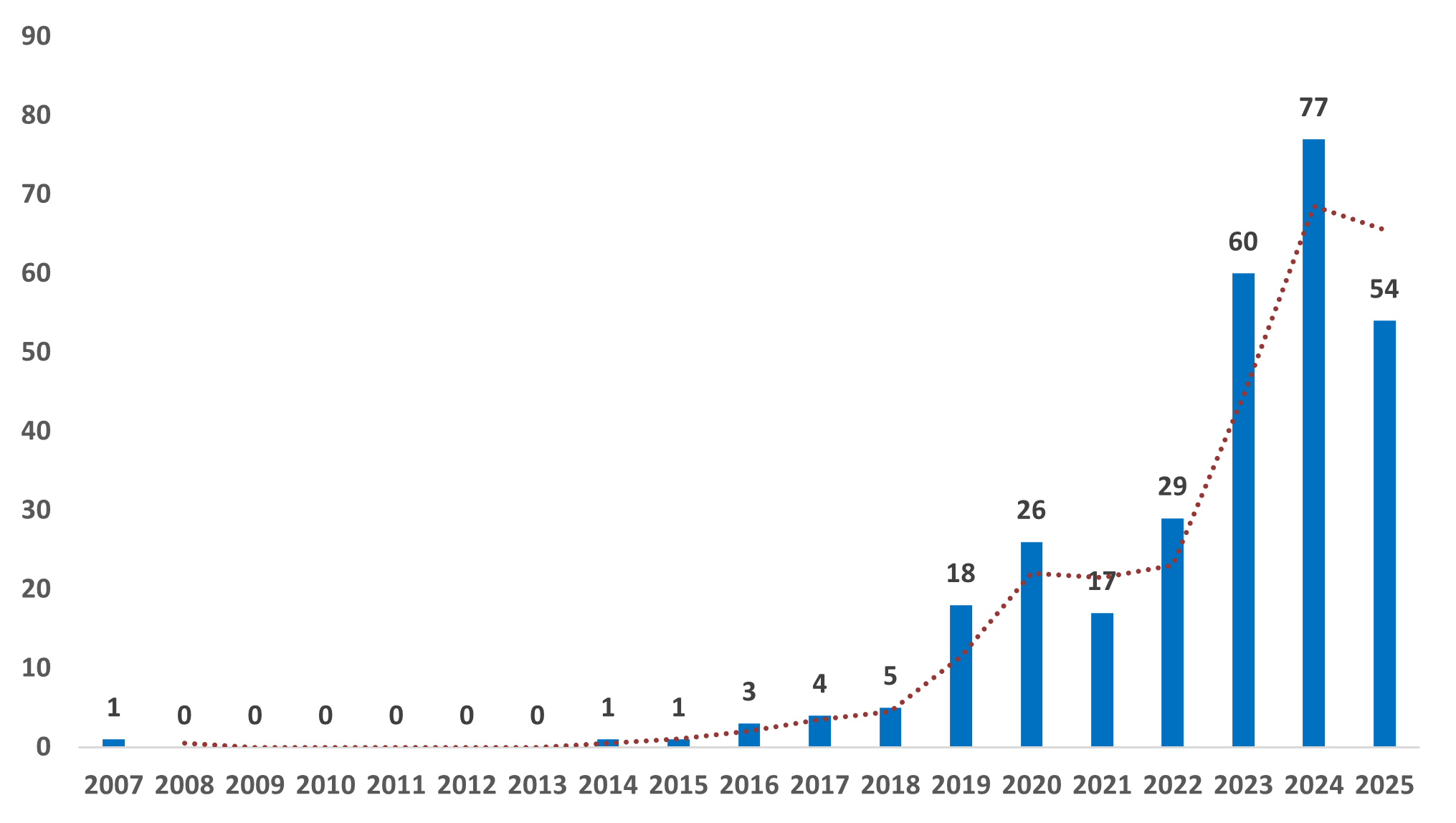
Figure 1.Annual scientific production of halal industry research in Indonesia
This research used 333 Keywords Plus terms generated automatically from cited reference titles (Aria & Cuccurullo, 2017) and 1,197 keywords (DE) to map the landscape. In terms of authorship, the dataset included 1,001 contributing authors, where 16 produced single-authored documents. Generally, 17 publications were written by a single author. On average, each document was co-authored by 3.9 research, with 34.46% of the works including international collaboration. Approximately 296 documents formed the primary dataset for this analysis.
(Figure 1) shows the annual scientific production on the topic of the halal industry from 2007 to 2025. The earliest publication appeared in 2007, followed by a period of limited activity with almost no output until 2013. Research interest began to develop gradually in 2014–2017, with publications ranging from one to five documents per year. This is in line with the Indonesian Government Policy, which requires Halal Certification through Undang-Undang Nomor 33 Tahun 2014 about Halal Product Assurance. A more significant research increase occurred in 2018, with production reaching five documents, and continued to rise sharply in the following years. In October 2017, the Indonesian Government set up an institution known as Badan Jaminan Produk Halal (BPJPH) to increase Halal Certification. This appeared as an issue because of the duration of process of halal certification process. People are more curious about halal products, and research about the industry continues to increase. This was reflected in an increase in halal analyses between 2019 and 2020, when annual publications rose from 18 to 26 documents. Even though there was a slight decline in 2021 (17 documents), the trend quickly recovered, reaching 29 publications in 2022. The most substantial growth occurred in 2023 and 2024, with 60 and 77 publications, marking the peak of research productivity. In 2025, the number of publications slightly decreased to 54 but remained significantly higher compared to the earlier years of analysis.
(Table 2) shows the leading contributors to halal industry research in Indonesia, reporting the productivity and scholarly impact. Ratnasari RT and Vanany IW were reported as the most prolific authors, each with ten publications. Vanany IW’s fractionalized count of 2.74, which was higher than Ratnasari RT’s 2.01, suggested a particularly influential role through co-authorship and collaboration networks.
This was followed by Puspitasari NB and Susanty A, who produced six publications each with identical fractionalized scores of 1.40, showing the consistent engagement in shaping the discourse around the halal industry. A further tier of contributors includes Ahmad Fadzillah N from Malaysia and Alam A from Indonesia, with four publications. However, the fractionalized contributions differ (0.50 and 0.90), reflecting variations in collaborative intensity. Lestari F and Masudin I also fall within the group, with Masudin I’s score of 1.08 reporting a stronger impact relative to peers.
Scholars such as Abdul Hamid AB (Malaysia) and Abror A (Indonesia), with three publications each, contribute to broadening the thematic landscape of halal industry research but with smaller fractionalized impacts (0.53 and 0.47). These patterns report a field where certain authors dominate in terms of sheer output, while others exert influence through strategic collaborations to enhance visibility and research impact.
| Authors | Country | Article | ArticleFractionalized |
|---|---|---|---|
| Ratnasari, RT | Indonesia | 10 | 2.01 |
| Vanany, IW | Indonesia | 10 | 2.74 |
| Puspitasari, NB | Indonesia | 6 | 1.40 |
| Susanty, A | Indonesia | 6 | 1.40 |
| Ahmad Fadzillah, N | Malaysia | 4 | 0.50 |
| Alam, A | Indonesia | 4 | 0.90 |
| Lestari, F | Indonesia | 4 | 0.70 |
| Masudin, I | Indonesia | 4 | 1.08 |
| Abdul Hamid, AB | Malaysia | 3 | 0.53 |
| Element | h-index | g-index | m-index | TC | NP | PY- |
|---|---|---|---|---|---|---|
| Ratnasari, RT | 6 | 9 | 2.00 | 94 | 10 | 2023 |
| Vanany, IW | 6 | 10 | 0.86 | 254 | 10 | 2019 |
| Masudin, I | 4 | 4 | 0.67 | 51 | 4 | 2020 |
| Ahmad Fadzillah, | 3 | 4 | 0.33 | 51 | 4 | 2017 |
| N | ||||||
| Ahyani, H | 3 | 3 | 0.60 | 51 | 3 | 2021 |
| Alam, A | 3 | 4 | 1.00 | 32 | 4 | 2023 |
| Puspitasari, NB | 3 | 6 | 0.50 | 58 | 6 | 2020 |
| Soetjipto, BE | 3 | 3 | 0.75 | 21 | 3 | 2022 |
| Soon-Sinclair, JM | 3 | 3 | 0.43 | 146 | 3 | 2019 |
| Susanty, A | 3 | 6 | 0.50 | 58 | 6 | 2020 |
(Table 3) summarizes the local impact assessment of prominent authors contributing to halal industry research in Indonesia. This is measured through standard bibliometric indicators such as the h-index, g-index, and m-index. The indicators provide insights into author productivity as well as depth and longevity of the scholarly influence (Aria & Cuccurullo, 2017).
Ratnasari RT and Vanany IW, both with an h-index of 6, have strong citation profiles. Ratnasari has already produced 10 articles with 94 citations, a g-index of 9, and an impressive m-index of 2.00, reflecting a rapid and impactful entry into the field. Meanwhile, Vanany, active since 2019, with 10 publications, has accumulated 254 citations and achieved the highest g-index score (10). The m-index of 0.86 shows steady and sustained scholarly productivity, with a broader influence across collaborative networks.
Masudin I (h-index 4, m-index 0.67) has consistently published since 2020, while Ahmad Fadzillah N from Malaysia, active since 2017, has reported 51 citations from four publications. The lower m-index (0.33) suggests a more gradual trajectory. Ahyani H and Alam A each hold an h-index of 3, with Alam’s higher m-index of 1.00 reporting a rapid increase in impact since 2023. Meanwhile, Puspitasari NB and Susanty A, with six articles since 2020, share identical citation records (58 total citations, h-index 3, g-index 6), suggesting parallel contributions to the literature.
Soetjipto BE, who began publishing in 2022, has reached an h-index of 3 with an m-index of 0.75, showing strong potential for growth. Soon-Sinclair JM, with three publications since 2019, has accumulated an impressive 146 citations, suggesting international recognition and significant scholarly visibility.
(Table 4) identifies the key institutional affiliations that have madesubstantial contributions to halal industry research in Indonesia. UniversitasAirlangga stands out as the most productive institution, with 53 publications.This is followed by Universitas Diponegoro and Institut Teknologi SepuluhNopember (ITS), contributing 43 and 41 articles, respectively. The strongpresence of the three institutions suggests that major state universities areat the forefront of driving scholarly output and shaping research directionsrelated to the halal industry.
A second cluster of contributors is represented by Universitas Muhammadiyah Surakarta (34 articles), as well as Universitas Indonesia and Universitas Negeri Malang, with 27. The publication records show the role of prominent national universities and the growing participation of private higher education institutions in advancing the field. Meanwhile, Brawijaya University and the International Islamic University Malaysia (IIUM) contributed 25 publications, reflecting the strength of Indonesian universities and the significance of cross-border collaborations with Malaysia.
Universitas Andalas and Universitas Islam Indonesia, each with 20 publications, show that the research agenda is not confined to a handful of elite institutions. The inclusion of Universitas Andalas also shows a broader geographical and institutional spread of halal industry research beyond Java. The distribution of institutional contributions shows the field’s multidisciplinary and collaborative character, spanning public and private universities as well as domestic and international networks. These universities clearly signal a strong interest in the halal industry through scholarly activity and the work of the dedicated halal institutes.
(Table 5) shows the leading publication outlets that serve as key platforms for disseminating research on the halal industry. The Journal of Islamic Marketing dominates the field with 54 articles as the most influential source for advancing scholarship on halal markets. The prominence reflects the journal’s strong focus on consumer behavior, branding strategies, and market development in both domestic and international contexts.
| Affiliation | Articles |
|---|---|
| Universitas Airlangga | 53 |
| Universitas Diponegoro | 43 |
| Institut Teknologi Sepuluh Nopember | 41 |
| Universitas Muhammadiyah Surakarta | 34 |
| Universitas Indonesia | 27 |
| Universitas Negeri Malang | 27 |
| Brawijaya University | 25 |
| International Islamic University Malaysia | 25 |
| Universitas Andalas | 20 |
| Universitas Islam Indonesia | 20 |
| Sources | Articles |
|---|---|
| Journal of Islamic Marketing | 54 |
| Indonesian Journal of Halal Research | 7 |
| International Journal of Advanced and Applied Sciences | 5 |
| International Journal of Supply Chain Management | 5 |
| Journal of Environmental Management and Tourism | 5 |
| Journal of Islamic Accounting and Business Research | 5 |
| Journal of Islamic Monetary Economics and Finance | 5 |
| Cogent Business and Management | 4 |
| Food Research | 4 |
| Mazahib Jurnal Pemikiran Hukum Islam | 4 |
The Indonesian Journal of Halal Research follows as a specialized national outlet, contributing seven articles emphasizing growing academic commitment to halal analyses. Several multidisciplinary journals have published five articles, including the International Journal of Advanced and Applied Sciences, the International Journal of Supply Chain Management, the Journal of Environmental Management and Tourism, the Journal of Islamic Accounting and Business Research, and the Journal of Islamic Monetary Economics and Finance. The contributions report the diverse scope of halal industry research, extending across sustainability, tourism, supply chain management, accounting, and Islamic finance.
Additional contributions were reported from journals such as Cogent Business and Management, Food Research, and Mazahib Jurnal Pemikiran Hukum Islam, each with four articles. These outlets publish less research and play an important role in enriching the discourse by offering perspectives from business management, food science, and Islamic legal thought. The distribution of sources shows the interdisciplinary nature of halal industry scholarship, with both international and local journals providing complementary platforms for advancing theoretical, practical, and policy-oriented discussions.
(Table 6) presents the local impact evaluation of the most influential publication outlets in halal industry research. The Journal of Islamic Marketing clearly dominates the field, with an h-index of 19 and a g-index of 30, supported by 978 citations across 54 publications since 2015. The high m-index of 1.73 reflects sustained productivity and an increased influence as the primary reference for research on halal marketing, consumer behavior, and Islamic business practices. Several other journals have established positions in shaping the discourse. The Journal of Islamic Monetary Economics and Finance (h-index 4, g-index 5, m-index 0.57) has contributed significantly since 2019 by connecting halal industry research with Islamic finance perspectives. Similarly, Ijtihad: Jurnal Wacana Hukum Islam dan Kemanusiaan (h-index 3, g-index 3, m-index 0.50) plays an important role in integrating Islamic law and humanistic approaches into halal industry scholarship.
The multidisciplinary breadth of the field is reported by journals such as the International Journal of Advanced and Applied Sciences (h-index 3, g-index 5, m-index 1.00) and Uncertain Supply Chain Management (h-index 3, g-index 4, m-index 1.00), achieving visibility despite the recent inclusion in 2023. This rapid impact suggests the growing relevance of halal industry research in applied sciences and supply chain management.
Additionally, the Journal of Islamic Accounting and Business Research (h-index 3, g-index 5, m-index 0.75) and the Journal of Environmental Management and Tourism (h-index 3, g-index 3, m-index 0.60) emphasize the interdisciplinary expansion of halal research into accounting, sustainability, and tourism. Other outlets, including the African Journal of Hospitality, Tourism and Leisure, Cogent Business and Management, and Food Research, with an h-index of 2, provide complementary contributions. These small article volumes enrich the literature by offering perspectives from hospitality, general business management, and food science.
| Authors | h-index | g-index | m-index | TC | NP | PY_start |
|---|---|---|---|---|---|---|
| Journal of Islamic Marketing | 19 | 30 | 1.73 | 978 | 54 | 2015 |
| Journal of Islamic Monetary Economics and Finance | 4 | 5 | 0.57 | 47 | 5 | 2019 |
| Ijtihad: Jurnal Wacana Hukum Islam dan Kemanusiaan | 3 | 3 | 0.50 | 57 | 3 | 2020 |
| International Journal of Advanced and Applied Sciences | 3 | 5 | 1.00 | 29 | 5 | 2023 |
| Journal of Environmental Management and Tourism | 3 | 3 | 0.60 | 14 | 5 | 2021 |
| Journal of Islamic Accounting and Business Research | 3 | 5 | 0.75 | 30 | 5 | 2022 |
| Uncertain Supply Chain Management | 3 | 4 | 1.00 | 40 | 4 | 2023 |
| African Journal of Hospitality, Tourism and Leisure | 2 | 2 | 0.33 | 22 | 2 | 2020 |
| Cogent Business and Management | 2 | 4 | 0.67 | 29 | 4 | 2023 |
| Food Research | 2 | 3 | 0.29 | 13 | 4 | 2019 |
| Paper | Total Citations | TC per Year | Normalized TC |
|---|---|---|---|
| Determinants of halal-food consumption in Indonesia (Vanany et al. 2020) | 90 | 15.00 | 5.28 |
| Food safety and halal food in the supply chain: Review and bibliometric analysis (Wahyuni et al. 2019) | 70 | 10.00 | 4.68 |
| Blockchain-Based Traceability System to Support the Indonesian Halal Supply Chain Ecosystem (Alamsyah et al. 2022) | 67 | 16.75 | 4.51 |
| Revealing factors hindering halal certification in East Kalimantan, Indonesia. Available to Purchase (Prabowo et al. 2015) | 64 | 5.82 | 1.00 |
| Antecedents of word of mouth in Muslim-friendly tourism marketing: the role of religiosity (Abror et al. 2021) | 63 | 10.50 | 3.70 |
| Designing a Permissioned Blockchain Network for the Halal Industry using Hyperledger Fabric with multiple channels and the raft consensus mechanism (Suriandari et al. 2021) | 62 | 12.40 | 4.07 |
| Halal certification for tourism marketing: the attributes and attitudes of food operators in Indonesia (Katuk et al. 2021) | 56 | 11.20 | 3.68 |
| An expansion of the technology acceptance model applied to the halal tourism sector (Berakon et al. 2023) | 53 | 17.67 | 5.10 |
| Muslim millennials’ purchase intention of halal-certified cosmetics and pharmaceutical products: the mediating effect of attitude (Widyanto & Sitohang 2022) | 52 | 13.00 | 3.50 |
| Application of multi-based quality function deployment (QFD) model to improve the halal meat industry (Vanany et al. 2019) | 47 | 6.71 | 3.14 |
(Table 7) presents the most highly cited publications that have shaped the trajectory of halal industry research. The most influential work was “Determinants of halal-food consumption in Indonesia” by (Vanany et al., 2020), which amassed 90 citations (15 per year). This research has become a cornerstone in understanding consumer behavior and the key drivers influencing halal food choices. This was followed by “Food safety and halal food in the supply chain: Review and bibliometric analysis” by (Wahyuni et al., 2019) with 70 citations, reporting the central role of food safety and supply chain management in ensuring halal integrity.
Technological innovation has been reported as another dominant theme. The article “Blockchain-Based Traceability System to Support the Indonesian Halal Supply Chain Ecosystem” by (Alamsyah et al., 2022), with 67 citations and the highest citation rate among the top works (16.75 per year), shows the growing relevance of digital tools in enhancing transparency and trust. Similarly, “Designing a Permissioned Blockchain Network for the Halal Industry” by(Surjandari et al., 2021) (62 citations) suggests the integration of advanced technologies into halal systems. Issues of certification and tourism are also central to the discourse. “Revealing factors affecting halal certification in East Kalimantan” by (Prabowo et al., 2015) (64 citations) emphasizes the institutional and regulatory barriers to certification. Meanwhile, “Halal certification for tourism marketing” by (Katuk et al., 2021) (56 citations) reflects the strategic role of certification in developing halal tourism. “Antecedents of word of mouth in Muslim-friendly tourism marketing: the role of religiosity” by (Abror et al., 2021)(63 citations) reports the significance of religious values in shaping consumer engagement and brand trust. More recent contributions also show rapid influence. “An expansion of the technology acceptance model applied to the halal tourism sector” by (Berakon et al., 2023)has achieved 53 citations, with the highest yearly rate of 17.67, signaling the strong academic and practical relevance. Similarly, “Muslim millennials’ purchase intention of halal-certified cosmetics and pharmaceutical products” by (Widyanto & Sitohang, 2022) (52 citations) expands the discussion of halal into lifestyle and healthcare markets. Methodological advancements are also evident in “Application of multi-based QFD model to improve halal meat industry” by (Vanany et al., 2019) (47 citations), which offers process-oriented insights for improving halal production systems.
(Figure 2) reports the evolving landscape of halal industry research bymapping the dominant themes and the progression over time. The analysisshows a clear intensification of scholarly focus in the period 2023–2025,where “halal tourism,” “halal certification,” and “supply chain management”are developed as the most influential clusters. Halal tourism appears asthe largest and most frequent keyword, showing a growing academic andpractical interest in Muslim-friendly travel services, halal-certified hospitality,and tourism experiences in line with Islamic values. The prominence ofterms such as “halal,” “halal industry,” “halal food,” and “Indonesia” since 2021 reflects the central role as a case research and a policy-driven contextin global halal analysis. This suggests that the country produces significantvolumes of scholarship and positions as a leading reference point in thehalal economy. Therefore, Indonesia can be considered the largest muslimcountry with the largest market.
Figure 2.Trend topics of halal industry research in Indonesia
Earlier years (2019–2021) introduced smaller and meaningful themes, including “blockchain,” “food safety,” “human,” and “female.” These terms appear with lower frequencies and represent different areas of inquiry. For instance, Blockchain technology shows research efforts aimed at enhancing traceability and trust within halal supply chains, while food safety remains intrinsically connected to the production standards.
(Figure 2) shows a distinct thematic shift toward halal-focused research after 2021, with a rapid increase from 2023 onwards. The dominance of halal tourism, certification, and supply chain integrity shows the industry’s expansion across economic, cultural, and technological dimensions, while secondary themes show innovation and inclusivity as increasingly integral to the halal industry research agenda.
(Figure 3) reports the international research collaboration network inthe field of halal industry analysis. The map shows Indonesia’s extensiveconnections spanning Asia, the Middle East, Europe, and Oceania,reflecting the academic leadership and growing role of the global halaleconomy.The strongest and most visible collaborations occur withMalaysia, a natural partner due to shared cultural and religious contexts,as well as overlapping policy priorities in halal certification, supply chainmanagement, and tourism development.
Indonesia’s network extends well beyond the region, establishing robust ties with the United Kingdom, Germany, and the Netherlands in Europe, as well as with the United States and Australia. These partnerships show the integration of halal research into global scholarly conversations, allowing for the exchange of expertise across disciplines such as business, economics, sustainability, and digital innovation. The cross-continental linkages enrich the methodological and thematic diversity of halal industry research, elevating global relevance. In Asia, Indonesia has cultivated collaborations with China, Japan, and Saudi Arabia, which broaden the scope of inquiry into trade, consumer markets, and supply chain integrity. Meanwhile, partnerships with Middle Eastern and North African countries, including the United Arab Emirates and Algeria, suggest the recognition of contributions to shaping the international halal agenda.
Figure 3.reports the international research collaboration network in the field of halal industry analysis. The map shows Indonesia’s extensive connections spanning Asia, the Middle East, Europe, and Oceania, reflecting the academic leadership and growing role of the global halal economy. The strongest and most visible collaborations occur with Malaysia, a natural partner due to shared cultural and religious contexts, as well as overlapping policy priorities in halal certification, supply chain management, and tourism development.
4. Discussion
The bibliometric results report a significant increase in halal-related research in Indonesia, particularly after the enactment of Law No. 33/2014 and the establishment of BPJPH in 2017, reflecting the growing academic attention to halal certification, tourism, and supply chain management. The complexity of procedures, institutional fragmentation, and disparities in halal standards across organizations suggest a persistent gap between academic knowledge and the practical application. These challenges affect the efficiency of certification and influence consumer trust, positioning regulatory and institutional issues as recurring themes in the literature that demand ongoing policy attention.
Developing research directions, such as digitalization through blockchain and AI, food safety, sustainability, and gendered consumption, show a gradual broadening of scholarly focus, but the contributions remain relatively limited. The international co-authorship rate of 34.46% largely centered on Malaysia reports Indonesia’s strong regional collaboration and points to the need for expanding partnerships with Europe, North America, and East Asia to enrich methodological diversity and technological innovation. Addressing the translational gap between research and industry adoption requires stronger triple helix collaboration among government, academia, and the private sector. Therefore, future scholarship should emphasize governance reform in certification, harmonization of global halal standards, capacity building of professionals, and integration of digital tools. These efforts strengthen Indonesia’s position as a global halal hub and contribute directly to the achievement of SDG 8, 9, 12 and 17.
5. Conclusion
In conclusion, research on halal in Indonesia showed significant annual growth. This is reflected in an increased number of publications, which reached 296 documents in 2007–2025, with an annual growth rate of 24.81%. The increase occurred mainly in 2023–2024, peaking at 77 publications, supported by significant contributions from leading universities such as Airlangga University, Diponegoro University, and the Sepuluh Nopember Institute of Technology. Bibliometric analysis showed that the dominant themes included halal tourism, certification, and supply chain management. New issues, including digitization, blockchain, food security, and gender-based consumption, were also stated. The Journal of Islamic Marketing was reported as a dominant outlet with the highest volume and impact. However, several obstacles appeared in the literature, including the complexity of the halal certification process, the limited effectiveness of institutional coordination, and disparities in the application of halal standards between sectors. Future research should strengthen certification governance using digital innovation, and integrating international halal standards to increase Indonesia’s role as a global halal center.
Conflict of Interest
The authors declare no conflict of interest.
References
- Abror A., Patrisia D., Trinanda O., Omar M.. Antecedents of word of mouth in Muslim-friendly tourism marketing: the role of religiosity. J Islam Mark. 2021; 12(2):249-68. DOI
- Alamsyah A., Rahman A., Surjandari I.. Blockchain-Based Traceability System to Support the Indonesian Halal Supply Chain Ecosystem. Foods. 2022; 11(15)DOI
- Aria M., Cuccurullo C.. Bibliometrix: An R-tool for comprehensive science mapping analysis. J Informetr. 2017; 11(4):959-75. DOI
- Arifuddin Z., Cahyani N.. Eco-friendly practices in Indonesian halal tourism. J Environ Manag Tour. 2019; 10(5):1135-46.
- Asih D.N., Fadillah A., Pratama A.. Halal Product Assurance Agency and standardization: A regulatory overview. Indones J Halal Res. 2020; 2(1):11-22.
- Bahrudin A., Hidayat T.. Halal market growth and ethical consumption trends. J Bus Ethics. 2024; 19(2):250-65.
- Berakon I., Sentosa I., Abdullah R.. An expansion of the technology acceptance model applied to the halal tourism sector. Tour Manag Perspect. 2023; 45(101068)DOI
- Ejaz S., Khan S., Malik F.. Bibliometric trends of halal food consumption research. J Food Prod Mark. 2022; 28(3):235-50.
- Fadillah A., Pratama A., Harahap R.. Halal certification policy and consumer confidence. Indones J Halal Res. 2023; 3(1):23-34.
- Franco A., Pranckutė R.. Screening criteria in bibliometric analysis: a methodological note. Scientometrics. 2022; 127(2):1105-18.
- Hasan H., Johari F., Ramli N.. The resilience of halal tourism post COVID-19 pandemic: Evidence from Indonesia. J Tour Futures. 2024; 10(2):180-95.
- Hidayat A., Maharani D., Sara F.. Indonesia's halal hub strategy and economic implications. J Islam Econ Stud. 2025; 33(2):211-30.
- Katuk N., Hasan H., Johari F.. Halal certification for tourism marketing: the attributes and attitudes of food operators in Indonesia. J Islam Mark. 2021; 12(3):564-82. DOI
- Khan R., Sulaiman R.. Mathematical models in bibliometric research. J Informetr. 2003; 7(1):20-9.
- Madnasir A., Cahyani N.. Green practices in Muslim-friendly Indonesian tourism. J Environ Manag Tour. 2024; 15(3):512-24.
- Masruroh S.. Human resource challenges in Indonesia's halal industry. Indones J Halal Res. 2020; 2(2):77-85.
- Misbah M., Johari F.. Halal tourism and sustainable practices in Muslim-friendly destinations. Sustainability. 2024; 16(1):155-66.
- Mubarok S., Imam S.. Sharia finance support for MSMEs in the halal sector. J Islam Monet Econ Finance. 2020; 6(2):245-60.
- Musa N., Musa H.. Bibliometric study of halal industry research: A global overview. J Islam Mark. 2022; 13(5):1050-65.
- Nurrachmi R.. The global development of the halal industry. J Halal Stud. 2018; 1(1):1-9. DOI
- Oh J., Kim H., Lee S.. Global halal food market share and growth dynamics. Food Res. 2018; 2(3):200-12.
- Pedraja-Rejas L., Rodríguez-Ponce E.. Bibliometric analysis of sustainability in halal supply chains. Sustainability. 2021; 13(12):6500-15.
- Prabowo H., Rahman T., Nurrachmi R.. Revealing factors hindering halal certification in East Kalimantan, Indonesia. J Islam Mark. 2015; 6(2):268-83. DOI
- Pranckutė R.. Web of Science and Scopus: The titans of bibliographic information in today's academic world. Publications. 2021; 9(1)DOI
- Pratama A., Harahap R.. Strengthening halal product assurance: regulatory notes. Indones J Halal Res. 2024; 4(1):1-10. DOI
- Rahim R., Sulaiman N.. Global halal economy size and outlook. J Islam Econ Stud. 2023; 31(4):345-60.
- Sara D., Maharani A.. Indonesia as a global halal hub: policy narrative and roadmap. J Islam Mark. 2022; 13(6):1280-98.
- Sazali S., Ligte L.. Halal fashion industry and young consumer behavior in Indonesia. Cogent Bus Manag. 2021; 8(1)
- Surjandari I., Alamsyah A., Rahman A.. Designing a Permissioned Blockchain Network for the Halal Industry using Hyperledger Fabric with multiple channels and the Raft consensus mechanism. Sustainability. 2021; 13(21)DOI
- Takhim M., Mubarok S.. Sharia finance and MSMEs in supporting the halal industry in Indonesia. J Islam Monet Econ Finance. 2023; 9(3):301-15.
- Tsilika T.. Bibliometric mapping of Islamic finance literature. Int J Islam Middle East Finance Manag. 2023; 16(1):100-15.
- Uula R.. Halal lifestyle industries in Indonesia: A consumer perspective. J Islam Mark. 2024; 15(2):300-15.
- Vanany I.W., Ratnasari R.T., Masudin I.. Determinants of halal-food consumption in Indonesia. J Islam Mark. 2020; 11(5):1041-60. DOI
- Vanany I.W., Masudin I., Susanty A.. Application of multi-based quality function deployment (QFD) model to improve halal meat industry. J Ind Eng Manag. 2019; 12(3):376-90. DOI
- Wahyuni S., Purwanto A., Nugroho Y.. Food safety and halal food in the supply chain: Review and bibliometric analysis. Sustainability. 2019; 11(12)DOI
- Widyanto A., Sitohang R.. Muslim millennials' purchase intention of halal-certified cosmetics and pharmaceutical products: the mediating effect of attitude. Cogent Bus Manag. 2022; 9(1)
Copyright & License
© 2025 Muh. Firmansyah, Ayu Tri Nursyarah, Dian Andrayani, Iqlima Fairuz Syifa.
This work is licensed under a Creative Commons Attribution-ShareAlike 4.0 International License.

References
Abror A, Patrisia D, Trinanda O, Omar M. Antecedents of word of mouth in Muslim-friendly tourism marketing: the role of religiosity. J Islam Mark. 2021;12(2):249-68. https://doi.org/10.1108/JIMA-01-2020-0006 DOI: https://doi.org/10.1108/JIMA-01-2020-0006
Alamsyah A, Rahman A, Surjandari I. Blockchain-Based Traceability System to Support the Indonesian Halal Supply Chain Ecosystem. Foods. 2022;11(15):2298. https://doi.org/10.3390/economies10060134 DOI: https://doi.org/10.3390/economies10060134
Aria M, Cuccurullo C. Bibliometrix: An R-tool for comprehensive science mapping analysis. J Informetr. 2017;11(4):959-75. https://doi.org/10.1016/j.joi.2017.08.007 DOI: https://doi.org/10.1016/j.joi.2017.08.007
Arifuddin Z, Cahyani N. Eco-friendly practices in Indonesian halal tourism. J Environ Manag Tour. 2019;10(5):1135-46.
Asih DN, Fadillah A, Pratama A. Halal Product Assurance Agency and standardization: A regulatory overview. Indones J Halal Res. 2020;2(1):11-22.
Bahrudin A, Hidayat T. Halal market growth and ethical consumption trends. J Bus Ethics. 2024;19(2):250-65.
Berakon I, Sentosa I, Abdullah R. An expansion of the technology acceptance model applied to the halal tourism sector. Tour Manag Perspect. 2023;45:101068. https://doi.org/10.1108/JIMA-03-2021-0064 DOI: https://doi.org/10.1108/JIMA-03-2021-0064
Ejaz S, Khan S, Malik F. Bibliometric trends of halal food consumption research. J Food Prod Mark. 2022;28(3):235-50.
Fadillah A, Pratama A, Harahap R. Halal certification policy and consumer confidence. Indones J Halal Res. 2023;3(1):23-34.
Franco A, Pranckutė R. Screening criteria in bibliometric analysis: a methodological note. Scientometrics. 2022;127(2):1105-18.
Hasan H, Johari F, Ramli N. The resilience of halal tourism post COVID-19 pandemic: Evidence from Indonesia. J Tour Futures. 2024;10(2):180-95.
Hidayat A, Maharani D, Sara F. Indonesia's halal hub strategy and economic implications. J Islam Econ Stud. 2025;33(2):211-30.
Katuk N, Hasan H, Johari F. Halal certification for tourism marketing: the attributes and attitudes of food operators in Indonesia. J Islam Mark. 2021;12(3):564-82. https://doi.org/10.1108/JIMA-03-2020-0068 DOI: https://doi.org/10.1108/JIMA-03-2020-0068
Khan R, Sulaiman R. Mathematical models in bibliometric research. J Informetr. 2003;7(1):20-9.
Madnasir A, Cahyani N. Green practices in Muslim-friendly Indonesian tourism. J Environ Manag Tour. 2024;15(3):512-24.
Masruroh S. Human resource challenges in Indonesia's halal industry. Indones J Halal Res. 2020;2(2):77-85.
Misbah M, Johari F. Halal tourism and sustainable practices in Muslim-friendly destinations. Sustainability. 2024;16(1):155-66.
Mubarok S, Imam S. Sharia finance support for MSMEs in the halal sector. J Islam Monet Econ Finance. 2020;6(2):245-60.
Musa N, Musa H. Bibliometric study of halal industry research: A global overview. J Islam Mark. 2022;13(5):1050-65.
Nurrachmi R. The global development of the halal industry. J Halal Stud. 2018;1(1):1-9. https://doi.org/10.30993/tifbr.v11i1.113 DOI: https://doi.org/10.30993/tifbr.v11i1.113
Oh J, Kim H, Lee S. Global halal food market share and growth dynamics. Food Res. 2018;2(3):200-12.
Pedraja-Rejas L, Rodríguez-Ponce E. Bibliometric analysis of sustainability in halal supply chains. Sustainability. 2021;13(12):6500-15.
Prabowo H, Rahman T, Nurrachmi R. Revealing factors hindering halal certification in East Kalimantan, Indonesia. J Islam Mark. 2015;6(2):268-83. https://doi.org/10.1108/JIMA-05-2014-0040 DOI: https://doi.org/10.1108/JIMA-05-2014-0040
Pranckutė R. Web of Science and Scopus: The titans of bibliographic information in today's academic world. Publications. 2021;9(1):12. https://doi.org/10.3390/publications9010012 DOI: https://doi.org/10.3390/publications9010012
Pratama A, Harahap R. Strengthening halal product assurance: regulatory notes. Indones J Halal Res. 2024;4(1):1-10. https://doi.org/10.58968/hs.v1i1.434 DOI: https://doi.org/10.58968/hs.v1i1.434
Rahim R, Sulaiman N. Global halal economy size and outlook. J Islam Econ Stud. 2023;31(4):345-60.
Sara D, Maharani A. Indonesia as a global halal hub: policy narrative and roadmap. J Islam Mark. 2022;13(6):1280-98.
Sazali S, Ligte L. Halal fashion industry and young consumer behavior in Indonesia. Cogent Bus Manag. 2021;8(1):1953812.
Surjandari I, Alamsyah A, Rahman A. Designing a Permissioned Blockchain Network for the Halal Industry using Hyperledger Fabric with multiple channels and the Raft consensus mechanism. Sustainability. 2021;13(21):11852. https://doi.org/10.21203/rs.3.rs-62396/v1 DOI: https://doi.org/10.21203/rs.3.rs-62396/v1
Takhim M, Mubarok S. Sharia finance and MSMEs in supporting the halal industry in Indonesia. J Islam Monet Econ Finance. 2023;9(3):301-15.
Tsilika T. Bibliometric mapping of Islamic finance literature. Int J Islam Middle East Finance Manag. 2023;16(1):100-15.
Uula R. Halal lifestyle industries in Indonesia: A consumer perspective. J Islam Mark. 2024;15(2):300-15.
Vanany IW, Ratnasari RT, Masudin I. Determinants of halal-food consumption in Indonesia. J Islam Mark. 2020;11(5):1041-60. https://doi.org/10.1108/JIMA-09-2018-0177 DOI: https://doi.org/10.1108/JIMA-09-2018-0177
Vanany IW, Masudin I, Susanty A. Application of multi-based quality function deployment (QFD) model to improve halal meat industry. J Ind Eng Manag. 2019;12(3):376-90. https://doi.org/10.1108/JIMA-10-2017-0119 DOI: https://doi.org/10.1108/JIMA-10-2017-0119
Wahyuni S, Purwanto A, Nugroho Y. Food safety and halal food in the supply chain: Review and bibliometric analysis. Sustainability. 2019;11(12):3332. https://doi.org/10.3926/jiem.2803 DOI: https://doi.org/10.3926/jiem.2803
Widyanto A, Sitohang R. Muslim millennials' purchase intention of halal-certified cosmetics and pharmaceutical products: the mediating effect of attitude. Cogent Bus Manag. 2022;9(1):2034238.
Published
Issue
Section
License
Copyright (c) 2025 Muh. Firmansyah, Ayu Tri Nursyarah, Dian Andrayani, Iqlima Fairuz Syifa

This work is licensed under a Creative Commons Attribution-ShareAlike 4.0 International License.
How to Cite