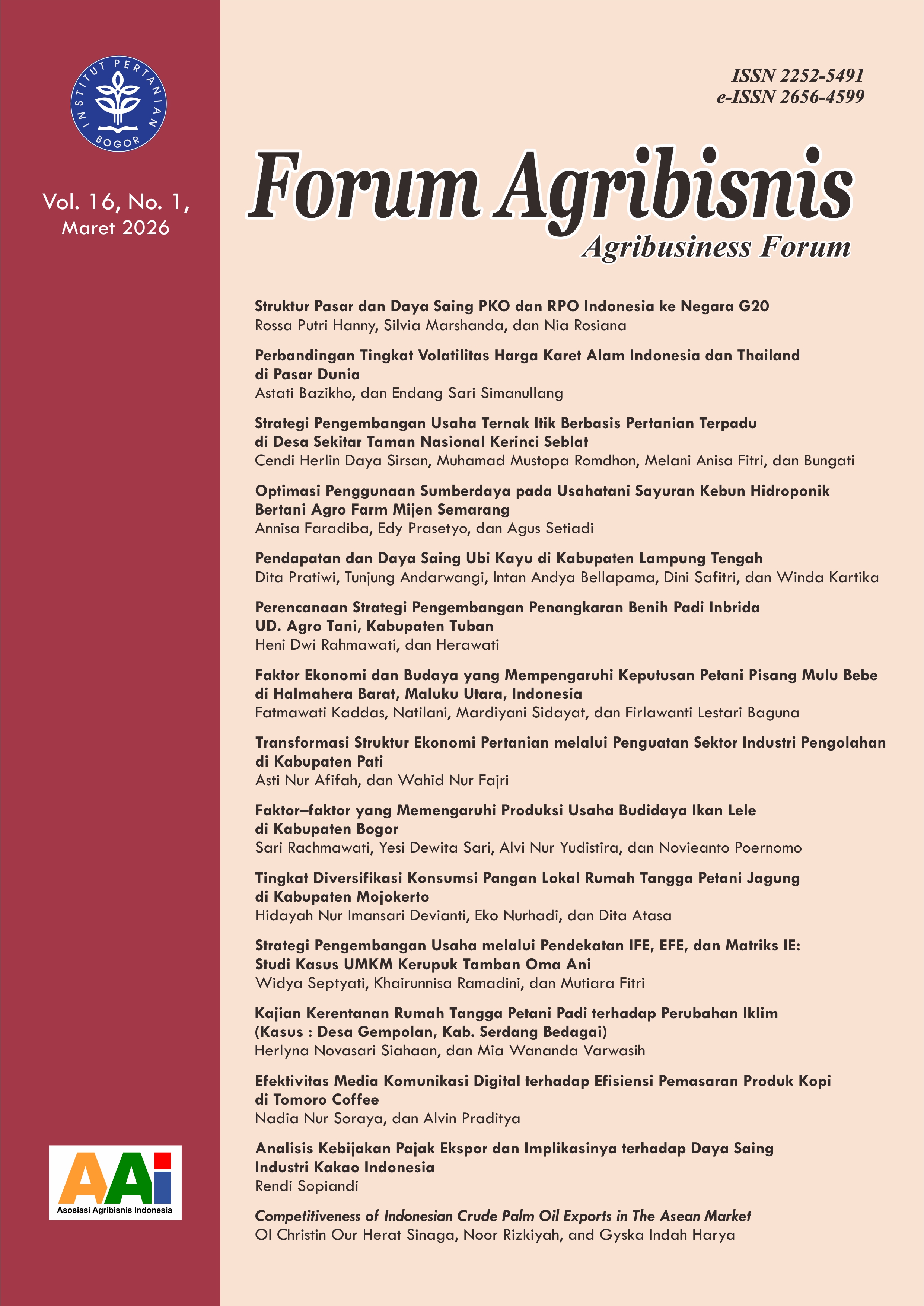
Optimasi Penggunaan Sumberdaya pada Usahatani Sayuran Kebun Hidroponik Bertani Agro Farm Mijen Semarang
DOI:
https://doi.org/10.29244/fagb.16.1.42-54Keywords:
farming, hyrdoponics, optimization, resources, vegetablesAbstract
Bertani Agro Farm is a hydroponic vegetable enterprise located in the Mijen District of Semarang City. Currently, the farm is unable to meet all consumer demands due to limited resource availability. The commodities produced include lettuce, pakcoy, caisim, romaine, green spinach, red spinach, and celery. To improve efficiency and maximize income, the farm needs to optimize its resource allocation. This research aims to analyze: (i) vegetable farming income under actual conditions; (ii) the optimal use of resources to achieve maximum income; and (iii) a comparison between income under actual conditions and optimal resource usage. The study was conducted from October to November 2024 at the Bertani Agro Farm Hydroponic Garden in Mijen, Semarang City. Data were analyzed using descriptive and quantitative methods, specifically Linear Programming via the POM-QM software. The resource optimization analysis encompassed income analysis, primal and dual analysis, sensitivity analysis, and a descriptive comparison of actual versus optimal income levels. The results indicate that with a land area of 7,000 the average monthly income under actual conditions was Rp16,358,000, achieved by producing only four types of vegetables: 1,652 kg of curly lettuce, 400 kg of caisim, 200 kg of romaine lettuce, and 55 kg of celery. Under optimal conditions, income increased by 7.36%, or Rp1,204,050, rising from Rp16,358,000 to Rp17,562,050 per month.
Downloads
References
BPS. (2021). Semarang dalam Angka 2021. BPS KotaSemarang.https://semarangkota.bps.go.id/id/publication/2021/02/26/cf7000f79cd1c7015c2939fc/kota-semarang-dalam-angka-2021.html
Chotimah, K., Baruwadi, M., & Bakari, Y. (2019). Analisis Efisiensi Usahatani Jagung di Kecamatan Randangan Kabupaten Pohuwato. Agrinesia, 3(3), 174–185.
Djafri, M. S., Harianto, H., & Syaukat, Y. (2017). Optimasi Produksi Usahatani Sayuran Organik (Studi Kasus Yayasan Bina Sarana Bakti, Cisarua, Bogor). Forum Agribisnis, 6(1). https://doi.org/10.29244/fagb.6.1.111-129. DOI: https://doi.org/10.29244/fagb.6.1.111-129
Don Piran, R., Payong, P., & Priscilla Cordanis, A. (2022). Analisis Pemasaran Sayuran di Pasar Inpres Ruteng Kabupaten Manggarai. Forum Agribisnis, 12(2). https://doi.org/10.29244/fagb.12.2.151-160. DOI: https://doi.org/10.29244/fagb.12.2.151-160
Metta, M., Suek, I. J., Bernadina, L., & Pellokila, M. R. (2023). Optimasi Keuntungan Pengusaha Sayuran Hidroponik Di Kota Kupang. J. Pengembangan Penyuluhan Pertanian, 20(1), 44–61. https://doi.org/https://doi.org/10.36626/jppp.v20i1.938. DOI: https://doi.org/10.36626/jppp.v20i1.938
Muhiddin, N., & Lestari, N. (2023). Pengaruh Media Tanam Organik dan Anaorganik terhadap Pertumbuhan Seledri (Apium graveolens L) dengan Sistem Hidroponik DFT. Jurnal Pendidikan Teknologi Pertanian. J. Pendidikan Teknologi Pertanian, 9(2), 155–162. https://doi.org/https://doi.org/10.26858/jptp.v9i2.663. DOI: https://doi.org/10.26858/jptp.v9i2.663
Normansyah, D., Rochaeni, S., & Humaerah, A. D. (2014). Analisis Pendapatan Usahatani Sayuran Di Kelompok Tani Jaya, Desa Ciaruteun Ilir, Kecamatan Cibungbulang, Kabupaten Bogor. Agribusiness Journal, 8(1). https://doi.org/10.15408/aj.v8i1.5127. DOI: https://doi.org/10.15408/aj.v8i1.5127
Cahyanda, Q., Fauzi, A. R., & Agustin, H. ,. (2022). Pengaruh Metode Penanaman Hidroponik Dan Konvensional Terhadap Pertumbuhan Tanaman Selada Romaine Dan Pakcoy. Jurnal Bioindustri, 4(2). https://doi.org/10.31326/jbio.v4i2.95. DOI: https://doi.org/10.31326/jbio.v4i2.951
Rosyidah, I., Anshory, I., Sulistiyowati, I., & Syahrorini, S. (2024). Implementation of Image Processing On Hydroponic Pakcoy Plants To Detect AB MIX Nutrient Levels. Jambura Journal of Electrical and Electronics Engineering, 6(2), 234–239. https://doi.org/https://doi.org/10.37905/jjeee.v6i2.26143. DOI: https://doi.org/10.37905/jjeee.v6i2.26143
Septiadi, D., & Nursan, M. (2021). Optimasi Produksi Usaha Tani Sebagai Upaya Peningkatan Pendapatan Petani Sayuran Di Kota Mataram. Agrifo : Jurnal Agribisnis Universitas Malikussaleh, 5(2). https://doi.org/10.29103/ag.v5i2.3489. DOI: https://doi.org/10.29103/ag.v5i2.3489
Setiawan, A. (2019). Buku Pintar Hidroponik. In LaksanaShinta, A. (2001). Ilmu Usaha Tani. Universitas Brawijaya.
Shinta, A. (2001). Ilmu Usaha Tani. Universitas Brawijaya.
Sibuea, P. (2021). Kajian manfaat makanan fungsional di saat pandemi COVID-19. Jurnal Riset Teknologi Pangan Dan Hasil Pertanian (RETIPA), 2(1), 83–92. DOI: https://doi.org/10.54367/retipa.v2i1.1483
Suratiyah, K. (2015). Ilmu Usahatani. Penebar Swadaya.
Tando, E. (2019). Pemanfaatan Teknologi Greenhouse Dan Hidroponik Sebagai Solusi Menghadapi Perubahan Iklim Dalam Budidaya Tanaman Hortikultura. Buana Sains,19(1). https://doi.org/10.33366/bs.v19i1.1530 DOI: https://doi.org/10.33366/bs.v19i1.1530
Wati, D. R., & Sholihah, W. (2021). Pengontrol pH dan Nutrisi Tanaman Selada pada Hidroponik Sistem NFT Berbasis Arduino. MULTINETICS, 7(1). https://doi.org/10.32722/multinetics.v7i1.3504 DOI: https://doi.org/10.32722/multinetics.v7i1.3504
Winda, G., Mutiara, V. I., & Sari, R. (2020). Optimalisasi Produksi Usahatani Sayuran Hidroponik Usaha Hydro Garden Padang. JOSETA Journal of Socio-Economics on Tropical Agriculture, 2(2). https://doi.org/10.25077/joseta.v2i2.239Zahara, V. M.& Anwar, C. J. (2021). Mikroekenomi (Sebuah Pengantar). Media Sains Indonesia. DOI: https://doi.org/10.25077/joseta.v2i2.239
Zahara, V. M., & Anwar, C. J. (2021). Mikroekonomi (Seuah Pengantar). Media Sains Indonesia. Universitas Malikussaleh, 5(2). https://doi.org/10.29103/ag.v5i2.3489.
Downloads
Published
Issue
Section
License
Copyright (c) 2026 Forum Agribisnis

This work is licensed under a Creative Commons Attribution-ShareAlike 4.0 International License.
The author submitting the manuscript must understand and agree that the copyright of the article manuscript must be submitted/transferred to the Journal Forum Agribisnis. This work is licensed under the Creative Commons Attribution-ShareAlike 4.0 (CC BY-SA) International License in which the Author and Reader can copy and redistribute the material in any media or format, and remix, modify and build material for any purpose, but they must provide appropriate credit (citing articles or content), provide a link to the license, and indicate whether there is a change. If you mix, change, or create material, you must distribute your contribution under the same license as the original.