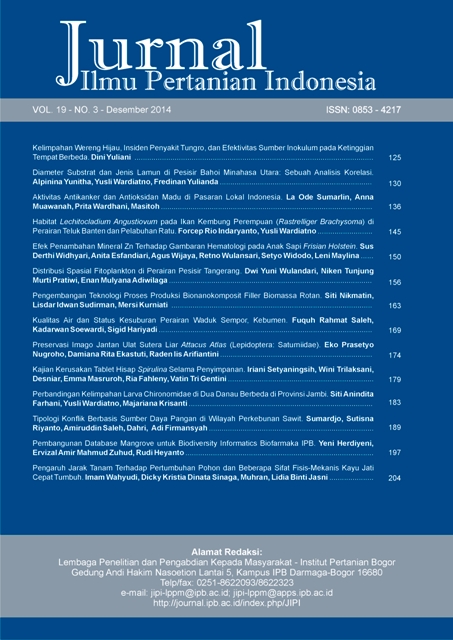
Pengembangan Teknologi Proses Produksi Bionanokomposit Filler Biomassa Rotan
Keywords:
bark of rattan, cellulose, nanocomposites, nanoparticleAbstract
Rattan biomass is a fiber waste from processing industry of rattan. Its abundant availability, as well as does not threaten the balance of food and feed, make it a potential source as raw material for composite filler of cellulose nanoparticles. To obtain a high cellulose content, it was inoculated with White rote fungi and Aspergillus niger. The experiments were conducted at inoculation time of 15, 21, and 30 days. The results showed that biomass of rattan extracted with White rote fungi and Aspergillus niger reached maximum cellulose content at the inoculation time of 21 days ie 76.47% cellulose, lignin 2.39%, and 20% moisture content. Cellulose has a monoclinic crystal structure, a =7.87; b=10.31; c=10.13 α= γ = 90, β=120. Nanoparticles were produced by disk mill-hummer mill method with variation milling time of 15, 30, and 45 minutes. Collision, friction, and heat for 30 minutes of milling could produce energy that was transferred to the particles and caused cavitation which resulted particles of 16.22-51.30 nm particle size. Production of test piece and prototype of nanocomposite using TSE and injection molding produced material which has 2 phases of crystal structure, namely monoclinic, and orthorhombic phases. The mechanical properties of impact strength was 67.769 J/m and hardness of 79.97 HRR. Thermal properties and density of bionanokomposit showed comparable values with synthetic composites.
Downloads
References
Ifuku S, Nogi M, Yoshioka M, Morimoto M. 2010. Fibrillation of dried chitin into 10-20 nm nanofibers by a simple grinding method under acidic conditions. Journal of Polymers. 81: 134-139.
Irwanto D. 2011. Efisiensi proses produksi komponen sepeda motor melalui pemilihan material yang tepat. Astra Honda Motor. 5-6.
Irwanto D. 2012. Fenomena impor granular komposit sintetis sebagai material komponen sepeda motor. Astra Honda Motor. 2-3.
Sisworo S. 2009. Pengaruh penggunaan serat kulit rotan sebagai penguat pada komposit polimer dengan matriks polyester yucalac 157 terhadap kekuatan tarik dan tekuk. Jurnal Teknik. 30: 3-10.
Nikmatin S. 2009. Karakterisasi kulit dan batang rotan. Jurnal Biofisika. 2(1): 7-12.
Nikmatin S. 2010. Pengaruh fermentasi kapang terhadap rendemen selulosa kulit rotan. Jurnal Biofisika. 4(2): 41-49.
Nikmatin S. 2011. Karakterisasi selulosa kulit rotan sebagai material pengganti serat sintetis. Jurnal Agrotek UNEJ. 5(1): 40-47.
Nikmatin S. 2012. Analisis struktur selulosa kulit rotan sebagai filler bionanokomposit dengan difraksi sinar x. Jurnal Sains Material Indonesia. 13(2): 97-102.
Wang Y, Chang C, Zhang L. 2010. Effects of freezing/thawing cycles and cellulose nanowhiskers on structure and properties of biocompatible starch/PVA sponges. Journal of Macromolecular Materials and Engineering. 295(2): 137-145.
Downloads
Published
Issue
Section
License
This journal is published under the terms of the Creative Commons Attribution-NonCommercial 4.0 International License. Authors who publish with this journal agree to the following terms: Authors retain copyright and grant the journal right of first publication with the work simultaneously licensed under a Creative Commons Attribution-NonCommercial 4.0 International License. Attribution — You must give appropriate credit, provide a link to the license, and indicate if changes were made. You may do so in any reasonable manner, but not in any way that suggests the licensor endorses you or your use. NonCommercial — You may not use the material for commercial purposes.





















 View JIPI StatsCounter