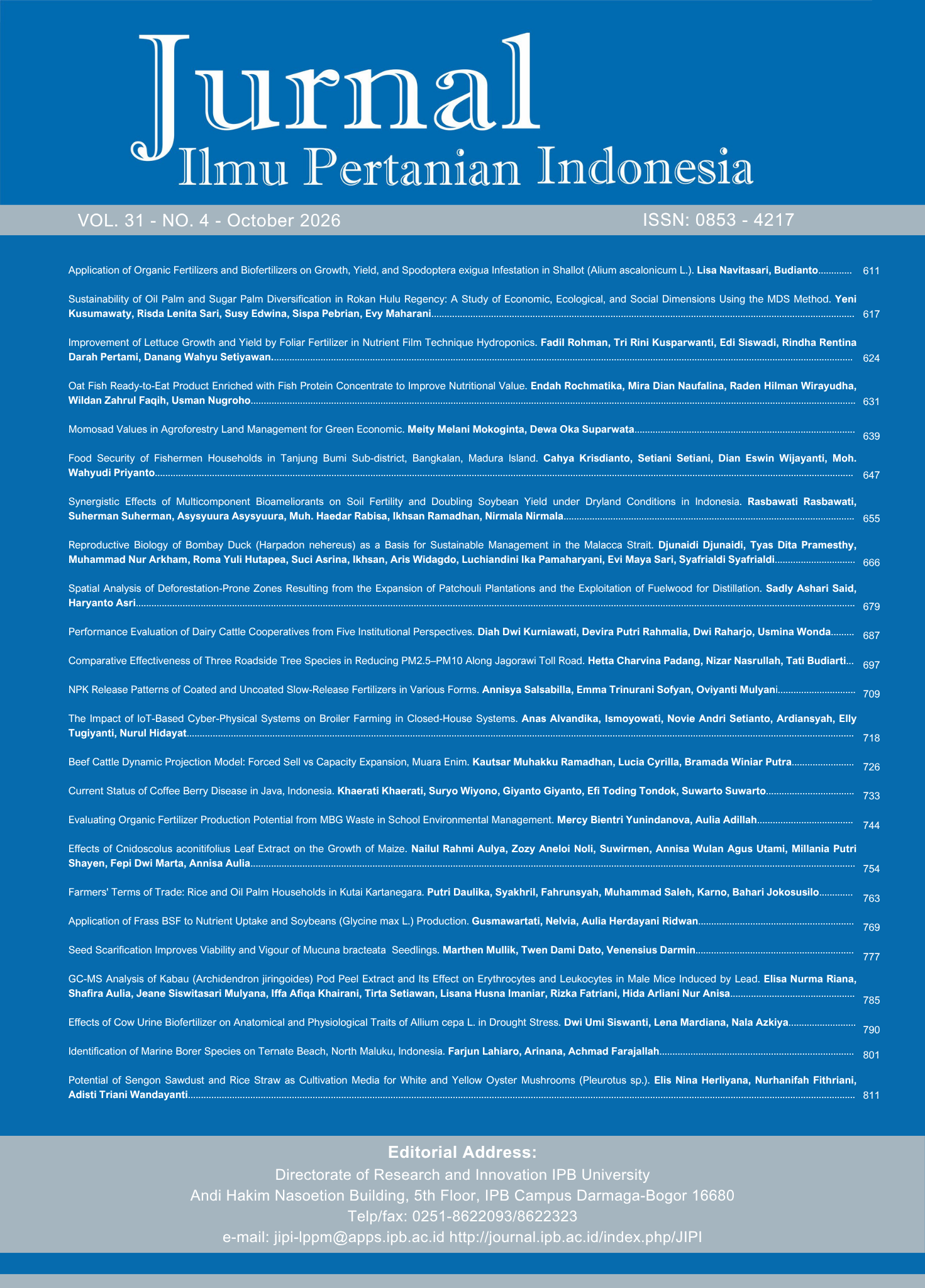
The Impact of IoT-Based Cyber-Physical Systems on Broiler Farming in Closed-House Systems
DOI:
https://doi.org/10.18343/jipi.31.4.718Keywords:
broiler chickens, closed-house system, cyber-physical system, internet of things, precision livestock farmingAbstract
Broiler chicken production requires appropriate environmental control to maintain productivity and animal welfare. This study evaluated the effect of implementing an IoT-based cyber-physical system on microclimate stability and broiler chicken performance under semi-industrial conditions. A total of 4,200 CP-707 broiler chickens were reared for 33 days in a closed-house facility using a before-and-after design that compared a non-system controller with an IoT-based cyber-physical system that integrated environmental sensors, a programmable logic controller, and cloud-based monitoring. This system maintained stable environmental conditions and reduced deviations from standard operating procedures. Average house temperature and feed conversion ratio (FCR) did not differ significantly before and after implementation (p = 0.080 and p = 0.645, respectively). However, mortality rates decreased significantly from 5.09% to 2.36% (p = 0.005), and body weight increased from 846.29 g to 895.43 g (p < 0.001). The Performance Index (PI) also increased, although the difference was not statistically significant (p = 0.088). These findings indicate that the IoT-based cyber-physical system improves the survival and growth of broiler chickens whilst maintaining feed efficiency through more stable environmental control. This system offers a practical and adaptable approach to improving productivity, sustainability, and animal welfare within modern closed-house broiler chicken production systems.
Keywords: broiler chickens, closed-house system, cyber-physical system, internet of things, precision livestock farming
Downloads
References
Arif R, Widiatmoko A, Nurzuliana D. 2024. Health and Production Performance of Broiler strain Cobb with Closed House IoT system in Cimahpar, Bogor. Jurnal Sain Veteriner 42(3): 303–307. https://doi.org/10.22146/jsv.82670
Aviagen. 2019. Broiler Management Handbook. Aviagen Group. Aviagen. Ross broiler management handbook. Aviagen Group. https://aviagen.com/assets/Tech_Center/Ross_Broiler/Aviagen-ROSS-Broiler-Handbook-EN.pdf
Aviagen. 2025. Ross broiler management handbook. Aviagen Group. https://aviagen.com/assets/Tech_Center/Ross_Broiler/Aviagen-ROSS-Broiler-Handbook-EN.pdf
Bai H, Teng G, Ma L, Yuan Z, Li Z, Li C. 2006. Layer healthy breeding management information system based on Internet. https://www.cabidigitallibrary.org/doi/full/10.5555/20073249087
Berckmans D. 2017. General introduction to precision livestock farming. Animal Frontiers. 7(1): 6–11. https://doi.org/10.2527/af.2017.0102
BPS. 2023. Statistik produksi daging ayam ras pedaging Indonesia 2021–2023. Badan Pusat Statistik. https://www.bps.go.id/id/statistics-table/2/NDg4IzI=/produksi-daging-ayam-ras-pedaging-menurut-provinsi.html
Bumanis N, Arhipova I, Paura L, Vitols G, Jankovska L. 2022. Data conceptual model for smart poultry farm management system. Procedia Computer Science. 200: 517–526. https://doi.org/10.1016/j.procs.2022.01.249
Chivarov N, Dimitrov K, Chivarov S. 2023. Algorithm for Autonomous Management of a Poultry Farm by a Cyber-Physical System. Animals. 13(20): 3252. https://doi.org/10.3390/ani13203252
Darwish AH, El-Sayiad GA, El-Maghawry AM, Mahrose KM. 2017. Growth performance, carcass traits and some blood parameters of broiler chicks as affected by housing system. Zagazig Journal of Agricultural Research. 44(4): 1379–1387. https://doi.org/10.21608/zjar.2017.52941
Depuru BK, Putsala S, Mishra P. 2024. Automating poultry farm management with artificial intelligence: real-time detection and tracking of broiler chickens for enhanced and efficient health monitoring. Tropical Animal Health and Production. 56(2): 75. https://doi.org/10.1007/s11250-024-03922-2
Dwipradipta AGA, Putra IDA, Ardana IP, Agung IR. 2024. Rancang bangun smart closed house pada peternakan ayam broiler. Jurnal Spektrum. 11(1). https://doi.org/10.24843/SPEKTRUM.2024.v11.i01.p1
Eltaieb AAM, Min ZJ. 2015. Automatic water level control system. International Journal of Science Research. 4(12): 1505–1509. https://doi.org/10.21275/v4i12.NOV152239
Elwakeel, A. E. 2025. A smart automatic control and monitoring system for environmental control in poultry houses integrated with earlier warning system. Scientific Reports, 15(1), 31630. https://www.nature.com/articles/s41598-025-17074-2
Fairchild BD. 2009. Environmental factors to control when brooding chicks. http://hdl.handle.net/10724/12476
Farrell D. 2013. The role of poultry in human nutrition. Poultry Development Review. Rome: Food and Agriculture Organization, 2-9. www.fao.org/ publications
Huang Q, Wen C, Yan W, Sun C, Gu S, Zheng J, Yang N. 2022. Comparative analysis of the characteristics of digestive organs in broiler chickens with different feed efficiencies. Poultry Science. 101(12): 102184. https://doi.org/10.1016/j.psj.2022.102184
Huang R, Zhang ZC. 2011. Predictive model-aided filtering scheme of data-collection in WSN. The Journal of China Universities of Posts and Telecommunications. 18(2): 17–24. https://doi.org/10.1016/S1005-8885(10)60040-4
Iriani J, Sitorus N, Meliala MD, Hasibuan RD. 2024. Realtime broiler chicken cage control and monitoring system. Global Journal Indexing. https://doi.org/10.59890/ijarss.v2i5.1810
Jiang B, Tang W, Cui L, Deng X. 2023. Precision livestock farming research: a global scientometric. Animals. 13(13): 2096. https://doi.org/10.3390/ani13132096
Komaludin D. 2024. Penerapan teknologi Internet of Things (IoT) untuk pengukuran amonia pada kandang ayam jenis close house. MESA. 8(2): 90–95. https://doi.org/10.35569/ftk.v8i2.1987
Lashari MH, Karim S, Alhussein M, Hoshu AA, Aurangzeb K, Anwar MS. 2023. Internet of Things-based sustainable environment management for large indoor facilities. Computer Science. 9: e1623. https://doi.org/10.7717/peerj-cs.1623
Lashari MH, Memon AA, Shah SAA, Nenwani K, Shafqat F. 2018. IoT based poultry environment monitoring system. In 2018 IEEE International Conference on Internet of Things and Intelligence System (IOTAIS) (pp. 1–5). IEEE. https://doi.org/10.1109/IOTAIS.2018.8600837
Leeson S, Summers JD. 2009. Commercial poultry nutrition. Nottingham (UK): Nottingham university press. https://doi.org/10.7313/UPO9781904761099
Li H, Wang H, Yin W, Li Y, Qian Y, Hu F. 2015. Development of a remote monitoring system for henhouse environment based on IoT technology. Future Internet. 7(3): 329–341. https://doi.org/10.3390/fi7030329
Martinez DA, Weil JT, Suesuttajit N, Umberson C, Scott A, Coon CN. 2022. The relationship between performance, body composition, and processing yield in broilers: A systematic review and meta-regression. Animals. 12(19): 2706. https://doi.org/10.3390/ani12192706
Masriwilaga AA, Al-Hadi TAJM, Subagja A, Septiana S. 2019. Monitoring system for broiler chicken farms based on Internet of Things (IoT). Telekontran. 7(1): 1–13. https://doi.org/10.34010/telekontran.v7i1.1641
Mirzaee-Ghaleh E, Omid M, Keyhani A, Dalvand MJ. 2015. Comparison of fuzzy and on/off controllers for winter season indoor climate management in a model poultry house. Computers and Electronics in Agriculture, 110, 187–195. https://doi.org/10.1016/j.compag.2014.11.017
Mulia SB, Erdani Y, Febrian MR, Alfian RF. 2022. Rancang bangun miniatur sistem kontrol dan monitoring suhu kandang close house berbasis Arduino Uno. Jurnal TEDC, 16(2): 116–125. https://ejournal.poltektedc.ac.id/index.php/tedc/article/view/588/444
Pratama S, Candra W. 2024. Effect Of Cage Temperature And Humidity On Body Weight And Feed Conversion of Broiler Chickens (Pengaruh suhu dan kelembapan kandang terhadap bobot badan dan konversi ransum ayam broiler). Jurnal Nukleus Peternakan, 11(1), 1–5. https://doi.org/10.35508/nukleus.v11i1.16107
Prayogi HS. 2014. The performance of broiler rearing in system stage floor and double floor. Jurnal Ilmu-Ilmu Peternakan, 24(3). https://jiip.ub.ac.id/index.php/jiip/article/view/207/285
Rowe E, Dawkins MS, Gebhardt-Henrich SG. 2019. A systematic review of precision livestock farming in the poultry sector: Is technology focussed on improving bird welfare. Animals. 9(9): 614. https://doi.org/10.3390/ani9090614
Saragih Y, Silaban JHP, Roostiani HA, Elisabet SA. 2020. Design of automatic water flood control and monitoring systems in reservoirs based on Internet of Things (IoT). In 2020 3rd International Conference on Mechanical, Electronics, Computer, and Industrial Technology (MECnIT) (pp. 30–35). IEEE.https://doi.org/10.1109/MECnIT48290.2020.9166593
Stoica P, Xu L, Li J. 2005. A new type of parameter estimation algorithm for missing data problems. Statistics and Probability Letters. 75(3): 219–229. https://doi.org/10.1016/j.spl.2005.05.018
Yasi RM, Candra AT. 2022. Analisis sistem otomatisasi kandang ayam broiler berbasis IoT. Journal of Science and Technology. 2(2): 183–195. https://doi.org/10.51135/justevol2issue2page183-195
Yerpes M, Llonch P, Manteca X. 2020. Factors associated with cumulative first-week mortality in broiler chicks. Animals. 10(2): 310. https://doi.org/10.3390/ani10020310
Zammit VA, Park SO. 2023. Impact of the combination of probiotics and digital poultry system on behavior, welfare parameters, and growth performance in broiler chicken. Microorganisms. 11(9): 2345. https://doi.org/10.3390/microorganisms11092345
Downloads
Published
Issue
Section
License
Copyright (c) 2026 Anas Alvandika, Ismoyowati Ismoyowati, Novie Andri Setianto, Ardiansyah Ardiansyah, Elly Tugiyanti, Nurul Hidayat

This work is licensed under a Creative Commons Attribution-NonCommercial 4.0 International License.
This journal is published under the terms of the Creative Commons Attribution-NonCommercial 4.0 International License. Authors who publish with this journal agree to the following terms: Authors retain copyright and grant the journal right of first publication with the work simultaneously licensed under a Creative Commons Attribution-NonCommercial 4.0 International License. Attribution — You must give appropriate credit, provide a link to the license, and indicate if changes were made. You may do so in any reasonable manner, but not in any way that suggests the licensor endorses you or your use. NonCommercial — You may not use the material for commercial purposes.
How to Cite
























 View JIPI StatsCounter