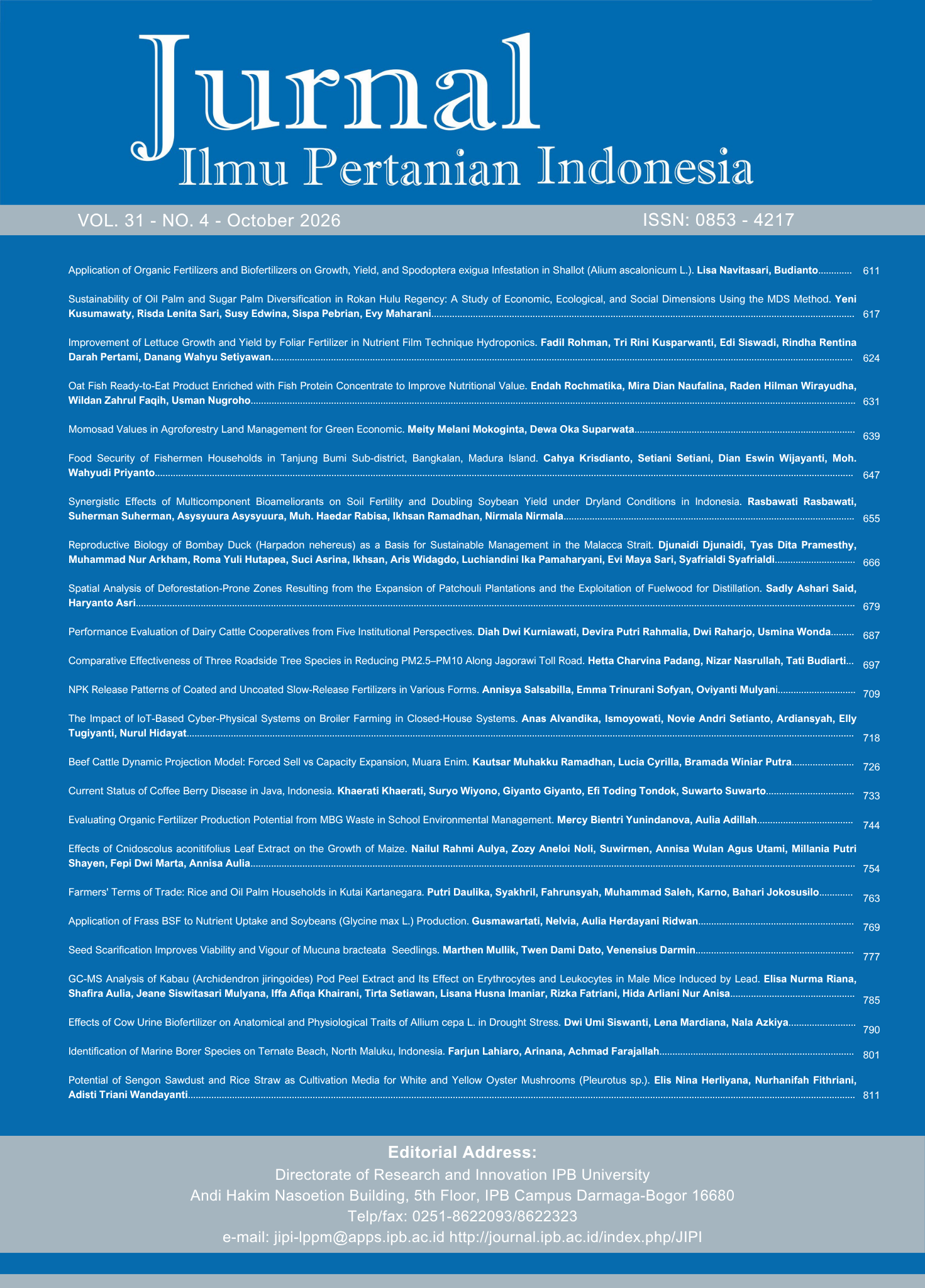
Effects of Cnidoscolus aconitifolius Leaf Extract on the Growth of Maize
DOI:
https://doi.org/10.18343/jipi.31.4.754Keywords:
biostimulant, chaya, maize, plant extractAbstract
The growth and yield of maize (Zea mays L.) are constrained by abiotic and biotic stresses, necessitating sustainable approaches to improve crop performance. Cnidoscolus aconitifolius leaf extract, rich in bioactive phytochemicals, has potential as a natural biostimulant for enhancing maize growth. This study aimed to evaluate the effects of C. aconitifolius leaf extract on the growth of maize. The experiment was conducted using a two-factor Completely Randomized Design (CRD), with solvent type (aqueous, ethanol, methanol, and butanol) and extract concentration (0, 25, 50, and 100 mg/L) as the experimental factors. The results showed that maize treated with C. aconitifolius leaf extract prepared using 70% ethanol at 50 mg/L exhibited the highest shoot fresh weight (455.0 g), shoot dry weight (319.1 g), and 100-grain weight (40.2 g). The 70% ethanol extract applied at 25 mg/L produced the greatest leaf number (14) and root fresh weight (202.5 g). In contrast, the highest plant height (199.4 cm) was recorded in plants treated with the 70% methanol extract at 50 mg/L. The greatest root dry weight (102.5 g) was observed in the control treatment, whereas the highest total number of grains per cob (563.7) was obtained with the aqueous extract applied at 25 mg/L.
Keywords: biostimulant, chaya, maize, plant extract
Downloads
References
Adisti JP, Suwirmen S, Idris M. 2023. The effect of centella (Centella asiatica (L.) Urb.) extract with several types of solvents as a biostimulant on the growth of pagoda mustard (Brassica rapa var. narinosa L.). Jurnal Biologi UNAND. 11(1): 54–61. https://doi.org/10.25077/jbioua.11.1.54-61.2023
Ashour M, Al-Souti AS, Hassan SM, Ammar GA, Goda AMS, El-Shenody R, Abomohra AE, El-Haroun E, Elshobary ME. 2022. Commercial seaweed liquid extract as strawberry biostimulants and bioethanol production. Life. 13(1): 85. https://doi.org/10.3390/life13010085
Aulya NR, Noli ZA, Bakhtiar A. 2018. Effect of plant extracts on growth and yield of maize (Zea mays L.). Pertanika Journal of Tropical Agricultural Science. 41(3).
Aulya NR. 2020. Effect of aqueous and ethanol extract of Acacia nilotica L. leaves on seed germination of Vigna radiata L. Indonesian Journal of Science and Education. 4(2). https://doi.org/10.31002/ijose.v4i2.2243
Auezov GA, Pernebekova R, Auezov NS, Uzakovich ZK, Rakhmonov T, Azamatovna TK, Kharchenko S, Ugli KJK, Toshtemirovich AZ, Suvonova L, Djumanazarovna SG, Narmaxmatovna PN, Inamovich RI. 2024. Comparative analysis of antimicrobial properties of medicinal plants used in veterinary medicine. Caspian Journal of Environmental Sciences. 22(5): 1043–1053. 10.22124/cjes.2024.8071
Emanet M, Ciofani G. 2023. Ethosomes as promising transdermal delivery systems of natural‐derived active compounds. Advanced NanoBiomed Research. 3(10): 2300020. https://doi.org/10.1002/anbr.202300020
Erenstein O, Jaleta M, Sonder K, Mottaleb K, Prasanna BM. 2022. Global maize production, consumption and trade: trends and R&D implications. Food Security. 14(5): 1295–1319. https://doi.org/10.1007/s12571-022-01288-7
Ibrahim M. 2022. Role of Endogenous and Exogenous Hormones in Bioactive Compounds Production in Medicinal Plants via In Vitro Culture Technique. London (UK): InTechOpen. https://doi.org/10.5772/intechopen.102814
Kuri-García A, Guzmán SH. 2017. Phenolic profile and antioxidant capacity of Cnidoscolus chayamansa and Cnidoscolus aconitifolius: A review. Journal of Medicinal Plants Research. 11(45): 713–727. https://doi.org/10.5897/JMPR2017.6512
Li J, Lardon R, Mangelinckx S, Geelen D. 2024. A practical guide to the discovery of biomolecules with biostimulant activity. Journal of Experimental Botany. 75(13): 3797–3817. https://doi.org/10.1093/jxb/erae156
Li Y, Liu C, Zhang J, Yang H, Xu L, Wang Q, Sack L, Wu L, Hou J, He N. 2018. Variation in leaf chlorophyll concentration from tropical to cold-temperate forests: Association with gross primary productivity. Ecological Indicators. 85: 383–389. https://doi.org/10.1016/j.ecolind.2017.10.025
Li Y, Xin G, Wei M, Shi Q, Yang F, Wang X. 2017. Carbohydrate accumulation and sucrose metabolism responses in tomato seedling leaves when subjected to different light qualities. Scientia Horticulturae. 225: 490–497. https://doi.org/10.1016/j.scienta.2017.07.053
Lin LG, Ung COL, Feng ZL, Huang L, Hu H. 2016. Naturally occurring diterpenoid dimers: source, biosynthesis, chemistry and bioactivities. Planta Medica. 82(15): 1309–1328. https://doi.org/10.1055/s-0042-114573
Mahmood I, Imadi SR, Shazadi K, Gul A, Hakeem KR. 2016. Effects of Pesticides on Environment. London(UK): Springer International Publishing. https://doi.org/10.1007/978-3-319-27455-3_13
Masters MD, Black CK, Kantola IB, Woli KP, Voigt T, David MB, DeLucia EH. 2016. Soil nutrient removal by four potential bioenergy crops: Zea mays, Panicum virgatum, Miscanthus× giganteus, and prairie. Agriculture, Ecosystems & Environment. 216: 51–60. https://doi.org/10.1016/j.agee.2015.09.016
Nardi S, Pizzeghello D, Schiavon M, Ertani A. 2016. Plant biostimulants: Physiological responses induced by protein hydrolyzed-based products and humic substances in plant metabolism. Scientia Agricola. 73(1): 18–23. https://doi.org/10.1590/0103-9016-2015-0006
Navarro-López E, Gallardo-Rodríguez JJ, del Carmen Cerón-García M, Gallego-López I, Acién-Fernández FG, Molina-Grima E. 2023. Extraction of phytostimulant molecules from Scenedesmus almeriensis using different extractor systems. Journal of Applied Phycology. 35(2): 701–711. https://doi.org/10.1007/s10811-023-02919-y
Njeru F, Wambua A, Muge E, Haesaert G, Gettemans J, Misinzo G. 2023. Major biotic stresses affecting maize production in Kenya and their implications for food security. PeerJ. 11: e15685. https://doi.org/10.7717/peerj.15685
Noli ZA, Shayen MP, Maideliza T, Suwirmen. 2024. Effect of nanoparticle seaweed extracts (Padina minor) as biostimulant on growth and yield of soybean (Glycine max). International Journal of Agriculture and Biology. 32: 233‒239. https://doi.org/10.17957/IJAB/15.2197
Padilla-Camberos E, Torres-Gonzalez OR, Sanchez-Hernandez IM, Diaz-Martinez NE, Hernandez-Perez OR, Flores-Fernandez JM. 2021. Anti-inflammatory activity of Cnidoscolus aconitifolius (Mill.) ethyl acetate extract on croton oil-induced mouse ear edema. Applied Sciences. 11(20): 9697. https://doi.org/10.3390/app11209697
Panghal A, Shaji AO, Nain K, Garg MK, Chhikara N. 2021. Cnidoscolus aconitifolius: Nutritional, phytochemical composition and health benefits–a review. Bioactive Compounds in Health and Disease. 4(11): 260‒286. https://doi.org/10.31989/bchd.v4i11.865
Purkait A, Hazra DK, Kole R, Mandal S, Bhattacharrya S, Karmakar R. 2024. Harnessing the carrier solvent complexity of crop biostimulant liquid formulations using locally available transesterified waste cooking oil: Economic recycling, solvent performance, and bioefficacy evaluation. Journal of Agricultural and Food Chemistry. 72(2): 1017‒1024. https://doi.org/10.1021/acs.jafc.3c06167
Revilla P, Alves ML, Andelković V, Balconi C, Dinis I, Mendes-Moreira P, Redaelli R, Galarreta JIR, Patto MCV, Žilić S, Malvar RA. 2022. Traditional foods from maize (Zea mays L.) in Europe. Frontiers in Nutrition. 8: 683399. https://doi.org/10.3389/fnut.2021.683399
Ritonga FN, Zhou D, Zhang Y, Song R, Li C, Li J, Gao J. 2023. The roles of gibberellins in regulating leaf development. Plants. 12(6): 1243. https://doi.org/10.3390/plants12061243
Silalahi M. 2021. Bioactivity and uses of Cnidoscolus aconitifolius (Mill.) IM Johnst. World Journal of Biology Pharmacy and Health Sciences. 7(3): 057‒064. https://doi.org/10.30574/wjbphs.2021.7.3.0097
Smitchger J, Weeden NF. 2018. The ideotype for seed size: A model examining the relationship between seed size and actual yield in pea. International Journal of Agronomy. 2018(1): 9658707. https://doi.org/10.1155/2018/9658707
Ummah KK, Noli ZA, Bakhtiar A, Mansyurdin M. 2017. Effect of certain plant crude extracts on the growth of upland rice (Oryza sativa L.). International Journal of Current Research Biosciences and Plant Biology. 4(9): 1‒6. https://doi.org/10.20546/ijcrbp.2017.409.001
Wang N, Liu Q, Ming B, Shang W, Zhao X, Wang X, Wang J, Zhang J, Luo Z, Liao Y. 2022. Impacts of heat stress around flowering on growth and development dynamic of maize (Zea mays L.) ear and yield formation. Plants. 11(24): 3515. https://doi.org/10.3390/plants11243515
Werdiningsih W, Fitria F. 2024. Analisis kadar senyawa tanin ekstrak etanol daun pepaya jepang (Cnidoscolus aconitifolius) menggunakan metode spektrofotometri UV-VIS. Bioscientist: Jurnal Ilmiah Biologi. 12(2): 2506‒2517. https://doi.org/10.33394/bioscientist.v12i2.13979
Yamori W, Shikanai T. 2016. Physiological functions of cyclic electron transport around photosystem I in sustaining photosynthesis and plant growth. Annual Review of Plant Biology. 67(1): 81‒106. https://doi.org/10.1146/annurev-arplant-043015-112002
Zhang L, Garneau MG, Majumdar R, Grant J, Tegeder M. 2015. Improvement of pea biomass and seed productivity by simultaneous increase of phloem and embryo loading with amino acids. The Plant Journal. 81(1): 134‒146. https://doi.org/10.1111/tpj.12716
Downloads
Published
Issue
Section
License
Copyright (c) 2026 Nailul Rahmi Aulya, Zozy Aneloi Noli, Suwirmen Suwirmen, Annisa Wulan Agus Utami, Millania Putri Shayen, Fepi Dwi Marta, Annisa Aulia

This work is licensed under a Creative Commons Attribution-NonCommercial 4.0 International License.
This journal is published under the terms of the Creative Commons Attribution-NonCommercial 4.0 International License. Authors who publish with this journal agree to the following terms: Authors retain copyright and grant the journal right of first publication with the work simultaneously licensed under a Creative Commons Attribution-NonCommercial 4.0 International License. Attribution — You must give appropriate credit, provide a link to the license, and indicate if changes were made. You may do so in any reasonable manner, but not in any way that suggests the licensor endorses you or your use. NonCommercial — You may not use the material for commercial purposes.
How to Cite
























 View JIPI StatsCounter