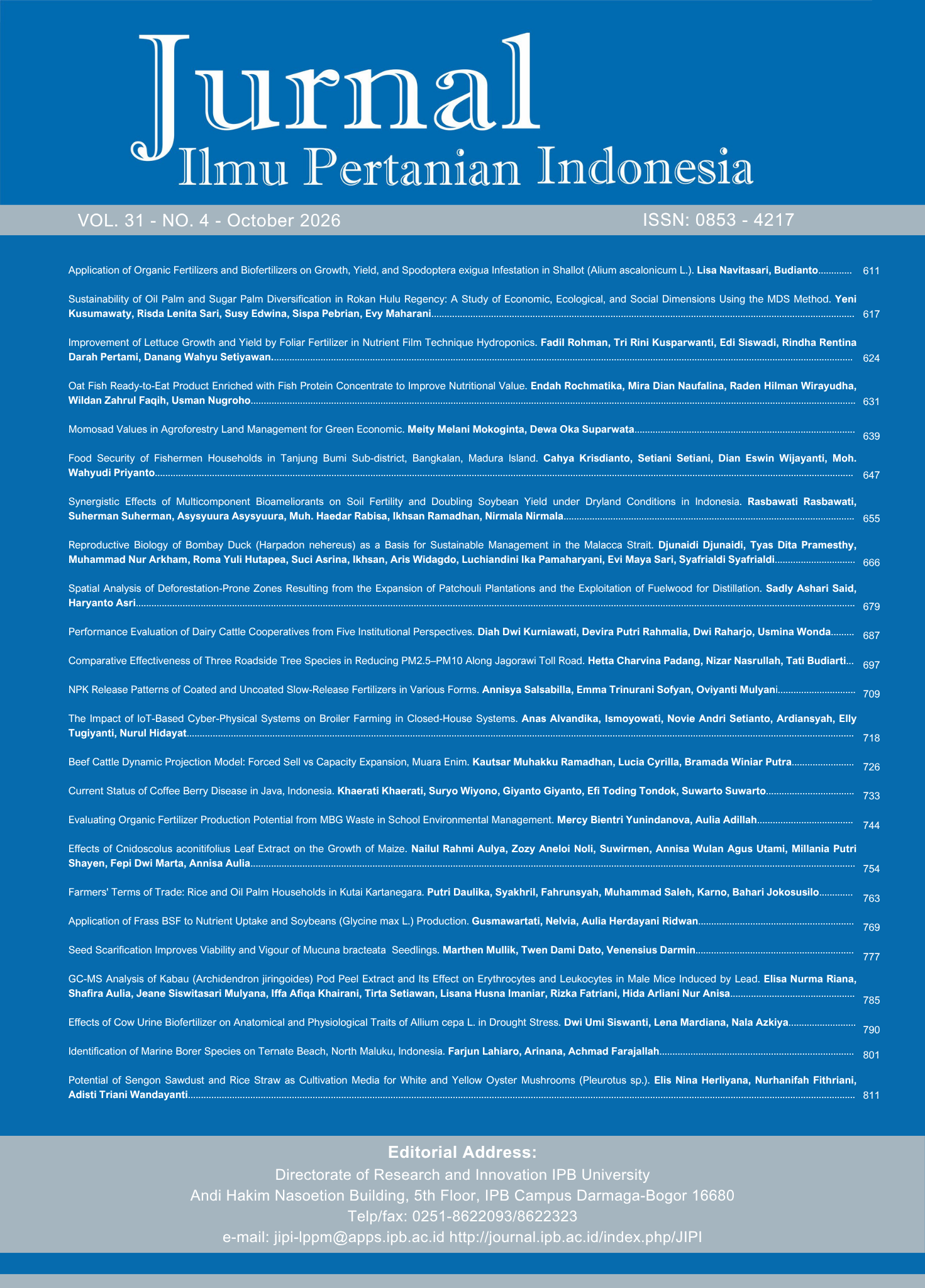
Improvement of Lettuce Growth and Yield by Foliar Fertilizer in Nutrient Film Technique Hydroponics
DOI:
https://doi.org/10.18343/jipi.31.4.624Keywords:
biomass, curly lettuce, nutrient management, plant yield, soilless cultivationAbstract
Lettuce (Lactuca sativa L.) is a popular leafy vegetable grown in hydroponic systems such as the fertilizer Film Technique (NFT) because of its excellent water and fertilizer efficiency. However, even under intense cultivation circumstances, transitory nutritional imbalance, reduced root activity, or poor nutrient absorption can impair plant growth and output. Foliar fertilization can thus be used as an additional fertilizer supply approach to improve plant performance in NFT systems. The purpose of this study was to evaluate how different foliar fertilizer concentrations affected the growth and yield of curly lettuce produced in an NFT hydroponic system. The experiment used a Completely Randomized Design (CRD) with eight different dosages of commercial foliar fertilizer (Gandasil D®: 0, 0.5, 1, 1.5, 2, 2.5, 3, and 3.5 g L⁻¹). Each experimental unit consisted of three replications and three plants. The fertilizer was applied weekly from transplanting to harvest in a greenhouse NFT system. Plant height, leaf number, leaf area, chlorophyll content, root volume, and fresh weight were among the parameters measured. Foliar fertilizer significantly increased plant height, number of leaves, leaf area, root volume, and plant fresh weight (p < 0.05), but had no significant effect on chlorophyll content. Plants performed best at 3.5 g L⁻¹, with a 105% increase in fresh weight compared to the control group. Plant fresh weight was substantially related to leaf area, number of leaves, and root volume. To boost lettuce growth and productivity in NFT hydroponic systems, apply 3.5 g of foliar fertilizer per L.
Keywords: biomass, curly lettuce, nutrient management, plant yield, soilless cultivation
Downloads
References
Alkaabi A, Almansoori E, Hebsi MAL, Aldhaheri S, Hassan FE, Ali NAA, Al Shurafa KA, Tzortzakis N, Di Gioia F, Ahmed ZFR. 2025. Vertical hydroponic lettuce: Impact of organic nutrients on antioxidant phytochemicals. Annals of Agricultural Sciences. 70(1): 100386. https://doi.org/10.1016/j.aoas.2025.100386
Carillo P, De Micco V, Ciriello M, Formisano L, El-Nakhel C, Giordano M, Colla G, Rouphael Y. 2022. Morpho-anatomical, phybiological, and mineral composition responses induced by a vegetal-based biostimulant at three rates of foliar application in greenhouse lettuce. Plants. 11(15): 2030. https://doi.org/10.3390/plants11152030
Chaski C, Petropoulos SA. 2022a. The alleviation effects of biostimulants application on lettuce plants grown under deficit irrigation. Horticulturae. 8(1089): 1–19. https://doi.org/10.3390/horticulturae8111089
Chaski C, Petropoulos SA. 2022b. The effects of biostimulant application on growth parameters of lettuce plants grown under deficit irrigation conditions. Biol. Life Sci. Forum. 16(4): 1–6. https://doi.org/10.3390/IECHo2022-12499
Chowdhury M, Samarakoon UC, Altland JE. 2024. Evaluation of hydroponic systems for organic lettuce production in controlled environment. Frontiers in Plant Science. 15: 1–12. https://doi.org/10.3389/fpls.2024.1401089
Cristofano F, El-Nakhel C, Pannico A, Giordano M, Colla G, Rouphael Y. 2021. Foliar and root applications of vegetal-derived protein hydrolysates differentially enhance the yield and qualitative attributes of two lettuce cultivars grown in floating system. Agronomy. 11(6): 1194. https://doi.org/10.3390/agronomy11061194
Dasgan HY, Yilmaz D, Zikaria K, Ikiz B, Gruda NS. 2023. Enhancing the yield, quality and antioxidant content of lettuce through innovative and eco-friendly biofertilizer practices in hydroponics. Horticulturae. 9(12): 1274. https://doi.org/10.3390/horticulturae9121274
Fragalà F, Salvagno E, La Bella E, Saccone R, Padoan E, Montoneri E, Miccichè J, Ferrarello D, Baglieri A, Puglisi I. 2024. Enhancing lettuce yield through innovative foliar spray of biopolymers derived from municipal biowastes. Plants. 13(12): 1664. https://doi.org/10.3390/plants13121664
Frassine D, Braglia R, Scuderi F, Redi EL, Valentini F, Relucenti M, Colasanti IA, Macchia A, Allegrini I, Gismondi A, Di Marco G, Canini A. 2024. Enhancing lettuce (Lactuca sativa) productivity: Foliar sprayed Fe-Alg-CaCO3 MPs as fertilizers for aquaponics cultivation. Plants. 13(23): 3416. https://doi.org/10.3390/plants13233416
Guimarães IT, De Assis Oliveira F, Leal CCP, De Lima Souza MW, Alves TRC. 2020. Foliar application of biofertilizer in semi-hydroponic lettuce fertigated with saline nutrient solution. Comunicata Scientiae. 11(e3155): 1–7. https://doi.org/10.14295/cs.v11i0.3115
Hidayat R, Suhardjono H. 2025. Growth, yield and chlorophyl content of lettuce (Lactuca sativa L.) in tower growth with different planting media compositions and types of leaf fertilizer. Nusantara Science and Technology Proceedings. 2024(47): 965–971. https://doi.org/10.11594/nstp.2025.47145
İkiz B, Dasgan HY, Balik S, Kusvuran S, Gruda NS. 2024. The use of biostimulants as a key to sustainable hydroponic lettuce farming under saline water stress. BMC Plant Biology. 24(1): 808. https://doi.org/10.1186/s12870-024-05520-8
Li C, Li Y, Yang J, Lian B, Wang J, Zou G. 2024. Regulating root structure of potted lettuce to magnify absorption from APP and UAN fertilizers. Frontiers in Plant Science. 15: 1–11. https://doi.org/10.3389/fpls.2024.1407984
Niu J, Liu C, Huang M, Liu K, Yan D. 2021. Effects of foliar fertilization: a review of current status and future perspectives. Journal of Soil Science and Plant Nutrition. 21(1): 104–118. https://doi.org/10.1007/s42729-020-00346-3
Salama DM, Osman SA, Mahmoud SH, El-Tanahy AMM, Abd El-Aziz ME. 2024. Improving the productivity and physiological characteristics of lettuce plants using spraying calcium as a nanofertilizer. Horticulturae. 10(11): 1157. https://doi.org/10.3390/horticulturae10111157
Samarakoon U, Palmer J, Ling P, Altland J. 2020. Effects of electrical conductivity, ph, and foliar application of calcium chloride on yield and tipburn of Lactuca sativa grown using the nutrient–film technique. HortScience. 55(8): 1265–1271. https://doi.org/10.21273/HORTSCI15070-20
Shaik A, Singh H, Singh S, Montague T, Sanchez J. 2022. Liquid organic fertilizer effects on growth and biomass of lettuce grown in a soilless production system. HortScience. 57(3): 447–452. https://doi.org/10.21273/HORTSCI16334-21
Souza JVN de, Menezes Filho ACP de, Ventura MVA. 2024. Initial development of Lactuca sativa (lettuce) using a biostimulant and bioactivator for hydroponic purposes. Cerrado: Agricultural and Biological Research. 2(1): 7–12. https://doi.org/10.14295/cerrado.v2i1.708
Downloads
Published
Issue
Section
License
Copyright (c) 2026 Fadil Rohman, Tri Rini Kusparwanti, Edi Siswadi, Rindha Rentina Darah Pertami, Danang Wahyu Setiyawan

This work is licensed under a Creative Commons Attribution-NonCommercial 4.0 International License.
This journal is published under the terms of the Creative Commons Attribution-NonCommercial 4.0 International License. Authors who publish with this journal agree to the following terms: Authors retain copyright and grant the journal right of first publication with the work simultaneously licensed under a Creative Commons Attribution-NonCommercial 4.0 International License. Attribution — You must give appropriate credit, provide a link to the license, and indicate if changes were made. You may do so in any reasonable manner, but not in any way that suggests the licensor endorses you or your use. NonCommercial — You may not use the material for commercial purposes.
How to Cite
























 View JIPI StatsCounter