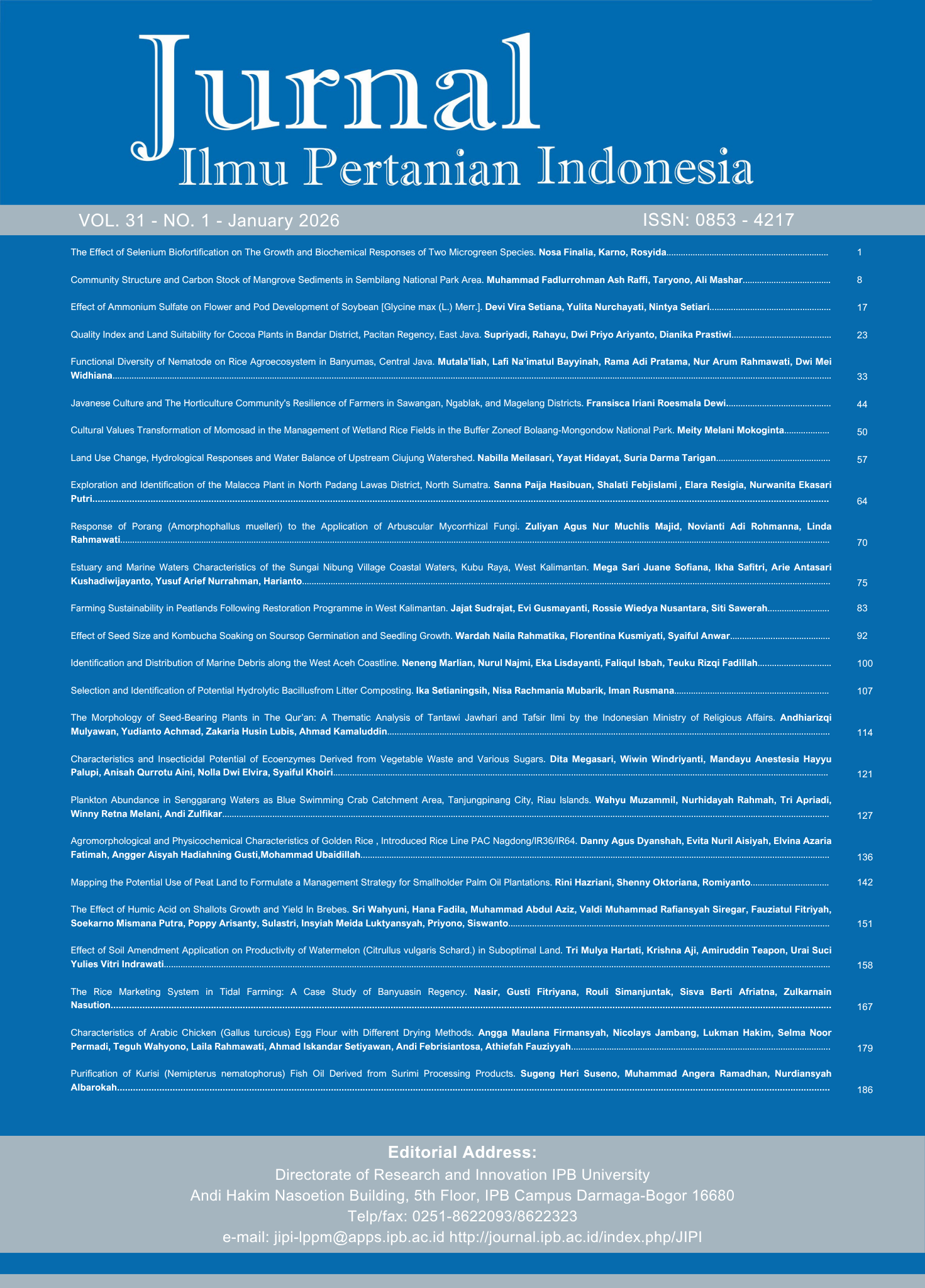
The Effect of Selenium Biofortification on The Growth and Biochemical Responses of Two Microgreen Species
DOI:
https://doi.org/10.18343/jipi.31.1.1Keywords:
biochemical, biofortification, growth, microgreens, seleniumAbstract
Microgreens are a type of vegetable crop that may be grown at a young age (7−14 days) and have a high nutritional value. Microgreens from the Brassicaceae family, such as red radish and broccoli, contain a variety of antioxidants. Selenium biofortification improves microgreen quality and selenium content. The purpose of this study was to determine the influence of selenium levels and the differences between microgreen species. This study was carried out in November−December 2023 at a housing development on Kudan Street in Semarang City, Central Java. Chlorophyll and carotenoid analyses were performed at the Plant Physiology and Breeding Laboratory, Faculty of Animal and Agricultural Sciences, the Waste Treatment Laboratory at the Faculty of Engineering conducted the phenol analysis, while the Cendekia Nanotech Hutama Chemical and Biological Analysis Laboratory in Semarang City performed the antioxidant analysis. This study utilized a randomized complete block design with a factorial pattern of 5×2 and four replications. The first factor was selenium concentration, which had five levels: 0, 2, 4, 6, and 8 mg/L. The second factor was microgreen species, which consisted of two components: red radish and broccoli microgreens. The study found that treating broccoli microgreen with selenium at a concentration of 4 mg/L increased total chlorophyll content and antioxidant capability. Broccoli outperformed red radish microgreens on all metrics.
Keywords: antioxidant, biofortification, microgreens, weight, selenium
Downloads
References
Alloggia FP, Bafumo RF, Ramirez DA, Maza MA, Camargo AB. 2023. Brassicaceae microgreens: a novel and promissory source of sustainable bioactive compounds. Current Research in Food Science. 6(100480): 1–12. https://doi.org/10.1016/j.crfs.2023.100480
Baldelli S, Lombardo M, D’Amato A, Karav S, Tripodi G, Aiello G. 2025. Glucosinolates in human health: metabolic pathways, bioavailability, and potential in chronic disease prevention. Foods. 14(6): 1–31. https://doi.org/10.3390/foods14060912
Cheng H, Li L, Dong J, Wang S, Wu S, Rao S, Li L, Cheng S, Li L. 2023. Transcriptome and physiological determin–ation reveal the effects of selenite on the growth and selenium metabolism in mung bean sprouts. Food Research International. 169: 112880. https://doi.org/10.1016/j.foodres.2023.112880
Danso OP, Asante–Badu B, Zhang Z, Song J, Wang Z, Yin X, Zhu R. 2023. Selenium biofortification: Strategies, progress and challenges. Agriculture. 13(2): 1–29. https://doi.org/10.3390/agriculture13020416
Fuente BDL, López GG, Máñez V, Alegría A, Barberá R, Cilla A. 2019. Evaluation of the bioaccessibility of antioxidant bioactive compounds and minerals of four genotypes of Brassicaceae microgreens. Foods. 8(7): 1–16. https://doi.org/10.3390/foods8070250
Gao M, He R, Shi R, Li Y, Song S, Zhang, Y, Su W, Liu H. 2021. Combination of selenium and UVA radiation affects growth and phytochemicals of broccoli microgreens. Molecules. 26(15): 1–17. https://doi.org/10.3390/molecules26154646
Germ M, Stibilj V, Šircelj H, Jerše A, Kroflič A, Golob, A, Maršić NK. 2019. Biofortification of common buckwheat microgreens and seeds with different forms of selenium and iodine. Science of Food and Agriculture. 99(9): 4353–4362. https://doi.org/10.1002/jsfa.9669
Giordano M., Petropoulos SA, Kyriacou MC, Graziani G, Zarrelli A, Rouphael, Y, El–Nakhel C. 2022. Nutritive and phytochemical composition of aromatic microgreen herbs and spices belonging to the Apiaceae family. Plants, 11(3057): 1–14. https://doi.org/10.3390/plants11223057
Gofar N, Nur TP, Permatasari SDI, Sriwahyuni N. 2022. Teknik Budidaya Microgreens. Palembang (ID): Bening Media Publ.
Gupta M, Gupta S. 2017. An overview of selenium uptake, metabolism, and toxicity in plants. Frontiers in Plant Science. 7(2074): 1–14. https://doi.org/10.3389/fpls.2016.02074
Hossain S, Skalicky M, Brestic M, Maitra S, Sarkar S, Ahmad Z, Vemuri H, Garai S, Mondal M, Bhatt R, Kumar P, Banarjee P, Saha S, Islam T, Laing AM. 2021. Selenium biofortification: Roles, mechanisms, responses and prospects. Molecules. 26(4): 1–29. https://doi.org/10.3390/molecules26040881
Islam, MZ, Park, BJ, Kang HM, Lee, YT. 2020. Influence of selenium biofortification on the bioactive compounds and antioxidant activity of wheat microgreen extract. Food Chemistry. 309: 125763. https://doi.org/10.1016/j.foodchem.2019.125763
Kusumaningrum S, Putra ETS, Waluyo S. 2016. Pengaruh konsentrasi selenium pada berbagai fase pertumbuhan tomat (Lycopersicon esculentum Mill.) sistem hidroponik terhadap kandungan likopen buah. Vegetalika. 5(4): 50–66.
Liu H, Xiao C, Qiu T, Deng J, Cheng H, Cong X, Cheng S, Rao S, Zhang Y. 2022. Selenium regulates antioxidants, photosynthesis, and cell permeability in plants under various abiotic stresses: A review. Plants. 12(1): 1–17. https://doi.org/10.3390/plants12010044
Mezeyová I, Hegedűsová A, Golian M, Andrejiová A, Šlosár M, Mezey J. 2022. Influence of microgreens biofortification with selenium on their quantitative and qualitative parameters. Agronomy. 12(5): 1–14. https://doi.org/10.3390/agronomy12051096
Naseem M, Anwar–ul–Haq M, Wang X, Farooq N, Awais M, Sattar H, El–Esawi MA. 2021. Influence of selenium on growth, physiology, and antioxidant responses in maize varies in a dose–dependent manner. Food Quality. 1(6642018): 1–9. https://doi.org/10.1155/2021/6642018
Pannico A, El–Nakhel C, Graziani G, Kyriacou MC, Giordano M, Soteriou GA, Zarelli A, Ritieni A, Pascale SD, Rouphael Y. 2020. Selenium biofortification impacts nutritive value, polyphenolic content, and bioactive constitution of variable microgreens genotypes. Antioxidants. 9(4): 1–21. https://doi.org/10.3390/antiox9040272
Portales VM, Martín SMJ, Llugany M, Boada R, Valiente M. 2024. Selenium biofortification of microgreens: Influence on phytochemicals, pigments and nutrients. Plant Physiology and Biochemistry. 206(108283): 1–8. https://doi.org/10.1016/j.plaphy.2023.108283
Poudel P, DiGioia F, Lambert JD, Connolly EL. 2023. Zinc biofortification through seed nutri–priming using alternative zinc sources and concentration levels in pea and sunflower microgreens. Frontiers in Plant Science. 14(1177844): 1–16. https://doi.org/10.3389/fpls.2023.1177844
Puccinelli M, Malorgio, Rosellini I, Pezzarossa B. 2019. Production of selenium‐biofortified microgreens from selenium‐enriched seeds of basil. Science of Food and Agriculture. 99(12): 5601–5605.
Puccinelli M, Pezzarossa B, Pintimalli L, Malorgio F. 2021. Selenium biofortification of three wild species, Rumex acetosa L., Plantago coronopus L., and Portulaca oleracea L., grown as microgreens. Agronomy. 11(6): 1–15. https://doi.org/10.1002/jsfa.9826
Puccinelli M, Malorgio F, Incrocci L, Rosellini I, Pezzarossa B. 2021. Effects of individual and simultaneous selenium and iodine biofortification of baby–leaf lettuce plants grown in two different hydroponic systems. Horticulturae. 7(12): 1–16. https://doi.org/10.3390/agronomy11061155
Roriz M, Carvalho SM, Castro PM, Vasconcelos MW. 2020. Legume biofortification and the role of plant growth–promoting bacteria in a sustainable agricultural era. Agronomy. 10(3): 1–13. https://doi.org/10.3390/agronomy10030435
Tenesaca MMG, Llugany M, Boada R, Sánchez–Martín MJ, Valiente M. 2024. Phytochemical profile, bioactive properties, and se speciation of se–biofortified red radish (Raphanus sativus), green pea (Pisum sativum), and alfalfa (Medicago sativa) microgreens. Agricultural and Food Chemistry. 72(9): 4947–4957. https://doi.org/10.1021/acs.jafc.3c08441
Thuong VT, Minh GH. 2020. Effects of growing substrates and seed density on yield and quality of radish microgreens. Research on Crops. 21(3): 579–586. https://doi.org/10.31830/2348-7542.2020.091
Turner ER, Luo Y, Buchanan RL. 2020. Microgreen nutrition, food safety, and shelf life: A review. Food Science. 85(4): 870–882. https://doi.org/10.1111/1750-3841.15049
Vicas SI, Cavalu S, Laslo V, Tocai M, Costea TO, Moldovan L. 2019. Growth, photosynthetic pigments, phenolic, glucosinolates content and antioxidant capacity of broccoli sprouts in response to nanoselenium particles supply. Notulae Botanicae Horti Agrobotanici Cluj–Napoca. 47(3): 821–828. https://doi.org/10.15835/nbha47311490
Wang P, Chen B, Huang Y, Li J, Cao D, Chen Z, Li J, Ran B, Yang J, Wang R, Wei Q, Dong D, Liu L. 2023. Selenium intake and multiple health–related outcomes: an umbrella review of meta–analyses. Frontiers in Nutrition. 10(1263853): 1–16. https://doi.org/10.3389/fnut.2023.1263853
Woch W, Nowak BH. 2019. Selected antioxidant properties of alfalfa, radish, and white mustard sprouts biofortified with selenium. Acta Agrobotanica. 72(2): 1–11. https://doi.org/10.5586/aa.1768
Wu Q, Wang J, Huang H, Mao S, Wu Q, Huang K. 2022. Exogenous selenium treatment promotes glucosinolate and glucoraphanin accumulation in broccoli by activating their biosynthesis and transport pathways. Applied Sciences. 12(9): 1–15. https://doi.org/10.3390/app12094101
Xiao Z, Rausch SR, Luo Y, Sun J, Yu L, Wang Q, Chen P, Yu L, Stommel JR. 2019. Microgreens of Brassicaceae: Genetic diversity of phytochemical concentrations and antioxidant capacity. LWT-Food Science and Technology. 101: 731–737. https://doi.org/10.1016/j.lwt.2018.10.076
Yadav LP, Koley TK, Tripathi A, Singh S. 2018. Antioxidant potentiality and mineral content of summer season leafy greens: Comparison at mature and microgreen stages using chemometric. Spring Nature. 8(2): 165–175. https://doi.org/10.1007/s40003-018-0378-7
Zhou X, Rao S, Wrightstone E, Sun T, Lui ACW, Welsch R, Li L. 2022. Phytoene synthase: The key rate–limiting enzyme of carotenoid biosynthesis in plants. Frontiers in Plant Science. 13(884720): 1–9. https://doi.org/10.3389/fpls.2022.884720
Downloads
Published
Issue
Section
License
Copyright (c) 2025 Nosa Finalia

This work is licensed under a Creative Commons Attribution-NonCommercial 4.0 International License.
This journal is published under the terms of the Creative Commons Attribution-NonCommercial 4.0 International License. Authors who publish with this journal agree to the following terms: Authors retain copyright and grant the journal right of first publication with the work simultaneously licensed under a Creative Commons Attribution-NonCommercial 4.0 International License. Attribution — You must give appropriate credit, provide a link to the license, and indicate if changes were made. You may do so in any reasonable manner, but not in any way that suggests the licensor endorses you or your use. NonCommercial — You may not use the material for commercial purposes.
How to Cite
























 View JIPI StatsCounter