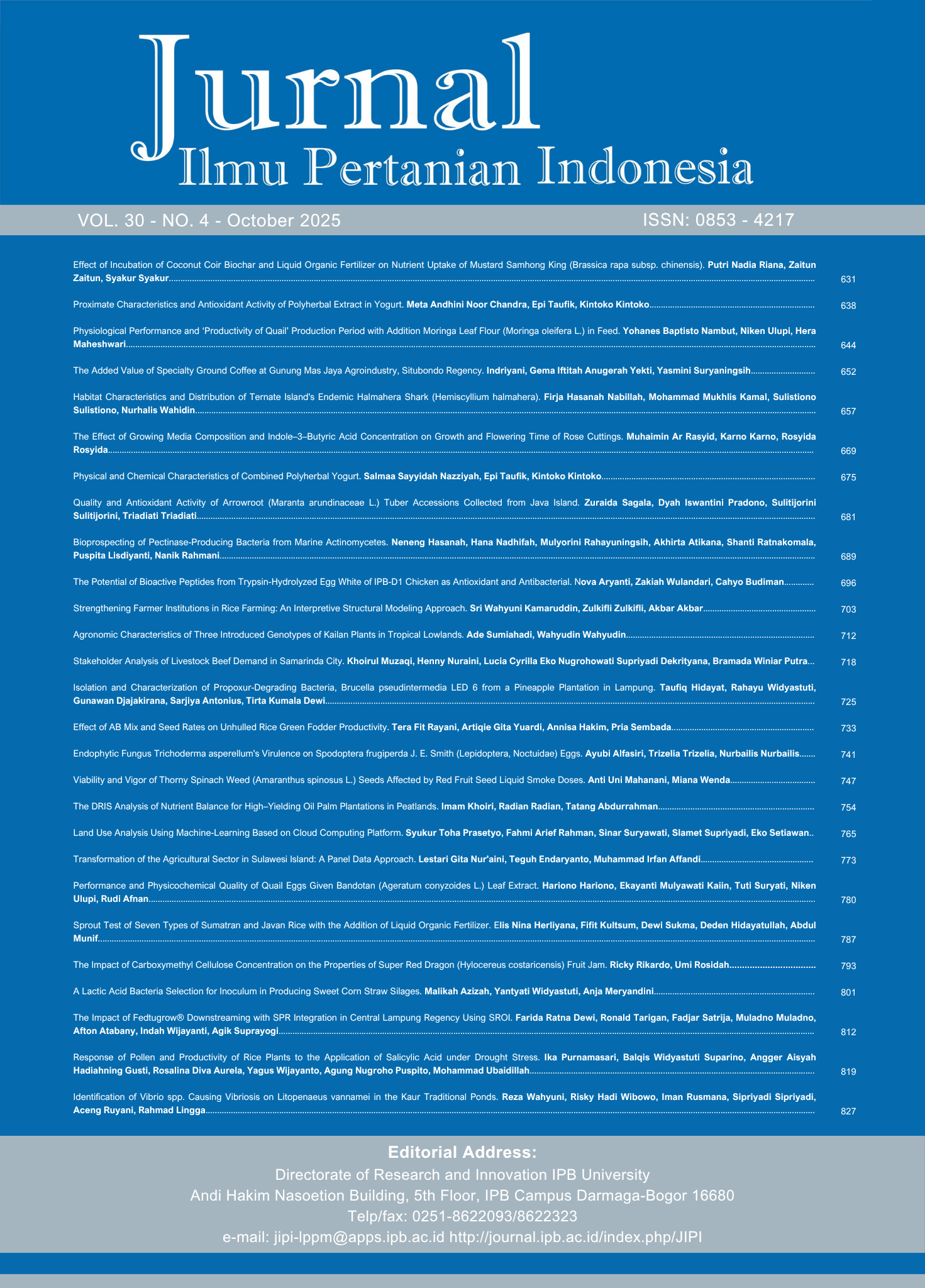
Isolation and Characterization of Propoxur-Degrading Bacteria, Brucella pseudintermedia LED 6 from a Pineapple Plantation in Lampung
DOI:
https://doi.org/10.18343/jipi.30.4.725Abstract
Propoxur is a non-systemic carbamate insecticide that is widely used in Indonesia to control insect pests. However, its persistence and toxicity pose environmental concerns. Bioremediation with bacteria is a viable method for mitigating the detrimental effects of propoxur residues. The goal of this work was to isolate and characterize bacterial strains that can degrade propoxur. Isolation by enrichment culture procedures, utilizing propoxur as the sole carbon source. The isolates' morphological and physiological features were examined, and their degradation potential was determined. Six bacterial samples were isolated from a pineapple plantation in Lampung, Indonesia, and one strain, known as LED 6, showed great potential for propoxur breakdown. Molecular identification with 16S rRNA gene sequencing identified the isolate as Brucella pseudintermedia. Growth characterisation revealed that the isolate performed best at 28 °C and pH 7. After 72 hours of incubation with 500 ppm propoxur, LED 6 had deteriorated around 26% of the starting concentration.
Keywords: bioremediation, Brucella pseudintermedia, pineapple, propoxur
Downloads
References
[WHO] World Health Organization. 1999. Technical Propoxur. WHO/SIT/30.R4. Geneva: WHO.
[WHO] World Health Organization. 2005. WHO Specifications and Evaluations for Public Health Pesticides: Propoxur. Geneva (CH): WHO.
Ainiyah RK, Wahyunindita V, Pratama WN, Pratiwi IA, Utami ESW, Hariyanto S. 2020. DNA barcoding: Study of bananas (Musa spp.) wild and cultivars group from East Java inferred by RBCL gene sequences. Ecology Environment Conservation. 26: S7–S13.
Alexander M. 1994. Biodegradation and Bioremediation. California (CA): Academic Press.
Al-Mur BA, Pugazhendi A, Jamal MT. 2021. Application of integrated extremophilic (halo-alkalo-thermophilic) bacterial consortium in the degradation of petroleum hydrocarbons and treatment of petroleum refinery wastewater under extreme conditions. Journal of Hazardous Materials. 413: 125351. https://doi.org/10.1016/j.jhazmat.2021.125351
Ananda A. 2012. Isolation, selection, identification, and ability of soil bacterial isolates to degrade propoxur (2–isopropoxyphenyl–N–methylcarbamate) [master’s thesis]. Depok (ID): University of Indonesia.
Anusha J, Kavitha PK, Louella CG, Chetan DM, and Rao CV. 2009. A study on biodegradation of propoxur by bacteria isolated from municipal solid waste. International Journal of Biotechnology Applications. 1(2): 26–31. https://doi.org/10.9735/0975-2943.1.2.26-31
Bartha R, Lanzilotta RP, Pramer D. 1967. Stability and effects of some pesticides in soil. Applied Microbiology. 15(1):67–75. https://doi.org/10.1128/AM
Dewi TK, Imamuddin H, Antonius S. 2015. Study of propoxur-degrading bacteria isolated from various sampling sites of rice fields in Ngawi. Knowledge E Life Sciences. 2: 658–661. https://doi.org/10.18502/kls.v2i1.241
Dharmayanti I. 2011. Molecular phylogenetics: a method of taxonomy of organisms based on evolutionary history. Wartazoa. 21(1): 1–10. https://doi.org/10.14334/wartazoa.v30i1.2469
Fahmy MAH, Fukuto TR, Myers RO, March RB. 1970. The selective toxicity of new N–phosphorothioylcarbamate esters. Journal of Agricultural and Food Chemistry. 18: 793–796. https://doi.org/10.1021/jf60171a014
Felsenstein J. 1985. Confidence limits on phylogenies: an approach using the bootstrap. Evolution. 39: 783–791. https://doi.org/10.1111/j.1558-5646.1985.tb00420.x
Hasegawa M, Kishino H, Saitou N. 1991. On the maximum likelihood method in molecular phylogenetics. Journal of Molecular Biology and Evolution. 32: 443–445. https://doi.org/10.1007/BF02101285
Hikmawati F, Susilowati A, Setyaningsih R. 2019. Detection of the number and pathogenicity test of Vibrio spp. in green mussels (Perna viridis) in the coastal tourism area of Yogyakarta. In: Setyawan AD, Sugiyarto, Pitoyo A, Widiastuti A, Windarsih G, Supatmi, editors. Proceedings of the National Seminar of the Indonesian Biodiversity Society; 2018 Nov 3; Surakarta, Indonesia. Surakarta (ID): Sebelas Maret University. p 334–339.
Hillis DM, Bull JJ. 1993. An empirical test of bootstrapping as a method for assessing confidence in phylogenetic analysis. Systematic Biology. 42(2):182–192. https://doi.org/10.1093/sysbio/42.2.182
Hussain S, Siddique T, Arshad M, Saleem M. 2009. Bioremediation and phytoremediation of pesticides. Environment Science and Technology. 39(10): 843–907. https://doi.org/10.1080/10643380801910090
Imamuddin H, Dewi TK, Antonius S. 2015. Isolation and screening of rhizobacteria from soil in Ngawi, East Java, as candidates for agents for liquid organic fertilizer production. Nusantara Bioscience. 7(2): 107–111. https://doi.org/10.13057/nusbiosci/n070208
Jae HP, Eun SC, Yousun K, Myung SH, Jin HH, Won JL. 2014. Exposure to dichlorodiphenyltrichloroethane and the risk of breast cancer: A systematic review and meta-analysis. Osong Public Health Research Perspectives. 5(2): 77–84. https://doi.org/10.1016/j.phrp.2014.02.001
Kamanavalli CM, Ninnekar HZ. 2000. Biodegradation of propoxur by Pseudomonas species. World Journal of Microbiology and Biotechnology. 16(4): 329–331. https://doi.org/10.1023/A:1008944410676
Kim H, Kim DU, Lee H, Yun J, Ka JO. 2017. Syntrophic biodegradation of propoxur by Pseudaminobacter sp. Sp1a and Nocardioides sp. Sp1b isolated from agricultural soil. International Biodeterioration and Biodegradation. 118: 1–9. https://doi.org/10.1016/j.ibiod.2017.01.024
Krechniak J, Foss W. 1982. Cholinesterase activity in rats treated with propoxur. Bulletin of Enviromental Contamination and Toxicology. 29 (5): 599–604. https://doi.org/10.1007/BF01669627
Kress WJ, Prince LM, Williams KJ. 2002. The phylogeny and a new classification of the gingers (Zingiberaceae): evidence from molecular data. American Journal of Botany. 89(10):1682–1696. https://doi.org/10.3732/ajb.92.1.167
Kuseske, DW, Funke BR, Schulz JT. 1974. Effect and persistence of Baygon (propoxur) and Temik (aldicarb) insecticides in soil. Plant and Soil. 41(2): 255–269. https://doi.org/10.1007/BF00017253
Kyrpides NC, Hugenholtz P, Elsen JA, Woyke T, Goker M, et al. 2014. Genomic encyclopedia of bacteria and archaea: sequencing a myriad of type strains. PloS Biology. 12(8): e1001920. https://doi.org/10.1371/journal.pbio.1001920
Lapage SP, Sneath PHA, Lessel EF, Skerman VBD, Seeliger HPR. 1990. International Code of Nomenclature of Bacteria. Washington (WA): ASM Pr.
Leja K, Lewandowicz G. 2010. Polymer biodegradation and biodegradable polymers—a review. Polish Journal of Environmental Studies. 19: 255–266.
Masotti F, Garavaglia BS, Piazza A, Burdisso P, Altabe S, Gotting N, Ottado J. 2021. Bacterial isolates from Argentine pampas and their ability to degrade glyphosate. Science of Total Environment. 774(2021): 145761. https://doi.org/10.1016/j.scitotenv.2021.145761.
Newell PD, Fricker AD, Roco CA, Chandrangsu P, Merkel SM. 2013. A small group activity introducing the use and interpretation of BLAST. Journal of Microbiology and Biology Education. 14(2):238–243. https://doi.org/10.1128/jmbe.v14i2.637
Oktafiyanto MF, Munif A, Mutaqin KH. 2018. Antagonistic activity of endophytic bacteria from mangroves against Ralstonia solanacearum and Meloidogyne spp. Journal of Indonesian Phytopathology. 14(1):23–29. https://doi.org/10.14692/jfi.14.1.23
Ou LT, Nkedi KP, Cisar JL, Snyder GH. 1992. Microbial degradation of propoxur in turfgrass soil. Journal of Environmental Science and Health, Part B: Pesticides, Food Contaminants, and Agricultural Wastes. 27(5): 545–564. https://doi.org/10.1080/03601239209372800
Park HD, Ka JO. 2003. Genetic and phenotypic diversity of dichlorprop–degrading bacteria isolated from soils. The Journal of Microbiology. 41(1): 7–15.
Paul D, Sinha SN. 2017. Isolation and characterization of phosphate-solubilizing bacterium Pseudomonas aeruginosa KUPSB12 with antibacterial potential from the River Ganga, India. Annals of Agrarian Science. 15(1): 10–136. https://doi.org/10.1016/j.aasci.2016.10.001
Sahlan AQ, Kusdiyantini E, Pujiyanto S, Antonius S. 2014. Isolation and characterization of agricultural land bacterial consortium isolates as potential propoxur pesticide degradation agents. Academic Journal of Biology. 3(3): 33–38.
Shin DH, Kim DU, Seong CN, Song HG, Ka JO. 2012. Genetic and phenotypic diversity of carbofuran-degrading bacteria isolated from agricultural soils. Journal of Microbiology and Biotechnology. 22(4): 448–456. https://doi.org/10.4014/jmb.1108.08087
Sun L, Lee HK. 2003. Stability studies of propoxur herbicide in environmental water samples by liquid chromatography–atmospheric pressure chemical ionization ion–trap mass spectrometry. Journal of Chromatography. 1014: 153–163. https://doi.org/10.1016/s0021–9673(03)00850–1.
Tamura K, Stecher G, Peterson D, Filipski A, Kumar S. 2013. MEGA6: Molecular evolutionary genetics analysis version 6.0. Molecular Biology and Evolution. 30(12): 2725–2729. https://doi.org/10.1093/molbev/mst197
Teng Z, Chen Z, Zhang Q, Yao Y, Song M, Li M. 2019. Isolation and characterization of phosphate-solubilizing bacteria from rhizosphere soils of the Yeyahu Wetland in Beijing, China. Environmental Science and Pollution Research. 26(33): 33976–33987. https://doi.org/10.1007/s11356-018-2955-5
Teyssier C, Marchandin H, Jean–Pierre H, Masnou A, Dusart G, Jumas–Bilak E. 2007. Ochrobactrum pseudintermedium sp. nov.: A novel member of the family Brucellaceae, isolated from human clinical samples. International Journal of Systematic and Evolutionary Microbiology. 57(5): 1007–1013. https://doi.org/10.1099/ijs.0.64416-0
Thompson JD, Gibson TJ, Plewniak F, Jeanmougin F, Higgins DG. 1997. The CLUSTAL_X windows interface offers flexible strategies for multiple sequence alignment aided by quality analysis tools. Nucleic Acids Research. 25(24): 4876–4882. https://doi.org/10.1093/nar/25.24.4876
Thomson WT. 1985. Agricultural Chemicals: Book 1 Insecticides. Fresno (CA): Thomson Publ.
Topp E, Hanson RS, Ringelberg DB, White DC, Wheatcroft R. 1993. Isolation and characterization of an N-methylcarbamate insecticide-degrading methylotrophic bacterium. Applied and Environmental Microbiology. 59(10): 3339–3349. https://doi.org/10.1128/aem.59.10.3339-3349.1993
Verma S, Singh D, Chatterjee S. 2021. Malathion biodegradation by a psychrotolerant bacteria Ochrobactrum sp. M1D, and metabolic pathway analysis. Letters in Applied Microbiology. 73(3): 326–335. https://doi.org/10.1111/lam.13517
Yadav CS, Kumar V, Suke SG, Ahmed RS, Mediratta PK, Banerjee BD. 2010. Propoxur-induced acetylcholinesteraseinhibition and impairment of cognitive function: Attenuation by Withania somnifera. Indian Journal of Biochemistry and Biophysics. 47(2): 117–120.
Yadav S, Khan MA, Sharma R, Malik A, Sharma S. 2021. Potential of formulated Dyadobacter jiangsuensis strain 12851 for enhanced bioremediation of chlorpyrifos-contaminated soil. Ecotoxicology and Environmental Safety. 213: 1–7. https://doi.org/10.1016/j.ecoenv.2021.112039.
Weisburg WG, Barns SM, Pelletier DA, Lane DJ. 1991. 16S ribosomal DNA amplification for phylogenetic study. Journal of Bacteriology. 173(2): 697–703. https://doi.org/10.1128/jb.173.2.697–703.1991.
Downloads
Published
Versions
- 2025-09-08 (2)
- 2025-08-08 (1)
Issue
Section
License

This work is licensed under a Creative Commons Attribution-NonCommercial 4.0 International License.
This journal is published under the terms of the Creative Commons Attribution-NonCommercial 4.0 International License. Authors who publish with this journal agree to the following terms: Authors retain copyright and grant the journal right of first publication with the work simultaneously licensed under a Creative Commons Attribution-NonCommercial 4.0 International License. Attribution — You must give appropriate credit, provide a link to the license, and indicate if changes were made. You may do so in any reasonable manner, but not in any way that suggests the licensor endorses you or your use. NonCommercial — You may not use the material for commercial purposes.
How to Cite

























 View JIPI StatsCounter