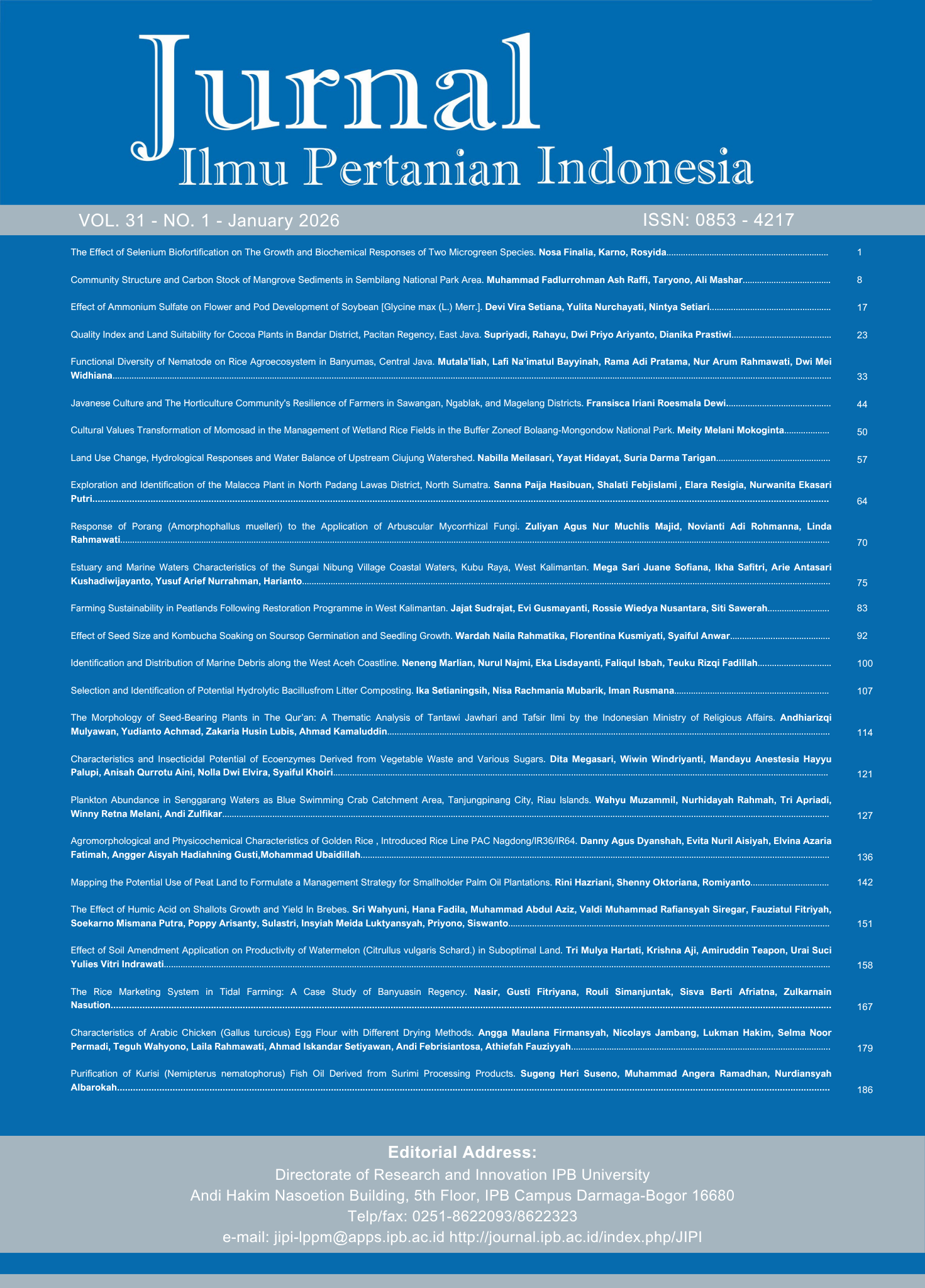
Farming Sustainability in Peatlands Following Restoration Programme in West Kalimantan
DOI:
https://doi.org/10.18343/jipi.31.1.83Keywords:
carbon rescue, farming, peatland restoration, rewettingAbstract
The Indonesian government's peat restoration program, which began in 2016, is alleged to have an impact on the sustainability of peatland farming, because rewetting has the potential to cause waterlogging, limiting the crop commodities that can be cultivated. This project will look at the viability of small-scale farming on restored peatlands. To fulfill the study's objectives, we used a combination of quantitative and qualitative methods. The quantitative technique included an analysis of agricultural income to determine the economic sustainability, whereas the qualitative approach explains social sustainability. The environmental sustainability was assessed using the carbon rescue acquired after rewetting. The findings revealed that rewetting had little effect on the income from vegetable and fruit crops. The farming income, which remains relatively high, demonstrates that farming's economic sustainability is viable. Similarly, the social dimension does not detract from the sustainability aspect, because the rewetting of the land did not significantly alter the social structures and institutions that had been built in the farmer's community. Meanwhile, from an environmental standpoint, the impact of rewetting is quite favorable, as every 1 cm increase in water table level has the potential to conserve at least 0.71 tons of CO2 per acre per year, or around IDR 13,888−26,993.
Keywords: carbon rescue, farming, peatland restoration, rewetting
Downloads
References
Abebe GK, Bijman J, Royer A. 2016. Are middlemen facilitators or barriers to improve smallholders’ welfare in rural economies? Empirical evidence from Ethiopia. Journal of Rural Studies. 43: 203–213. https://doi.org/10.1016/j.jrurstud.2015.12.004.
Afriyanti, Syarif M, Achnopha. 2021. Evaluasi tinggi muka air tanah gambut pada lahan pasca terbakar di areal Hutan Lindung Gambut Londerang Kabupaten Tanjung Jabung Timur. Jurnal Agroecotania. 4(2): 29–40. https://doi.org/10.22437/agroecotania.v4i2.20439
Agus F. 2007. Cadangan, emisi, dan konservasi pada lahan gambut. Bunga Rampai Konservasi Tanah dan Air. Pengurus Pusat Konservasi Tanah dan Air Indonesia 2004–2007. https://balittanah.litbang.pertanian.go.id/ind/dokumentasi/lainnya/buku%20bunga%20rampai%20kta%2012–07%20(fahmuddin_agus).pdf.
Agus F, Henson I, Sahardjo BH, Harris N, van Noordwijk M, Killeen T. 2013. Review of emission factors for assessment of CO2 emission from land use change to oil palm in Southeast Asia. http://www.rspo.org/file/GHGWG2/3_review_of_emission_factors_Agus_et_al.pdf.
Antang EU, Supriati L, Jaya A, Gunawan H. 2021. Pengembangan usahatani masyarakat dalam upaya restorasi lahan gambut di Kampung Misik, Kalimantan Tengah. Jurnal Pengabdian Kampus. 8(1): 43–51. https://doi.org/10.52850/jpmupr.v8i1.3978
Arifudin, Syahza A, Kozan O, Mizuno K, Mizuno K, Isnaini ZL, Iskandar W, Hadi, Asnawi, Natasya AA, Hasrullah. 2018. Dinamika penggunaan, kebakaran, dan upaya restorasi lahan gambut: Studi kasus di Desa Tanjung Leban, Bengkalis. Seminar Nasional Pembangunan Pertanian dan Pedesaan di Pekanbaru. Unri Conference Series: Agriculture and Food Security. 1: 40–45. https://doi.org/10.31258/unricsagr.1a6
Carlson KM, Goodman LK, May-Tobin CC. 2015. Modeling relationships between water table depth and peat soil carbon loss in Southeast Asian plantations. Environmental Research Letters. 10(7): 074006. https://doi.org/10.1088/1748-9326/10/7/074006
Daum T, Baudron F, Birner R, Qaim M, Grass I. 2023. Addressing agricultural labour issues is key to biodiversity smart-farming. Biological Corservation. 284(Aug): 110165−2023. https://doi.org/10.1016/j.biocon.2023.110165
Fauzi A. 2019. Teknik Analisis Keberlanjutan. Jakarta (ID): Gramedia Pustaka Utama.
Ferrol-Schulte D, Ferse SCA, Glaser M. 2014. Patron–client relationships, livelihoods and natural resource management in tropical coastal communities. Ocean & Coastal Management. 100(Nov): 63–73. https://doi.org/10.1016/j.ocecoaman.2014.07.016
Gusmayanti E, Nusantara RW, Sudrajat J. 2023. Fluktuasi muka air tanah lahan pertanian skala kecil di desa penerima Program Restorasi Gambut Kabupaten Kubu Raya, Kalimantan Barat. Jurnal Ilmu Lingkungan. 22(1): 20–27. https://doi.org/10.14710/jil.22.1.20-27
Hooijer A, Page S, Canadell JG, Silvius M, Kwadijk J, Wösten H, Jauhiainen J. 2010. Current and future CO2 emissions from drained peatlands in Southeast Asia. Biogeosciences. 7(5): 1505–1514. https://doi.org/10.5194/bg-7-1505-2010
Ishikura, Kiwamu, Hirata R, Hirano T, Okimoto Y, Wong GX, Melling L, Aeries EB, Kiew F, San LK, Musin KK, Waili JW, Ishii Y. 2019. Carbon dioxide and methane emissions from peat soil in an undrained tropical peat swamp forest. Ecosystems. 22(8): 1852–1868. https://doi.org/10.1007/s10021-019-00376-8
Jaenicke J, Rieley JO, Mott C, Kimman P, Siegert F. 2008. Determination of the amount of carbon stored in Indonesian peatlands. Geoderma. 147(3-4): 151–158. https://doi.org/10.1016/j.geoderma.2008.08.008
Khasanah N, Noordwijk MV. 2019. Subsidence and carbon dioxide emissions in a smallholder peatland mosaic in Sumatra, Indonesia. Mitigation and Adaptation Strategies for Global Change. 24(1): 147–163. https://doi.org/10.1007/s11027-018-9803-2
Kune SJ, Nubatonis A, Sipayung BP, Mambur YPV. 2021. Pengambilan keputusan dan preferensi petani menggunakan pupuk subsidi di kecamatan sentra padi Kabupaten Timor Tengah Utara (Studi kasus Kecamatan Biboki Anleu). Agrimor: Jurnal Agribisnis Lahan Kering. 6(4): 194–202. https://doi.org/10.32938/ag.v6i4.1497
Maizaldi, Amin B, Samiaji J. 2019. Estimasi jumlah stok karbon yang tersimpan di lahan basah Desa Sungai Tohor Kecamatan Tebing Tinggi Timur Kabupaten Kepulauan Maranti Provinsi Riau. Dinamika Lingkungan Indonesia. 6(2): 60–66. https://doi.org/10.31258/dli.6.2.p.60-66
Malta. 2011. Kompetensi petani jagung dalam berusahatani di lahan gambut (Kasus petani jagung di lahan gambut di Desa Limbung Kabupaten Pontianak Kalimantan Barat. Jurnal Bumi Lestari. 11(2): 276 –285. https://doi.org/10.20885/unisia.vol33.iss75.art3
Mamat HS, Nurida NL, Irawan, Sukarman, Mulyani A, Fitriani M, Saleh A, Las I. 2014. Potensi usahatani berkelanjutan di Lahan gambut terdegradasi: Analisis sosial ekonomi dan lingkungan. In: Prosiding Seminar Nasional Pengelolaan Berkelanjutan Lahan Gambut Terdegradasi untuk Mitigasi Emisi GRK dan Peningkatan Nilai Ekonomi. Badan Penelitian dan Pengembangan Pertanian Kementerian Pertanian, Jakarta, 18–19 Aug 2014.
Maswar. 2011. Kajian cadangan karbon pada lahan gambut tropika yang didrainase untuk tanaman tahunan [thesis]. Bogor (ID): Sekolah Pascasarjana Institut Pertanian Bogor.
Nusantara WR, Manurung R, Lestari U, Padagi S. 2023. Dampak sekat kanal terhadap fluktuasi muka air tanah pada lahan gambut di Kabupaten Kubu Raya, Provinsi Kalimantan Barat. Jurnal Ilmu Lingkungan. 21(2): 393–402. doi:10.14710/jil. 21.2.393–402.
Pangaribuan N. 2019. Restorasi lahan gambut untuk mencegah bencana ekosistem global. In: Prosiding Seminar Nasional Peran Sains dan Teknologi dalam Kebencanaan. Universitas Terbuka, Tangerang-Banten, 3 Oct 2019.
Prayitno W, Saam Z, Nurhidayah T. 2014. Hubungan pengetahuan, persepsi dan perilaku petani dalam penggunaan pestisida pada lingkungan di Kelurahan Maharatu Kota Pekanbaru. Jurnal Kajian Lingkungan. 2(2): 220–237.
Putra WE, Ishak A, Rokhani. 2018. Analisis usahatani pola tanam sayuran pada lahan gambut. In: Prosiding Seminar Nasional Pembangunan Pertanian dan Peran Pendidikan Tinggi Agribisnis. Jember (ID): Fakultas Pertanian Universitas Jember, 3 Nov. 2018.
Ranjan R. 2017. Challenges to farm produce marketing: A model of bargaining between farmers and middlemen under risk. Journal of Agricultural and Resource Economics. 42(3): 386–405. https://doi.org/10.22004/ag.econ.264068.
Reimers M, Klasen S. 2013. Revisiting the role of education for agricultural productivity. American Journal of Agricultural Economics. 95(1): 131–152. https://doi.org/10.1093/ajae/aas118
Sandika AL. 2011. Impact of middlemen on vegetable marketing channels in Sri Lanka. Tropical Agricultural Research and Extension. 14(3): 58–62. https://doi.org/10.4038/tare.v14i3.4843
Sebrennikov D, Thorne F, Kallas Z, McCarthy SN. 2020. Factors influencing adoption of sustainable farming practices in europe: A systemic review of empirical literature. Sustainability. 12(22): 9719.
https://doi.org/10.3390/su12229719
Subejo. 2009. Characteristic and Function of Labor Institutions in Rural Java: A Case Study in Yogyakarta Province. Journal of International Society for Southeast Asian Agricultural Sciencies (ISSAAS). 15(1): 101–117.
Sudrajat J, Isytar I, Arifin N. 2021. Farmers' perception and engagement with the role of middlemen: A case study of the vegetable farmers. Makara Human Behavior Studies in Asia. 25(1): 45–54. https://doi.org/10.7454/hubs.asia.1070220
Sudrajat J, Mulyo JH, Hartono S, Subejo. 2015. Peranan social capital dalam memelihara keberlanjutan agribisnis jagung. Masyarakat, Kebudayaan dan Politik. 28(3): 139–152. https://doi.org/10.20473/mkp.V28I32015.139-152
Downloads
Published
Issue
Section
License
Copyright (c) 2025 Jajat Sudrajat

This work is licensed under a Creative Commons Attribution-NonCommercial 4.0 International License.
This journal is published under the terms of the Creative Commons Attribution-NonCommercial 4.0 International License. Authors who publish with this journal agree to the following terms: Authors retain copyright and grant the journal right of first publication with the work simultaneously licensed under a Creative Commons Attribution-NonCommercial 4.0 International License. Attribution — You must give appropriate credit, provide a link to the license, and indicate if changes were made. You may do so in any reasonable manner, but not in any way that suggests the licensor endorses you or your use. NonCommercial — You may not use the material for commercial purposes.
How to Cite

























 View JIPI StatsCounter