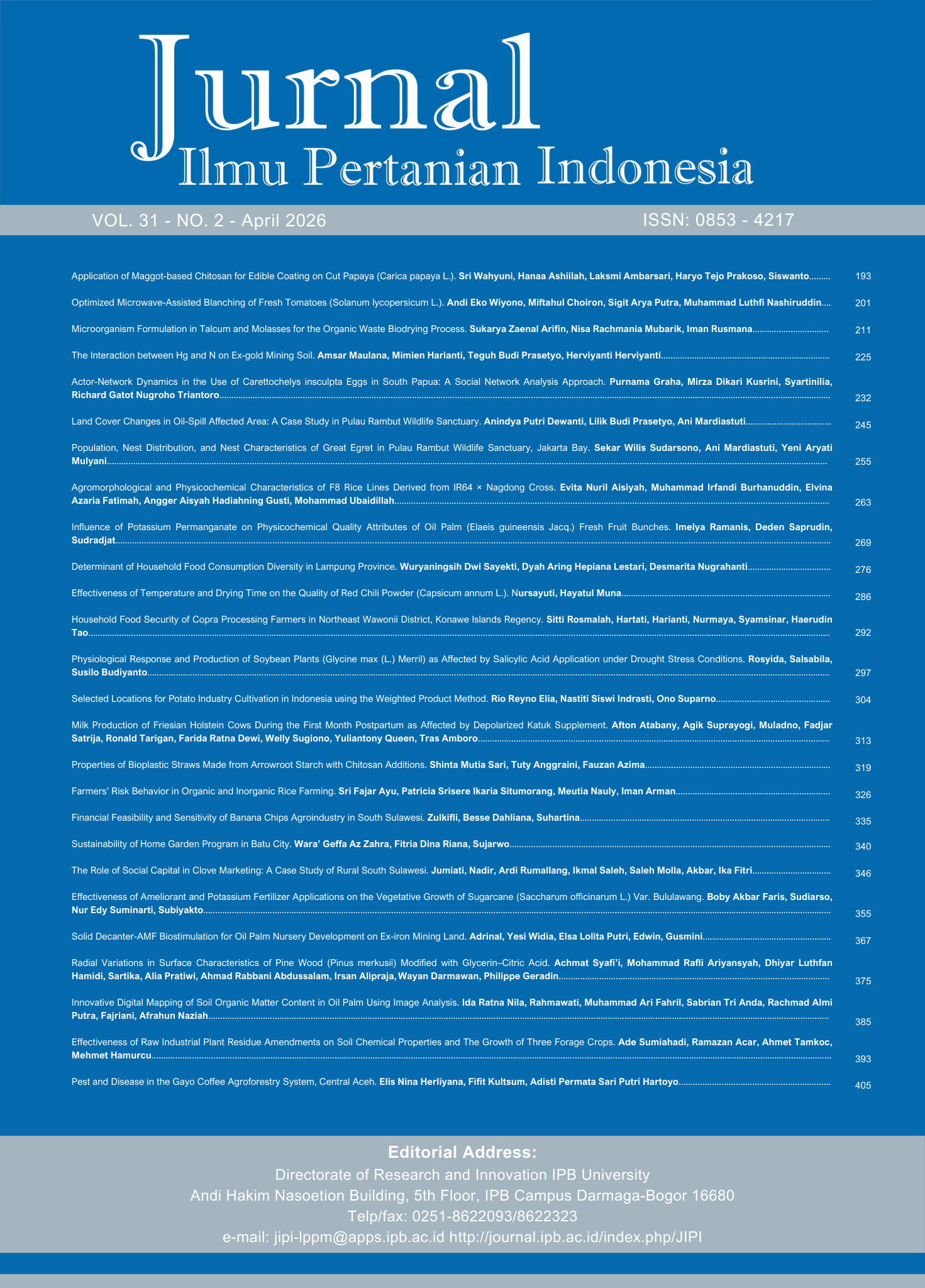
Physiological Response and Production of Soybean Plants (Glycine max (L.) Merril) as Affected by Salicylic Acid Application under Drought Stress Conditions
DOI:
https://doi.org/10.18343/jipi.31.2.297Keywords:
drought, physiological response, salicylic acid, soybeanAbstract
Drought alters plant physiological systems, which has an additional influence on soybean yield. Salicylic acid is a biostimulant that can help plants cope with stress. The study's goal was to examine how salicylic acid foliar spray affected the physiological response and productivity of soybean plants in drought conditions. The study employed soybeans from the Grobogan variety, carried out from August to October 2022 at the Greenhouse and Laboratory of Plant Physiology and Breeding, Faculty of Animal and Agricultural Science, Universitas Diponegoro, Semarang City. The study employed a 3×3 Factorial Complete Randomized Design with three repetitions, yielding 27 experimental units. The first factor was drought stress, which had three levels (80%, 60%, and 40% field capacity). The second factor was the concentration of salicylic acid, which has three levels (0, 0.5, and 1 mM). The parameters measured included leaf chlorophyll, relative water content, stomatal density, number of flowers, fresh pod weight, dry pod weight, and number of seeds. The observation data was statistically analyzed using 5% ANOVA, followed by the Duncan multiple distance test (DMRT). A 40% field capacity drought stress treatment reduced chlorophyll levels a, b, as well as the total number of flowers, fresh pod weight, and dried pod weight. The application of salicylic acid at a dosage of 1 mM increased the fresh weight of the pods.
Keywords: drought, physiological response, salicylic acid, soybean
Downloads
References
Ahmadikhah A, Marufinia A. 2016. Effect of reduced plant height on drought tolerance in rice. 3 Biotech. 6(221): 2–9. https://doi.org/10.1007/s13205-016-0542-3 DOI: https://doi.org/10.1007/s13205-016-0542-3
Apriana Y, Susanti E, Ramadhani F, Surmaini E. 2016. Analisis dampak perubahan iklim terhadap produksi tanaman pangan pada lahan kering dan rancang bangun sistem informasinya. Informatika Pertanian. 25(1): 69–80. https://doi.org/10.21082/ip.v25n1.2016.p69-80 DOI: https://doi.org/10.21082/ip.v25n1.2016.p69-80
Ardian A, Deviona D, Nathisa D. 2024. Pengujian beberapa varietas kedelai (Glycine max L.) pada kondisi cekaman kekeringan. Jurnal Pertanian Agros. 26(1): 5245–5262.
Arif Y, Sami F, Siddiqui H, Bajguz A, Hayat S. 2020. Salicylic acid in relation to other phytohormones in plant: A study towards physiology and signal transduction under challenging environment. Environmental and Experimental Botany. 175(104040). https://doi.org/10.1016/j.envexpbot.2020.104040 DOI: https://doi.org/10.1016/j.envexpbot.2020.104040
Asyura L AG, Hasanah Y, Irmansyah T. 2018. Respons pertumbuhan dan produksi kedelai (Glycine max (L.) Merril) terhadap perlakuan cekaman kekeringan dan pemberian antioksidan asam salisilat dan asam askorbat. Jurnal Agroekoteknologi. 6(1): 174–179. http:// talenta.usu.ac.id.
Aziez AF, Dewi TSK, Supriyadi T, Saputra AF. 2021. Analisis pertumbuhan kedelai varietas Grobogan pada cekaman kekeringan. Jurnal Ilmiah Agrineca. 21(1): 25–33. https://doi.org/10.36728/afp.v21i1.1335 DOI: https://doi.org/10.36728/afp.v21i1.1335
Barus WA, Munar A, Sofia I, Lubis E. 2021. Kontribusi asam salisilat untuk ketahanan cekaman salinitas pada tanaman. Jurnal Penelitian Bidang Ilmu Pertanian. 19(2): 9–19.
Ghassemi–Golezani, K, Farhangi–Abriz S. 2018. Foliar sprays of salicylic acid and jasmonic acid stimulate H+-ATPase activity of tonoplast, nutrient uptake and salt tolerance of soybean. Ecotoxicology and environmental safety. 166: 18–25. https://doi.org/10.1016/j.ecoenv.2018.09.059 DOI: https://doi.org/10.1016/j.ecoenv.2018.09.059
Hariandi D, Indradewa D, Yudono P. 2019. Pengaruh gulma terhadap komponen fisiologi beberapa kultivar kedelai (Glycine max (L.) Merr.). Jurnal Agroekoteknologi. 11(1): 1–8. https://doi.org/10.33512/jur.agroekotek.v11i1.7615 DOI: https://doi.org/10.33512/jur.agroekotek.v11i1.7615
Hidayati N, Hendrati RL, Triani A, Sudjino S. 2017. Pengaruh kekeringan terhadap pertumbuhan dan perkembangan tanaman nyamplung (Callophylum inophyllum L.) dan johar (Cassia florida Vahl.) dari provenan yang berbeda. Jurnal Pemuliaan Tanaman Hutan. 11(2): 99–111. https://doi.org/10.20886/jpth.2017.11.2.99-111 DOI: https://doi.org/10.20886/jpth.2017.11.2.99-111
Jayasumarta, D. 2015. Pengaruh sistem olah tanah dan pupuk P terhadap pertumbuhan dan produksi tanaman kedelai (Glycine max L. Merril). AGRIUM: Jurnal Ilmu Pertanian. 17(3). https://doi.org/10.30596/agrium.v17i3.313.
Kesuma AY, Khasanah, Charloq. 2019. Pengaruh pemberian asam askorbat terhadap pertumbuhan dan produksi kedelai (Glycine max L. Merril) pada kondisi cekaman kekeringan. Jurnal Pertanian Tropik. 6(1): 160–164.
Khan MIR, Fatma M, Per TS, Anjum NA, Khan NA. 2015. Salicylic acid–induced abiotic stress tolerance and underlying mechanism in plants. Frontiers in Plant Science. 6(462): 1–11. https://doi.org/10.3389/fpls.2015.00462 DOI: https://doi.org/10.3389/fpls.2015.00462
Maimunah M, Rusmayadi G, Langai BF. 2018. Pertumbuhan dan hasil dua varietas tanaman kedelai (Glycine max (L.) Merril) di bawah kondisi cekaman kekeringan pada berbagai stadia tumbuh. EnviroScienteae. 14(3): 211–221. https://doi.org/10.20527/es.v14i3.5693 DOI: https://doi.org/10.20527/es.v14i3.5693
Osama S, El Sherei M, Al–Mahdy DA, Bishr M, Salama O. 2019. Effect of salicylic acid foliar spraying on growth parameters, γ-pyrones, phenolic content and radical scavenging activity of drought stressed Ammi visnaga L. plant. Industrial Crops and Products. 134: 1–10. https://doi.org/10.1016/j.indcrop.2019.03.035 DOI: https://doi.org/10.1016/j.indcrop.2019.03.035
Rahman, F, Sukmono A, Yuwono BD. 2017. Analisis kekeringan pada lahan pertanian menggunakan metode nddi dan perka bnpb nomor 02 tahun 2012 (Studi kasus: Kabupaten Kendal tahun 2015). Jurnal Geodesi Undip. 6(4): 274–284. https://doi.org/10.14710/jgundip.2017.18152.
Rahmianna AA, Purnomo J. 2018. Hasil, kualitas fisik polong dan biji beberapa genotipe kacang tanah menurut ragam lengas tanah pada fase generatif. Jurnal Agronomi Indonesia (Indonesian Journal of Agronomy). 46(1): 71–80. https://doi.org/10.24831/jai.v46i1.11402 DOI: https://doi.org/10.24831/jai.v46i1.11402
Razmi N, Ebadi A, Daneshian J, Jahanbakhsh S. 2017. Salicylic acid induced changes on antioxidant capacity, pigments and grain yield of soybean genotypes in water deficit condition. Journal of Plant Interactions. 12(1): 457–464. https://doi.org/10.1080/17429145.2017.1392623 DOI: https://doi.org/10.1080/17429145.2017.1392623
Siregar SR, Zuraida Z, Zuyasna Z. 2017. Pengaruh kadar air kapasitas lapang terhadap pertumbuhan beberapa genotipe M3 kedelai (Glycine max L. Merr). Jurnal Floratek. 12(1): 10–20. Retrieved from jurnal.usk.ac.id
Sutrisno DK, Sri H, Parawita D. 2022. Peranan Trichoderma terhadap pertumbuhan dan hasil tanaman kedelai (Glycine max) pada kondisi cekaman kekeringan. Jurnal Agroteknologi dan Agribisnis. 6(1): 7–8. https://doi.org/10.30737/agrinika.v6i1.2339 DOI: https://doi.org/10.30737/agrinika.v6i1.2339
Vazirimehr MR, Rigi K. 2014. Effect of salicylic acid in agriculture. International Journal of Plant, Animal and Environmental Sciences. 4(2): 291–296.
Wahyuningsih W, Proklamasiningsih E, Dwiati M. 2017. Serapan fosfor dan pertumbuhan kedelai (Glycine max) pada tanah Ultisol dengan pemberian asam humat. Majalah Ilmiah Biologi Biosfera: A Scientific Journal. 33(2): 66–70. doi.org/10.20884/1.mib.2016.33.2.345 D. DOI: https://doi.org/10.20884/1.mib.2016.33.2.345
Wang Y, Li L, Cai W, Xu J, Shen Q. 2018. Salicylic acid enhances antioxidant enzyme activity and reduces oxidative stress in soybean under drought stress. Journal of Plant Physiology. 231: 111–119. doi.org/10.1016/j.jplph.2018.09.002.
Wijayanti NT, Wardhani T, Sugiarti U. 2022. Pertumbuhan dan produksi tanaman kedelai varietas Argomulyo terhadap pemberian pupuk NPK. Agrika. 15(2): 103–112. https://doi.org/10.31328/ja.v15i2.3507 DOI: https://doi.org/10.31328/ja.v15i2.3507
Downloads
Published
Issue
Section
License
Copyright (c) 2025 Salsabila, Rosyida

This work is licensed under a Creative Commons Attribution-NonCommercial 4.0 International License.
This journal is published under the terms of the Creative Commons Attribution-NonCommercial 4.0 International License. Authors who publish with this journal agree to the following terms: Authors retain copyright and grant the journal right of first publication with the work simultaneously licensed under a Creative Commons Attribution-NonCommercial 4.0 International License. Attribution — You must give appropriate credit, provide a link to the license, and indicate if changes were made. You may do so in any reasonable manner, but not in any way that suggests the licensor endorses you or your use. NonCommercial — You may not use the material for commercial purposes.
How to Cite
























 View JIPI StatsCounter