
Ecological and Sustainability Assessment of Mangrove Ecosystem in Gili Sulat and Gili Lawang, East Lombok, Indonesia
Article Sidebar
-
forest canopy density (FCD), mangrove ecosystem, multidimensional analysis, small islands, sustainability index
Abstract
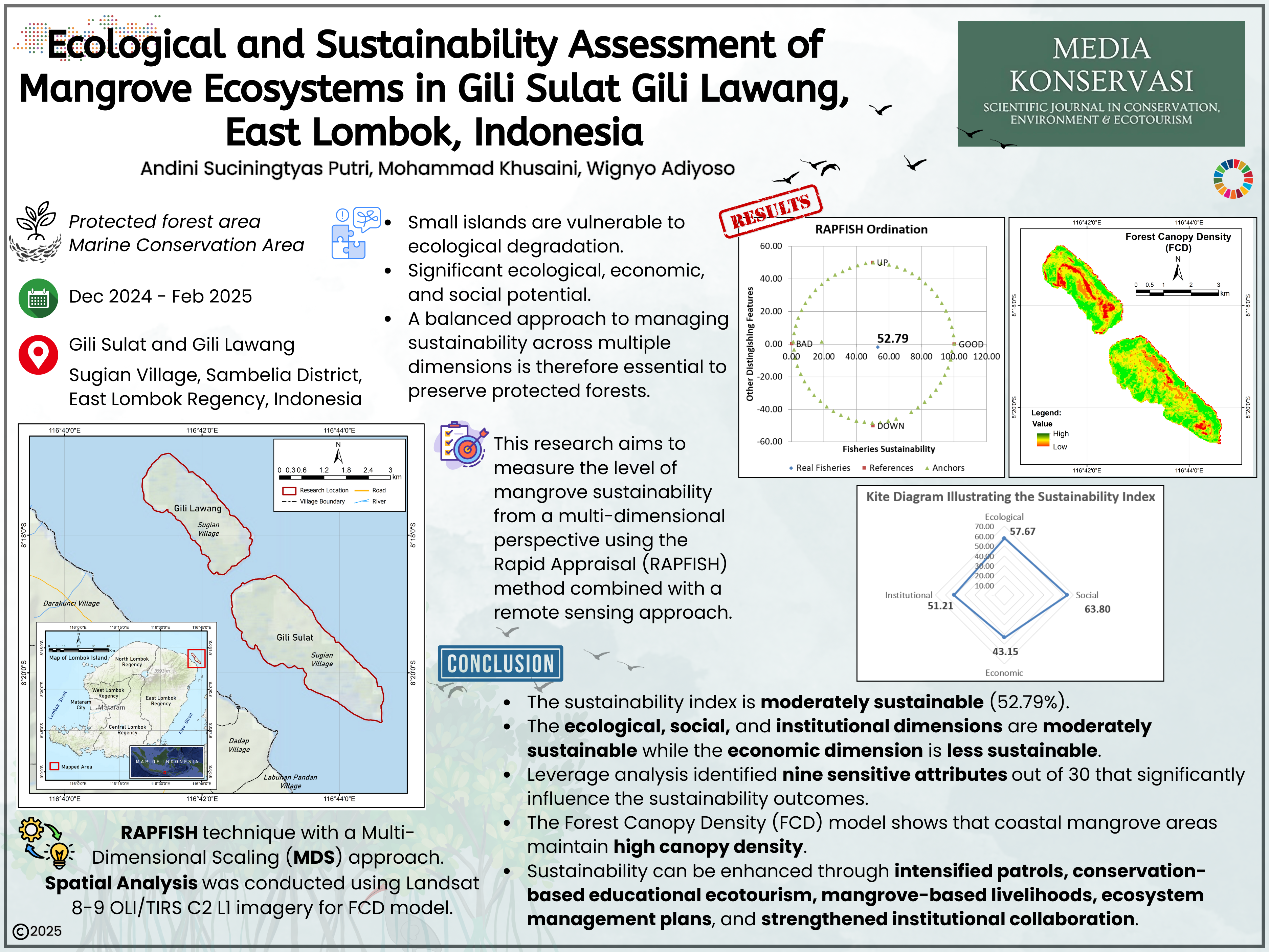
Small islands in Indonesia hold significant potential for tourism development and biodiversity conservation. However, their sustainability is increasingly threatened by various vulnerabilities. The Gili Sulat and Gili Lawang possess significant ecological, economic, and social potential through the presence of mangrove ecosystems. A balanced approach to managing sustainability across multiple dimensions is therefore essential to preserve protected forests. The gap between mangrove management on small islands and larger islands, in terms of area coverage, community dependence, utilization conflicts, and management strategies, highlights the significance of this study. This research aimed to measure the level of mangrove sustainability from multi-dimensional perspectives using the Rapid Appraisal (RAPFISH) method combined with a remote sensing approach. The RAPFISH analysis resulted in an overall sustainability index of 52.79%, indicating a moderately sustainable status. While the key ecological functions of the mangrove ecosystems remain preserved, further efforts are necessary in areas such as local economic development and institutional capacity to achieve a fully sustainable condition. Leverage analysis identified nine sensitive attributes out of 30 that significantly influence sustainability outcomes and guide future strategies. The Forest Canopy Density (FCD) model shows that coastal mangrove areas maintain high canopy density. Intensified patrols, conservation-based educational ecotourism, mangrove-based livelihoods, ecosystem management plans, and strengthened institutional collaboration are among the strategies to enhance sustainability. The study implies that mangrove sustainability depends on targeted adaptive management of the most influential attributes.
Full text article
References
1. Ministry of Marine Affairs and Fisheries Regulation of the Minister of Marine Affairs and Fisheries of the Republic of Indonesia Number 10 of 2024 Concerning the Utilization of Small Islands and Their Surrounding Waters; Ministry of Marine Affairs and Fisheries of the Republic of Indonesia: Jakarta, 2024;
2. Pelt, S.; Klassen, J.; Foster, S.; Larocque, I.; Hsieh, A.; Allen, D.; Holding, S. Groundwater Vulnerability on Small Islands. Nature Climate Change 2016, 6, 1100–1103, doi:10.1038/NCLIMATE3128.
3. Hernández-Delgado, E. The Emerging Threats of Climate Change on Tropical Coastal Ecosystem Services, Public Health, Local Economies and Livelihood Sustainability of Small Islands: Cumulative Impacts and Synergies. Marine pollution bulletin 2015, 101 1, 5–28, doi:10.1016/j.marpolbul.2015.09.018.
4. Wong, P. Small Island Developing States. Wiley Interdisciplinary Reviews: Climate Change 2021, 2, doi:10.1002/wcc.84.
5. Wise, R.; Duvat, V.; Hay, J.; Stojanovic, T.; Ballu, V.; Fazey, I.; Hinkel, J.; Yamano, H.; Magnan, A. Trajectories of Exposure and Vulnerability of Small Islands to Climate Change. Wiley Interdisciplinary Reviews: Climate Change 2017, 8, doi:10.1002/wcc.478.
6. Hantoro, W.S. Kerentanan-Ketahanan Kawasan Landai Pesisir Dan Pulau Kecil: Mitigasi Dan Adaptasinya; I.; LIPI Press: Jakarta, 2020; ISBN 9786024960865.
7. Ministry of National Development Planning/Bappenas Indonesia Biodiversity Strategy and Action Plan (IBSAP) 2025–2045; Jakarta, 2024;
8. As-Syakur, A.; Hidayah, Z.; Rachman, H. Sustainability Assessment of Mangrove Management in Madura Strait, Indonesia: A Combined Use of the Rapid Appraisal for Mangroves (RAPMangroves) and the Remote Sensing Approach. Marine Policy 2024, doi:10.1016/j.marpol.2024.106128.
9. Statistics Indonesia (BPS) of West Nusa Tenggara Province West Nusa Tenggara in Figures 2024; Mataram, 2024;
10. Ministry of Forestry Decree of the Minister of Forestry Number 8213/Kpts-II/2002 Concerning the Designation of the Gili Lawang, Gili Sulat, and Gili Petagan Forest Group (RTK.14), Covering an Area of 1,206 (One Thousand Two Hundred and Six) Hectares, Located in East Lombok Re; Ministry of Forestry of the Republic of Indonesia: Jakarta, 2002;
11. Ministry of Environment and Forestry Land Cover Map 2015–2024 2025.
12. Ghufrona, R.R.; Kusmana, C.; Rusdiana, O. Komposisi Jenis Dan Struktur Hutan Mangrove Di Pulau Sebuku, Kalimantan Selatan. Jurnal Silvikultur Tropika 2015, 06, 15–26.
13. Hilyana, S.; Amir, S.; Waspodo, S. Kesesuaian Zonasi Pulau-Pulau Kecil : Studi Kasus Kawasan Konservasi Gili Sulat Gili Lawang Lombok Indonesia. Jurnal Sains Teknologi & Lingkungan 2020, 6, 202–215, doi:10.29303/jstl.v6i2.183.
14. Iswahyudi Kebijakan Pengelolaan Ekosistem Hutan Mangrove Berkelanjutan Kota Langsa, Doctoral Disertation, IPB University, Bogor, 2019.
15. Katili, A.S.; Husalin, I.H.; Mamu, H.D. Pemanfaatan Nilai Struktur Vegetasi Dan Nilai Serapan Karbon Mangrove Dalam Pengembangan Buku Ajar Ekologi Pesisir. Biodik: Jurnal Ilmiah Pendidikan Biologi 2020, 6, 402–411.
16. Sribianti, I.; Muthmainnah; Hikmah; Kiswandi Economic Valuation of Mangrove Ecosystem Environmental Services Based on Green Economy. IOP Conf. Series: Earth and Environmental Science 2021.
17. Rahman, F.A. Ekologi Mangrove Pulau Lombok; Dr. Muhmmad Liwa Irrubai, M.P., Ed.; I.; UIN Mataram Press: Mataram, 2022; ISBN 9786238816859.
18. Bhokaleba, B.P.P.W.; Erfin; Utami, P.B. Indirect Economic Value of Mangrove Ecosystem in the North Coastal of Sikka Regency in Disaster Mitigation. IOP Conference Series: Earth and Environmental Science 2023, 1224, doi:10.1088/1755-1315/1224/1/012016.
19. Djamaluddin, R. Mangrove: Biologi, Ekologi, Rehabilitasi, Dan Konservasi; I.; Unsrat Press: Manado, 2018; ISBN 9786020752280.
20. Riyandari, R. Peran Mangrove Dalam Melindungi Daerah Pesisir Terhadap Gelombang Tsunami. Jurnal Sains dan Teknologi Mitigasi Bencana 2019, 12, 74, doi:10.29122/jstmb.v12i1.3702.
21. Kawirian, R.R.; Himawan, C.; Muhidin; Pardede, S.T. Laporan Teknis Pemantauan Kondisi Ekosistem Mangrove Di Taman Wisata Perairan (TWP) Gili Sulat Dan Gili Lawang, Lombok Timur, Provinsi Nusa Tenggara Barat Periode 2023; 2023;
22. Ministry of Environment and Forestry Decree of the Minister of Environment Number 201 of 2004 on Standard Criteria and Guidelines for Determining Mangrove Degradation; Ministry of Environment and Forestry of the Republic of Indonesia: Jakarta, 2004;
23. Ministry of Marine Affairs and Fisheries Decree of the Minister of Marine Affairs and Fisheries of the Republic of Indonesia Number 92/KEPMEN-KP/2018 Concerning the Marine Conservation Area of Gili Sulat, Gili Lawang, and Surrounding Waters in West Nusa Tenggara Province; Ministry of Marine Affairs and Fisheries of the Republic of Indonesia: Jakarta, 2018;
24. Hernawati; Tarigan, S.A.R.; Ardiansyah, F.; Aryawan, M.D.; Rafandi, T.; Kartawijaya, T. Kearifan Lokal Dalam Pengelolaan Sumberdaya Perikanan Di Provinsi Nusa Tenggara Barat; Wildlife Conservation Society Indonesia Program: Bogor, 2018;
25. McCarthy, M.; Herrero, H.; Insalaco, S.; Hinten, M.; Anyamba, A. Satellite Remote Sensing for Environmental Sustainable Development Goals: A Review of Applications for Terrestrial and Marine Protected Areas. Remote Sensing Applications: Society and Environment 2025, doi:10.1016/j.rsase.2025.101450.
26. Vyvlečka, P.; Pechanec, V. Optical Remote Sensing in Provisioning of Ecosystem-Functions Analysis—Review. Sensors (Basel, Switzerland) 2023, 23, doi:10.3390/s23104937.
27. De Almeida, D.; Vedovato, L.; Fuza, M.; Molin, P.; Cassol, H.; Resende, A.; Krainovic, P.; De Almeida, C.; Amaral, C.; Haneda, L.; et al. Remote Sensing Approaches to Monitor Tropical Forest Restoration: Current Methods and Future Possibilities. Journal of Applied Ecology 2024, doi:10.1111/1365-2664.14830.
28. Del Río-Mena, T.; Willemen, L.; Vrieling, A.; Nelson, A. How Remote Sensing Choices Influence Ecosystem Services Monitoring and Evaluation Results of Ecological Restoration Interventions. Ecosystem Services 2023, doi:10.1016/j.ecoser.2023.101565.
29. Kamran, M.; Yamamoto, K. Evolution and Use of Remote Sensing in Ecological Vulnerability Assessment: A Review. Ecological Indicators 2023, doi:10.1016/j.ecolind.2023.110099.
30. Wibowo, A.B.; Anggoro, S.; Yulianto, B. Status Keberlanjutan Dimensi Ekologi Dalam Pengembangan Kawasan Minapolitan Berkelanjutan Berbasis Perikanan Budidaya Air Tawar Di Kabupaten Magelang. SAINTEK PERIKANAN : Indonesian Journal of Fisheries Science and Technology 2015, 10, 107–113, doi:10.14710/IJFST.10.2.107-113.
31. Hossain, M.J.; Porter, S.; Roque, A.; Brewis, A.; Wutich, A.; Zheng, M.; Quimby, B. Participatory Approaches in Water Research: A Review. Wiley Interdisciplinary Reviews: Water 2022, 9, doi:10.1002/wat2.1577.
32. Omondi, L. Learning Together: Participatory Rural Appraisal for Coproduction of Climate Change Knowledge. Action Research 2020, 21, 198–210, doi:10.1177/1476750320905901.
33. Loi, D.T.; Chou, T.-Y.; Fang, Y.-M. Integration of GIS and Remote Sensing for Evaluating Forest Canopy Density Index in Thai Nguyen Province, Vietnam. International Journal of Environmental Science and Development 2017, 8.
34. Dibs, H.; Ali, A.; Al‐Ansari, N.; Abed, S. Fusion Landsat-8 Thermal TIRS and OLI Datasets for Superior Monitoring and Change Detection Using Remote Sensing. Emerging Science Journal 2023, doi:10.28991/esj-2023-07-02-09.
35. Onačillová, K.; Gallay, M.; Paluba, D.; Péliová, A.; Tokarčík, O.; Laubertová, D. Combining Landsat 8 and Sentinel-2 Data in Google Earth Engine to Derive Higher Resolution Land Surface Temperature Maps in Urban Environment. Remote. Sens. 2022, 14, 4076, doi:10.3390/rs14164076.
36. Vanhellemont, Q. Automated Water Surface Temperature Retrieval from Landsat 8/TIRS. Remote Sensing of Environment 2020, 237, 111518, doi:10.1016/j.rse.2019.111518.
37. Zhao, J.; Huang, L.; Yang, H.; Zhang, D.; Dong, L. Evaluation of Landsat-8 OLI Satellite Imagery by a Cross-Comparison Method Combining Spectral and Texture Features. Journal of Optics 2017, 46, 295–303, doi:10.1007/S12596-016-0374-X.
38. Pitcher, T.J.; Preikshot, D. RAPFISH: A Rapid Appraisal Technique to Evaluate the Sustainability Status of Fisheries. Fisheries Research 2001, 49, 255–270, doi:10.1016/S0165-7836(00)00205-8.
39. Fauzi, A. Teknik Analisis Keberlanjutan; PT. Gramedia Pustaka Utama: Jakarta, 2019; ISBN 978-602-06-3025-0.
40. Santoso, N. Arahan Kebijakan Dan Strategi Pengelolaan Kawasan Mangrove Berkelanjutan Di Muara Angke Daerah Khusus Ibukota Jakarta, Doctoral Disertation, Institut Pertanian Bogor, Bogor, 2012.
41. Odum, E.P. Fundamentals of Ecology Third Edition. W. B. Saunders Company 1971, 593.
42. Theresia; Boer, M.; Pratiwi, N.T.M. Status Keberlanjutan Pengelolaan Ekosistem Mangrove Di Taman Nasional Sembilang Kabupaten Banyuasin Provinsi Sumatera Selatan. Jurnal Ilmu dan Teknologi Kelautan Tropis 2015, 7, 703–714.
43. Haris, A.M.; Hardjomidjojo, H.; Kusmana, C. Status Keberlanjutan Pengelolaan Ekosistem Mangrove Di Kecamatan Tarumajaya, Kabupaten Bekasi. Jurnal Analisis Kebijakan Kehutanan 2021, 18, 105–124, doi:10.20886/jakk.2021.18.2.105-124.
44. Pattimahu, D.V. Kebijakan Pengelolaan Hutan Mangrove Berkelanjutan Di Kabupaten Seram Bagian Barat Maluku, Doctoral Disertation, Institut Pertanian Bogor, Bogor, 2010.
45. Provincial Government of West Nusa Tenggara Decree of the Governor of West Nusa Tenggara Number: 500.15.1-802 of 2024 Concerning the Minimum Wage of East Lombok Regency for 2025 2025.
46. Statistics Indonesia (BPS) of East Lombok Regency Gross Regional Domestic Product of East Lombok Regency by Business Field, 2019–2023. 2024, 11.
47. Thamrin; Sutjahjo, S.H.; Herison, C.; Sabiham, S. Analisis Keberlanjutan Wilayah Perbatasan Kalimantan Barat- Malaysia Untuk Pengembangan Kawasan Agropolitan. Jurnal Agro Ekonomi 2007, 25, 103–124.
48. Rikimaru, A.; Roy, P.S.; Miyatake, S. Tropical Forest Cover Density Mapping. Tropical Ecology 2002, 43, 39–47.
49. Falensky, M.A.; Sulti, A.L.; Putra, R.D.; Marko, K. Application of Forest Canopy Density (FCD) Model for the Hotspot Monitoring of Crown Fire in Tebo, Jambi Province. Jurnal Geografi Lingkungan Tropik (Journal of Geography of Tropical Environments) 2020, 4, doi:10.7454/jglitrop.v4i1.76.
50. Purwanti, P.; Fattah, M.; Qurrata, V.A.; Narmaditya, B.S. An Institutional Reinforcement Model for the Protection of Mangroves Sustainable Ecotourism in Indonesia. GeoJournal of Tourism and Geosites 2021, 35, 471–479, doi:https://doi.org/10.30892/gtg.35227-674.
51. Azizah, D.; Raza’i, T.S.; Hamidy, R.; Muzammil, W.; Pardi, H.; Mubarak; Efryeldi Sustainability of Mangrove Forest Management in the Former Bauxite Mining Area on Bintan Island. F1000Research 2022, doi:10.12688/f1000research.108913.1.
52. Thamrin, T.; Sukendi, S.; Putra, R.M.; Hanifah, A. Mangrove Ecosystem Management for Sustainable Renewable Energy Production: A Multi-Dimensional Analysis. International Journal of Energy Economics and Policy 2023, doi:10.32479/ijeep.14299.
53. Arfan, A.; Sanusi, W.; Rakib, M. Analisis Kerapatan Mangrove Dan Keanekaragaman Makrozoobenthos Di Kawasan Ekowisata Mangrove Lantebung Kota Makassar. Journal of Marine Research 2023, 12, 493–500, doi:10.14710/jmr.v12i3.38060.
54. Damayanti, A.A.; Gigentika, S.; Destikawati; Murdin, L.F.A.; Marwan, M.; Rahfika; Jayawangsa, R. Aktivitas Perikanan Tangkap Di Kawasan Konservasi TWP Gili Sulat Dan Gili Lawang, Kabupaten Lombok Timur, Provinsi NTB. Jurnal Ilmu Kelautan Lesser Sunda 2022, 2, 29–38, doi:10.29303/jikls.v2i1.55.
55. Hu, X.; Zhao, J.; Li, Q. Dynamic Effects of Education Investment on Sustainable Development Based on Comparative Empirical Research Between China and the United States. Sustainability 2025, doi:10.3390/su17073068.
56. Moussa, N. Effects of Quality Education on Sustainability in Developing Countries. 2020, 69–77, doi:10.4018/978-1-7998-0062-0.ch005.
57. Gheler-Costa, C.; Toqueti, F.; Vieira, C.; Spazziani, M.; Rumenos, N.N. Environmental Education in Urban Cities: Planet Regeneration through Ecologically Educating Children and Communities. International Journal of Educational Research Open 2022, doi:10.1016/j.ijedro.2022.100208.
58. President of Republic Indonesia Government Regulation Number 27 of 2025 Concerning the Protection and Management of Mangrove Ecosystems; Ministry of State Secretariat, 2025;
Authors
Copyright (c) 2025 Andini Suciningtyas Putri, Moh. Khusaini, Wignyo Adiyoso

This work is licensed under a Creative Commons Attribution 4.0 International License.
Media Konservasi is an open access journal, meaning that all content is freely available without charge to the user or their institution. Users are allowed to read, download, copy, distribute, print, search, or link to the full texts of the articles in this journal without needing to request prior permission from the publisher or the author.
All articles published by Media Konservasi are licensed under the Creative Commons Attribution 4.0 International License. This allows for unrestricted use, distribution, and reproduction in any medium, provided proper credit is given to the original authors.
Authors submitting manuscripts should understand and agree that the copyright of published manuscripts is retained by the authors. Copyright encompasses the exclusive rights of authors to reproduce, distribute, and sell any part of the journal articles in all forms and media. Reproduction of any part of this journal, its storage in databases, and its transmission by any form or media is allowed without written permission from Media Konservasi.
Article Details
How to Cite



