Balancing Tourism and Conservation: The Role of Local Communities in Bali’s Ecotourism Management
Article Sidebar
-
leaders, business opportunities, industrial cooperation, participation, environment conservation
Abstract
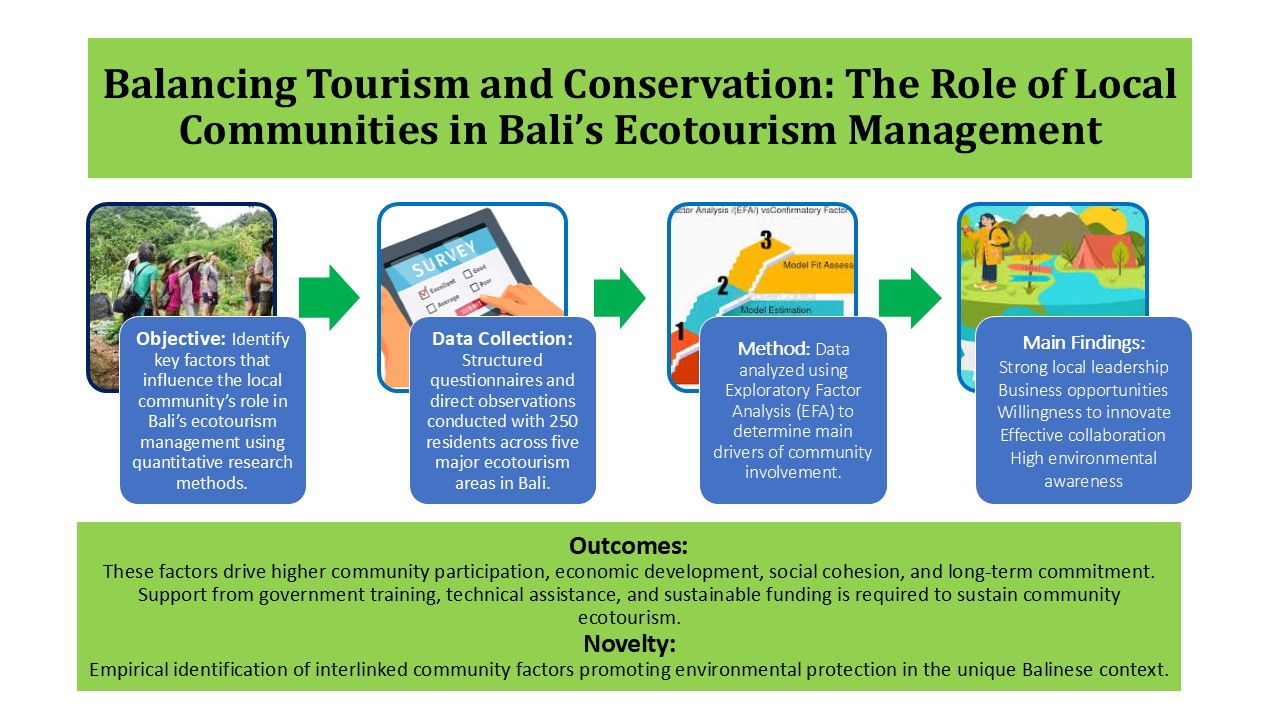
This study examines key factors and interaction patterns influencing local community participation in Bali’s ecotourism management, responding to the persistent imbalance between tourism interests and nature conservation. It aims to provide policy and program recommendations that strengthen community roles in sustainable practices across five key sites: West Bali National Park, Buyan–Tamblingan, Bali Mangroves, Batur Kintamani, and Lembongan. This study aims to identify key factors influencing the role of local communities in Bali’s ecotourism management, providing targeted policy recommendations to enhance sustainable practices through a quantitative approach. The study utilizes structured questionnaires and direct observation among 250 residents from five different ecotourism areas. Data were analyzed using Exploratory Factor Analysis (EFA) to identify the main drivers of community involvement. The results show strong local leadership, plenty of business openings, willingness for novelty, collaboration, and environmental awareness boost the level of participation leading to economic development through social cohesion and creating long-term commitment, on which government training, technical support, and funding role necessitate sustaining ecotourism enterprises. Novelty is empirically identifying such community-based factors with their linkages toward environmental protection within the unique context of Bali.
Full text article
References
1. Riswan, S.; Yamada, I. A Note on the Progress of Biodiversity Research in Indonesia. Tropics 2006, 15, 249–258.
2. Yasa, P.D. Tri Hita Karana:(Sekilas Historis Dan Hakikat Keharmonisan Semesta). Sphatika J. Teol. 2022, 13, 205–216.
3. Stone, M.T. Community-Based Ecotourism: A Collaborative Partnerships Perspective. J. Ecotourism 2015, 14, 166–184.
4. Mechinda, P.; Serirat, S.; Popaijit, N.; Lertwannawit, A.; Anuwichanont, J. The Relative Impact Of Competitiveness Factors And Destination Equity On Tourists Loyalty In Koh Chang, Thailand. Int. Bus. Econ. Res. J. 2010, 9, doi:10.19030/iber.v9i10.643.
5. Fennell, D.; Markwell, K. Ethical and Sustainability Dimensions of Foodservice in Australian Ecotourism Businesses. J. Ecotourism 2015, 14, 48–63.
6. Karmini, N.W. Ecotourism Management Based on Local Wisdom in Tenganan Village, Karangasem Bali. 2020.
7. Abd Aziz, N.; Ariffin, A.A. Identifying the Relationship between Travel Motivation and Lifestyles among Malaysian Pleasure Tourists and Its Marketing Implications. Int. J. Mark. Stud. 2009, 1, 96–106, doi:10.5539/ijms.v1n2p96.
8. Rogos, E.A. Factors Affecting Community Participation in Ecotourism Programs: A Case Study of Communities in Padawan District, Sarawak, Swinburne University of Technology Sarawak Campus: Kuching, Malaysia, 2020.
9. Utama, I.G.B.R.; Junaedi, I.W.R.; Krismawintari, N.P.D. The Bali Ecotourism Destination Management to Create Local Small Business. Int. J. Sustain. Dev. Plan. 2023, 18, 3439–3447, doi:10.18280/ijsdp.181109.
10. Utama, I.G.B.R. Travelling Motivation and Satisfaction Visiting Bali Indonesia in the Perspective of Senior Tourist. SSRN Electron. J. 2015, doi:10.2139/ssrn.2631875.
11. SUMARMI, S.; ARINTA, D.; SUPRIANTO, A.; ALIMAN, M. The Development of Ecotourism with Community-Based Tourism (CBT) in Clungup Mangrove Conservation (CMC) of Tiga Warna Beach for Sustainable Conservation. Folia Geogr. 2021, 63, 123.
12. Bhalla, P.; Bhattacharya, P.; Areendran, G.; Raj, K. Ecotourism Spatio-Temporal Models to Identify Visitation Patterns across the Indian Himalayan Region. GeoJournal 2022, 87, 1777–1792.
13. Regmi, K.D.; Walter, P.G. Conceptualising Host Learning in Community-Based Ecotourism Homestays. J. Ecotourism 2016, 15, 51–63, doi:10.1080/14724049.2015.1118108.
14. Chaudhary, S.; Kumar, A.; Pramanik, M.; Negi, M.S. Land Evaluation and Sustainable Development of Ecotourism in the Garhwal Himalayan Region Using Geospatial Technology and Analytical Hierarchy Process. Environ. Dev. Sustain. 2022, 1–42.
15. Oltean, F.D.; Curta, P.A.; Nagy, B.; Huseyn, A.; Gabor, M.R. Changes in Tourists’ Perceptions of Community-Based Ecotourism (CBET) After COVID-19 Pandemic: A Study on the Country of Origin and Economic Development Level. ISPRS Int. J. Geo-Information 2025, 14, 146.
16. Utama, I.G.B.R.; Turker, S.B.; Widyastuti, N.K.; Suyasa, N.L.C.P.S.; Waruwu, D. Model of Quality Balance Development of Bali Tourism Destination. Tech. Soc. Sci. J. 2020, 10, doi:10.47577/tssj.v10i1.1356.
17. Study on the Implementation of Community Based Tourism Principles in Jatiluwih, Tabanan, Bali. J. Kaji. Bali J. Bali Stud. 2019.
18. Wibisana, A.A.N.A.; Dewi, A.A.S.L. Tri Hita Karana as a Concept of Local Wisdom in The Development of Sustainable Tourism in Bali. In Proceedings of the International Conference on “Changing of Law: Business Law, Local Wisdom and Tourism Industry”(ICCLB 2023); Atlantis Press, 2023; pp. 65–72.
19. Pitana, I. Tri Hita Karana–the Local Wisdom of the Balinese in Managing Development. In Trends and issues in Global Tourism 2010; Springer, 2010; pp. 139–150.
20. Prasiasa, D.P.O.; Widari, D.A.D.S.; Menuh, N. Pengembangan Wisata Trekking Di Kawasan Hutan Taman Wisata Alam Danau Buyan, Kabupaten Buleleng. J. Sosiol. USK (Media Pemikir. Apl. 2019, 13, 124–145.
21. Ferdinand, A. Management Research Methods: Research Guidelines for Writing Theses and Dissertations of Management Science (in Indonesian); 2014;
22. Utama, I.; Mahadewi, N.M.E. Metodologi Penelitian Pariwisata Dan Perhotelan: Dilengkapi Studi Kasus Penelitian. Yogyakarta Andi 2014.
23. Jennett, K.; Coffele, F.; Booth, C. Comprehensive and Quantitative Analysis of Protection Problems Associated with Increasing Penetration of Inverter-Interfaced DG. In Proceedings of the 11th IET International Conference on Developments in Power Systems Protection (DPSP 2012); IET, 2012; pp. P31–P31.
24. Hair, J.F.; Money, A.H.; Samouel, P.; Page, M. Research Methods for Business. Educ. Train. 2007.
25. Utama, D.I.; Trimurti, C.P. The Implementation of the MOA Method in Ecotourism of Buyan-Tamblingan, Bali, Indonesia. I. Gusti Bagus Rai Utama, Christimulia Purnama Trimurti.(2021). Implement. MOA Method Ecotourism Buyan-Tamblingan, Bali, Indones. Int. J. Mod. Agric. 2021, 10, 957–970.
26. Nelson, A.N. The Modern Reader’s Japanese-English Character Dictionary: Original Classic Edition; Tuttle publishing, 2014; ISBN 1462904785.
27. Utama, I.G.B.R.; Trimurti, C.P. The Ethical of Agritourism Development in Border Protected Area from Stakeholder Perspective. In Proceedings of the IOP Conference Series: Earth and Environmental Science; 2021; Vol. 771.
28. Utama, I.G.B.R.; Laba, I.N.; Junaedi, I.W.R.; Krismawintari, N.P.D.; Turker, S.B.; Juliana, J. Exploring Key Indicators of Community Involvement in Ecotourism Management. J. Environ. Manag. Tour. 2021, 12, doi:10.14505/jemt.v12.3(51).20.
29. Kunasekaran, P.; Mostafa Rasoolimanesh, S.; Wang, M.; Ragavan, N.A.; Hamid, Z.A. Enhancing Local Community Participation towards Heritage Tourism in Taiping, Malaysia: Application of the Motivation-Opportunity-Ability (MOA) Model. J. Herit. Tour. 2022, 17, 465–484.
30. Dewi, R.K.; Ustriyana, I.N.G. Keberlanjutan Nilai-Nilai Tri Hita Karana (THK) Pada Sistem Subak Di Kawasan Wisata Dan Kawasan Agraris Kabupaten Gianyar. SOCA J. Sos. Ekon. Pertan. 2007, 7, 43976.
31. Udayana, A.A.G.B. Marginalisasi Ideologi Tri Hita Karana Pada Media Promosi Pariwisata Budaya Di Bali. Mudra J. Seni Budaya 2017, 32.
32. Anggawiguna, P.G.V.; Destiwati, R. Komunikasi Kelompok Dalam Implementasi Konsep Tri Hita Karana (Pawongan) Pada Perkumpulan Sekaa Gong Desa Wisata Penglipuran Bangli Bali. J. Ilmu Sos. dan Hum. 2019, 8, 268–274.
33. Pratiwi, N.K.A.; Triyuni, N.N.; Aryana, I. The Implementation of Tri Hita Karana in Supporting The Creation of Healthy Organization at Maya Ubud Resort and Spa 2023.
34. Maxwell, J.A. Designing a Qualitative Study; The SAGE handbook of applied social research methods, 2008; Vol. 2;.
35. Morse, J.M. Essentials of Qualitatively-Driven Mixed-Method Designs; Routledge, 2016; ISBN 1315543400.
36. Moriarty, J. Qualitative Methods Overview. 2011.
37. UTAMA, I.G.B.R.; LABA, I.N.; JUNAEDI, I.W.R.; KRISMAWINTARI, N.P.D.; TURKER, S.B.; JULIANA, J. Exploring Key Indicators of Community Involvement in Ecotourism Management. J. Environ. Manag. Tour. 2021, 12, doi:10.14505//jemt.12.3(51).20.
38. Utama, I.G.B.R.; Trimurti, C.P. The Implementation of the MOA Method in Ecotourism of Buyan-Tamblingan, Bali, Indonesia. Int. J. Mod. Agric. 2021, 10, 957–970.
39. Cohen, M.; Silva, J.F. da Evaluation of Collaborative Strategies for Ecotourism and Recreational Activities in Natural Parks of Rio de Janeiro. Rev. Adm. Pública 2010, 44, 1097–1123.
40. Utama, R.; Mahadewi, N.M.E. The Contradiction of Managing Tourism Objects Based on Culture and Its Heritage. SSRN Electron. J. 2014, doi:10.2139/ssrn.2517074.
41. Suansri, P. Community Based Tourism Handbook; Responsible Ecological Social Tour-REST Bangkok, 2003; ISBN 974914337X.
42. Hitchcock, M.; Putra, I. Tourism, Development and Terrorism in Bali. 2007.
43. Utama, R. Positioning of Eco Tourism Objects in Bali Indonesia. SSRN Electron. J. 2015, doi:10.2139/ssrn.2595139.
44. How and Who Are the Visitor World Heritage Tourist Attraction of Jatiluwih? 2018.
45. Kharisma, P.G.Y.; Muni, P.K.S. Local-Wisdom-Based Spa Tourism in Ubud Village of Bali, Indonesia. Russ. J. Agric. Socio-Economic Sci. 2017, 68, 188–196.
46. Smeral, E. Tourism Satellite Accounts: A Critical Assessment. J. Travel Res. 2006, 45, 92–98.
47. Barna, C.; Epure, M.; Vasilescu, R. Ecotourism–Conservation of the Natural and Cultural Heritage. Rev. Appl. Socio-Economic Res. 2011, 1, 87–96.
48. Mihardja, E.J.; Sari, D.A.P.; Widana, I.D.K.K.; Ridhani, C.; Suyasa, I.G.W. Forest Bathing: A New Attraction and Disaster Mitigation for Batur UNESCO Global Geopark Bali. In Proceedings of the IOP Conference Series: Earth and Environmental Science; December 2021; Vol. 940, p. 012008.
49. Belleflamme, P.; Neysen, N. Advances in Tourism Economics; 2009; ISBN 978-3-7908-2123-9.
50. Features, K.; Benefits, K. Country Economic Forecasts. 2018.
51. Strategi Menuju Pariwisata Bali yang Berkualitas. J. Kaji. BALI (JOURNAL BALI Stud. 2013.
52. D’Souza, C.; Taghian, M.; Marjoribanks, T.; Sullivan-Mort, G.; Manirujjaman, M.D.; Singaraju, S. Sustainability for Ecotourism: Work Identity and Role of Community Capacity Building. Tour. Recreat. Res. 2019, 44, 533–549, doi:10.1080/02508281.2019.1654727.
53. Ho, P.; To, A. Cultural Events as Tourism Products - Opportunities and Challenges. Glob. Events Congr. IV Festivals Events Res. State Art 2010, 1–16.
54. Utama, I.G.B.R.; Trimurti, C.P.; Erfiani, N.M.D.; Krismawintari, N.P.D.; Waruwu, D. The Tourism Destination Determinant Quality Factor from Stakeholders Perspective. Indones. J. Tour. Leis. 2021, 2, doi:10.36256/ijtl.v2i2.164.
Authors
Copyright (c) 2025 I Gusti Bagus Rai Utama, Christimulia Purnama Trimurti , I Wayan Ruspendi Junaedi , Ni Putu Dyah Krismawintari

This work is licensed under a Creative Commons Attribution 4.0 International License.
Media Konservasi is an open access journal, meaning that all content is freely available without charge to the user or their institution. Users are allowed to read, download, copy, distribute, print, search, or link to the full texts of the articles in this journal without needing to request prior permission from the publisher or the author.
All articles published by Media Konservasi are licensed under the Creative Commons Attribution 4.0 International License. This allows for unrestricted use, distribution, and reproduction in any medium, provided proper credit is given to the original authors.
Authors submitting manuscripts should understand and agree that the copyright of published manuscripts is retained by the authors. Copyright encompasses the exclusive rights of authors to reproduce, distribute, and sell any part of the journal articles in all forms and media. Reproduction of any part of this journal, its storage in databases, and its transmission by any form or media is allowed without written permission from Media Konservasi.
Article Details
How to Cite



