
Does the Tricolor Langur Truly Have a Specific Habitat in Danau Sentarum Landscape? An Analysis of The Preferences Habitat Using Maximum Entropy
Article Sidebar
-
Presbytis cruciger, habitat suitability modeling, wetland ecosystem, Danau Sentarum
Abstract
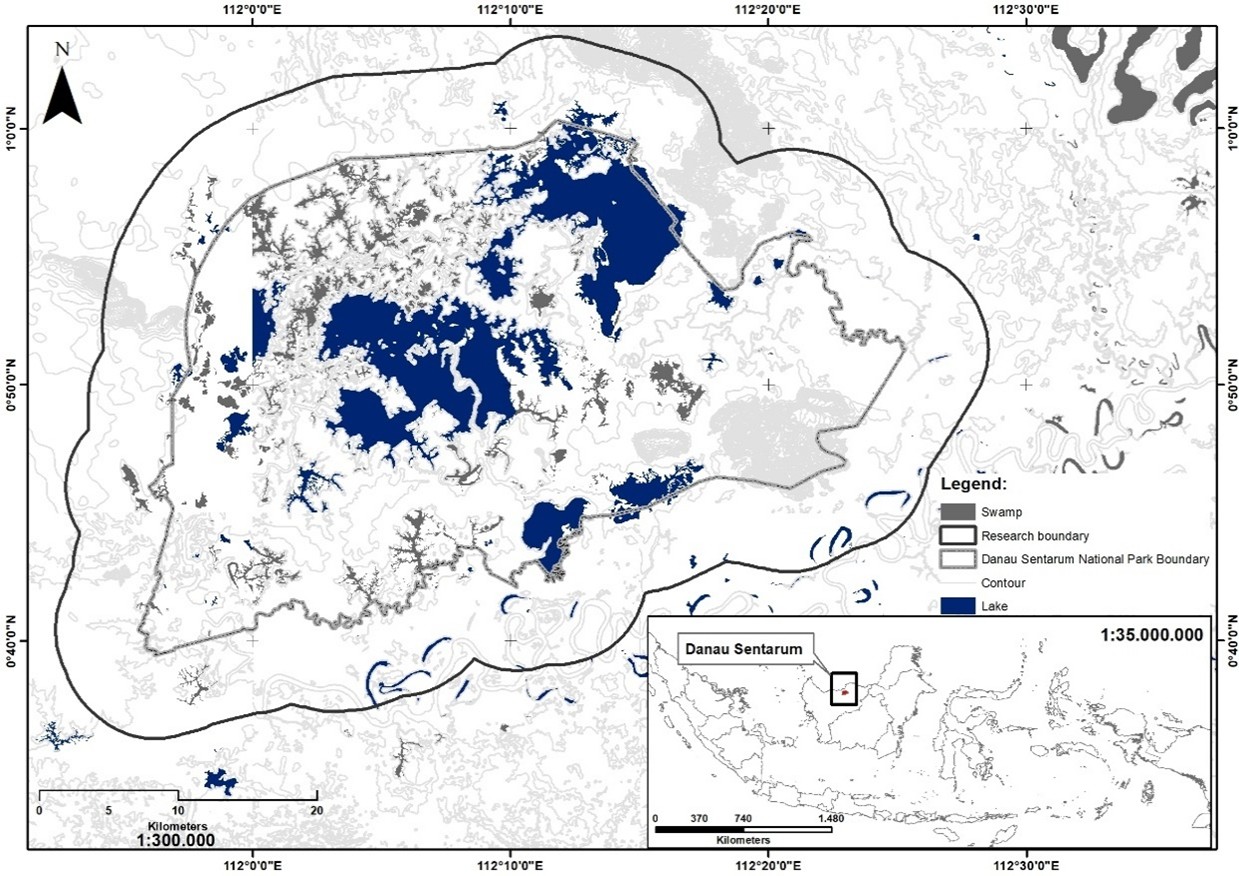
The tricolored langur (Presbytis cruciger) is not only geographically restricted but is also believed to strongly depend on specific habitat types, particularly wetland ecosystems in northern Borneo. Despite its limited range and potential vulnerability, no comprehensive habitat assessment has been conducted within its distribution area. This study aims to model the habitat suitability of P. cruciger in the Danau Sentarum landscape using environmental variables derived from direct encounter data collected between 2021 and 2023, and analyzed using MaxEnt. Habitat suitability modeling revealed that 95.94% (228,658 ha) of the total study area (238,329 ha) was classified as unsuitable habitat. The remaining areas were categorized as marginally suitable (7,080 ha), suitable (1,977 ha), and highly suitable (614 ha). Highly suitable areas are concentrated in peat swamp forests, riparian forests, and lowland secondary forests located within 1 km of lake edges, extending into the hilly zones of the Danau Sentarum landscape. Among the environmental predictors, land cover contributed the most to the model, though it showed low permutation importance. In contrast, proximity to fire hotspots demonstrated high permutation importance, indicating an avoidance behavior towards fire-prone areas. The species preferred elevations ranging from 100 to 200 meters above sea level, with 8–25% slopes, and proximity to swamp forest and lake ecosystems. These results highlight the species' strong association with wetland ecosystems and underscore the importance of conserving these habitats to ensure its survival.
Full text article
References
Buchanan, K.; de Perera, T.; Carere, C.; Carter, T.; Hailey, A.; Hubrecht, R.; Jennings, D.; Metcalfe, N.; Pitcher, T.; Peron, F.; et al. Guidelines for the Treatment of Animals in Behavioural Research and Teaching. Anim. Behav. 2012, 83, 301–309, doi:10.1016/j.anbehav.2011.10.03.
Nijman, V.; Cheyne, S.; Traeholt, C.; Setiawan, A. Presbytis Chrysomelas Ssp. Cruciger 2020.
Ehlers Smith, D.A. The Ecology and Conservation of Presbytis Rubicunda 2015.
Ehlers Smith, D.A. Feeding Ecology of Red Langurs in Sabangau Tropical Peat-Swamp Forest, Indonesian Borneo: Extreme Granivory in a Non-Masting Forest. Am. J. Primatol. 2013, 75, doi:10.1002/ajp.22148.
Santoso, N.; Sutopo; Meo, L.E.; Fauziah, N.N.; Diva, A.M. Preliminary Study: Feeding Ecology and Daily Activity of Three Colored Langur (Presbytis Chrysomelas Ssp. Cruciger) in Danau Sentarum National Park. Biotropia (Bogor). 2023, 30, 206–219, doi:10.11598/btb.2023.30.2.1850.
Santoso, N.; Fauziah, N.N.; Diva, A.M.; Sutopo Cohabitation Study of Tricolour Langur (Presbytis Chrysomelas Ssp. Cruciger) and Proboscis Monkey (Nasalis Larvatus) in Bukit Semujan Danau Sentarum National Park. J. Ilmu Kehutan. 2023, 17, 183–193, doi:10.22146/jik.v17i2.6442.
Nijman, V. Group Composition and Monandry in Grizzled Langurs, Presbytis Comata, on Java. Folia Primatol. 2017, 88, 237–254, doi:10.1159/000478695.
Widiana, A.; Hasby, R.M.; Uriawan, W. Distribution and Population Estimate of Surili (Presbytis Comata) in Kamojang Garut Regency West Java. Al-Kauniyah J. Biol. 2018, 11, 116–121, doi:10.15408/kauniyah.v11i2.6621.
Supartono, T.; Kosasih, D. Identification of the Cause of The Absence of Grizzled Leaf-Monkey (Presbytis Comata) in A Mixed Farm Ecosystem in Kuningan Regency, West Java. J. Penelit. Hutan dan Konserv. Alam 2022, 19, 69–83, doi:10.20886/jphka.2022.19.1.69-83.
Supartono, T.; Prasetyo, L.B.; Hikmat, A.; Kartono, A.P. Spatial Distribution and Habitat Use of Javan Langur (Presbytis Comata): Case Study in District of Kuningan. Procedia Environ. Sci. 2016, 33, 340–353, doi:10.1016/j.proenv.2016.03.085.
Noor-Faezah, M.; Nur-Aizatul, T.; Tawie, T.R.C.; Bukhori, M.F.; Mohd-Azlan, J.; Denel, A.; Md-Zain, B.M.; Abdul-Latiff, M.A.B.; Mohd-Ridwan, A.R. A Brief Review of Bornean Banded Langur Presbytis Chrysomelas (Müller, 1838) of Sarawak. J. Wildl. Biodivers. 2023, 7, 265–282, doi:10.5281/zenodo.8313172.
Fithria, A.; Husni, M.; Anisah, N.; Darmaji; Kissinger; Andi, N.; Syamsir, A.; Syam’ani; Rezekiah, A.R.; Yasinta, S. Distribution and Habitat Characteristics of the Lutung Dahi Putih (Presbytis Frontata) in the Senakin Mining Area of PT Arutmin Indonesia. J. Hunan Univ. Nat. Sci. 2023, 50, 64–74, doi:10.55463/issn.1674-2974.50.10.7.
Nijman, V. Geographic Distribution of Ebony Leaf Monkey (Trachypithecus Auratus) and Silvered Leaf Monkey (Trachypithecus Cristatus) in West Java, Indonesia. Contrib. to Zool. 2000, 69, 157–177, doi:10.1163/18759866-06903002.
Zhou, Q.; Wei, F.; Li, M.; Huang, C.; Luo, B. Diet and Food Choice of textit{Trachypithecus Francoisi} in the Nonggang Nature Reserve, China. Int. J. Primatol. 2006, 27, 1441–1460, doi:10.1007/s10764-006-9082-8.
Guisan, A.; Zimmermann, N.E. Predictive Habitat Distribution Models in Ecology. Ecol. Modell. 2000, 135, 147–186, doi:10.1016/S0304-3800(00)00354-9.
Phillips, S.J.; Anderson, R.P.; Schapire, R.E. Maximum Entropy Modeling of Species Geographic Distributions. Ecol. Modell. 2006, 190, 231–259.
Syphard A. D., R.V.C.H.T.J.& S.S.I. Conservation Threats Due to Human-Caused Increases in Fire Frequency in Mediterranean-Climate Ecosystems. Conserv. Biol. 2009, 23, 758–769, doi:10.1078/1433-8319-00042.
Elith, J.; Leathwick, J.R. Species Distribution Models: Ecological Explanation and Prediction Across Space and Time. Annu. Rev. Ecol. Evol. Syst. 2009, 40, 677–697.
Merow, C.; Smith, M.J.; Silander, J.A.J. A Practical Guide to MaxEnt for Modeling Species’ Distributions: What It Does, and Why Inputs and Settings Matter. Ecography (Cop.). 2013, 36, 1058–1069, doi:10.1111/j.16000587.2013.07872.x.
Chapman, C.A.; Chapman, L.J. Foraging Challenges of Red Colobus Monkeys: Influence of Nutrients and Secondary Compounds. Comp. Biochem. Physiol. Part A Mol. & Integr. Physiol. 2002, 133, 861–875, doi:10.1016/S1095-6433(02)00104-0.
Gibbons, J.M.; Harcourt, A.H. Biogeography and Ecology of Primates. In Primates in Perspective; Campbell, C.J., Fuentes, A., MacKinnon, K.C., Bearder, S.K., Stumpf, R.M., Eds.; Oxford University Press, 2009; pp. 433–447.
Estrada, A.; Coates-Estrada, R. Tropical Rain Forest Fragmentation and Wild Populations of Primates at Los Tuxtlas, Mexico. Int. J. Primatol. 1996, 17, 759–783, doi:10.1007/BF02735263.
Ningtyas, A.N.; Astuti, P.; Supriatna, J. Spatial Modelling Habitat Suitability of Javan Langur (textit{Trachypithecus Auratus}) in Bromo Tengger Semeru National Park. J. Trop. Biodivers. Biotechnol. 2022, 7, 228–238, doi:10.22146/jtbb.76841.
Nugroho, A. Pemodelan Spasial Untuk Tingkat Kesesuaian Habitat Surili Jawa (textit{Presbytis Comata Fredericae}) Di Taman Nasional Gunung Merbabu. Geomedia Maj. Ilm. dan Inf. Kegeografian 2022, 20, 105–114, doi:10.21831/geomedia.v20i2.51818.
Broekman, M.; Wulffraat, S.; Nijman, V. Habitat Suitability Analysis Reveals High Ecological Flexibility in a “Strict” Forest Primate. Front. Zool. 2020, 17, 1–10, doi:10.1186/s12983-020-00352-2.
Boyle, S.A.; Smith, A.T. Can Landscape and Species Characteristics Predict Primate Presence in Forest Fragments in the Brazilian Amazon? Biol. Conserv. 2010, 143, 1134–1143, doi:10.1016/j.biocon.2010.02.001.
Irwin, M.T. Diademed Sifaka (textit{Propithecus Diadema}) Ranging and Habitat Use in Continuous and Fragmented Forest: Higher Density but Lower Viability in Fragments? Biotropica 2008, 40, 231–240, doi:10.1111/j.1744-7429.2007.00382.x.
Primates in Fragments: Ecology and Conservation; Marsh, L.K., Ed.; Springer, 2003;
Laurance, W.F.; Goosem, M.; Laurance, S.G.W. Impacts of Roads and Linear Clearings on Tropical Forests. Trends Ecol. & Evol. 2009, 24, 659–669, doi:10.1016/j.tree.2009.06.009.
Santoso, N.; Aprillyasari, W.; Sutopo; Rahman, D.A. Is the Newly-Found Tricolor Langur More Tolerant of Humans than We Think? Inspecting Human-Primate Interaction in Danau Sentarum National Park. Int. J. Conserv. Sci. 2023, 1492, 671–684, doi:10.36868/IJCS.2023.02.20.
Cheyne, S.M.; Capilla, B.R.; Macdonald, D.W. Home-Range Use and Activity Patterns of the Red Langur (textit{Presbytis Rubicunda}) in the Sabangau Tropical Peat-Swamp Forest, Central Kalimantan, Indonesian Borneo. Int. J. Primatol. 2012, 33, 965–985, doi:10.1007/s10764-012-9602-8.
Meijaard, E.; Nijman, V. Conservation of the Red Langur in East Kalimantan, Indonesia: Population Density and the Effects of Logging. Trop. Biodivers. 2000, 7, 47–54.
Waser, P.M.; Brown, C.H. Habitat Acoustics and Primate Communication. Am. J. Primatol. 1986, 10, 135–154, doi:10.1002/ajp.1350100205.
Kinnaird, M.F.; O’Brien, T.G. Comparative Movement Patterns of Two Semi-Terrestrial Cercopithecine Primates: The Tana River Mangabey and the Sulawesi Crested Black Macaque. Ecol. Appl. 2000, 10, 1479–1490, doi:10.1890/1051-0761(2000)010[1479:CMPOST]2.0.CO;2.
Uhl, C.; Jordan, C.F. Succession and Nutrient Dynamics Following Forest Cutting and Burning in Amazonia. Ecology 1984, 65, 1476–1490, doi:10.2307/1939127.
Lamb, D.; Erskine, P.D.; Parrotta, J.A. Restoration of Degraded Tropical Forest Landscapes. Science (80-. ). 2005, 310, 1628–1632, doi:10.1126/science.1111773.
Bradshaw, A.D. Restoration of Mined Lands—Using Natural Processes. Ecol. Eng. 1997, 8, 255–269, doi:10.1016/S0925-8574(97)00022-0.
Chapman, C.A.; Chapman, L.J. Frugivory and the Ecology of Seed Dispersal in Tropical Forest Vertebrates. In Ecological Studies; 1996; Vol. 126, pp. 161–185.
Zhu, Z.; Wang, H.; Yang, Z.; Huai, W.; Huang, D.; Chen, X. Landscape Pattern Changes of Aquatic Vegetation Communities and Their Response to Hydrological Processes in Poyang Lake, China. Water 2024, 16, 1482, doi:10.3390/w16111482.
Coops, H.; Beklioglu, M.; Crisman, T.L. The Role of Water-Level Fluctuations in Shallow Lake Ecosystems – Workshop Conclusions. Hydrobiologia 2003, 506, 23–27, doi:10.1023/B:HYDR.0000008595.14393.77.
Authors
Media Konservasi is an open access journal, meaning that all content is freely available without charge to the user or their institution. Users are allowed to read, download, copy, distribute, print, search, or link to the full texts of the articles in this journal without needing to request prior permission from the publisher or the author.
All articles published by Media Konservasi are licensed under the Creative Commons Attribution 4.0 International License. This allows for unrestricted use, distribution, and reproduction in any medium, provided proper credit is given to the original authors.
Authors submitting manuscripts should understand and agree that the copyright of published manuscripts is retained by the authors. Copyright encompasses the exclusive rights of authors to reproduce, distribute, and sell any part of the journal articles in all forms and media. Reproduction of any part of this journal, its storage in databases, and its transmission by any form or media is allowed without written permission from Media Konservasi.
Article Details
How to Cite



