
Bird Community in Six Successional Stages of Habitats in Manokwari, Papua
Article Sidebar
-
bird community, stage succession, Manokwari, Papua
Abstract
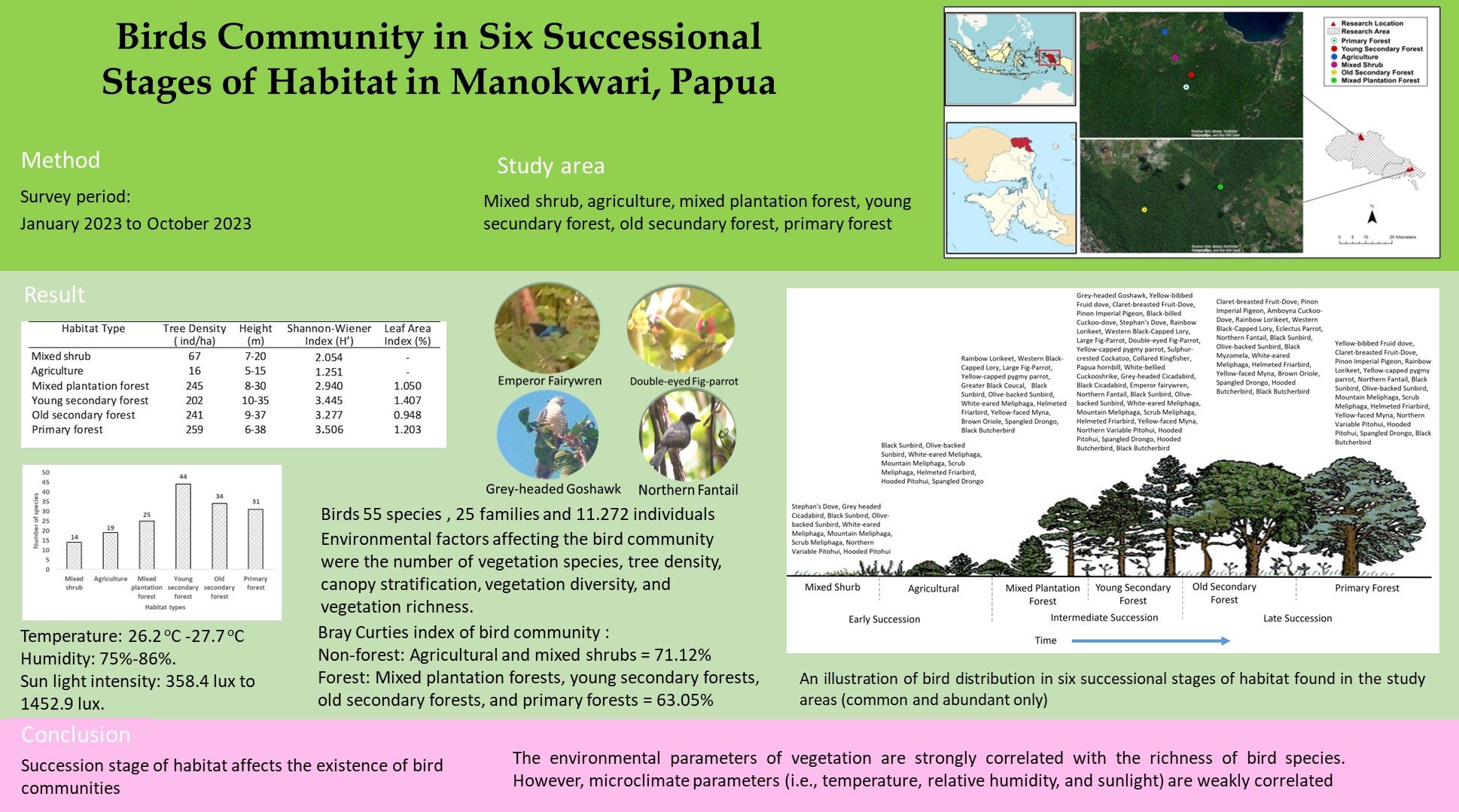
Succession after disturbance can affect the response of the bird community at each stage of habitat succession. Research on the impact of succession on birds has never been done in Papua, so this research is needed to understand how birds can survive habitat changes. This study aimed to analyze bird communities and their responses to successional stages of habitats, i.e., shrubs, agriculture, mixed plantation forest, young secondary forest, old secondary forest, and primary forest. Data collection was done from January 2023 to October 2023. Bird data (species and numbers) were collected using the point count method. Vegetation data (species and density) were collected by using the plot method, and abiotic data (air temperature, humidity, and light intensity) were collected using a dry-wet thermometer and a lux meter. The Shannon-Wiener diversity indices (H') were calculated for birds and trees. Correlation of the bird data against habitat and abiotic parameters was calculated. There were 11,272 birds from 55 species belonging to 25 families in the study area. The young secondary forest had the highest bird number and diversity (44 species; H' = 3,424), in line with the Intermediate Disturbance Hypothesis. Bird communities generally have a strong correlation with vegetation but a weak correlation with abiotic data. In light of conservation importance, young secondary forest held the highest bird species richness, while the primary forest provided habitat for some species that are highly dependent on natural forests.
Full text article
References
Mardiastuti, A. Ekologi Satwa Pada Lanskap yang Didominasi Manusia; IPB Press: Bogor, 2018; ISBN 978-602-440-029-3.
Yahner, R.H. Eastern Deciduous Forest: Ecology and Wildlife Conservation; 2nd ed.; University of Minnesota Press: Minneapolis, USA, 2000; ISBN 9780816633609.
Benítez-López, A.; Alkemade, R.; Verweij, P.A. The Impacts of Roads and Other Infrastructure on Mammal and Bird Populations: A Meta-Analysis. Biol. Conserv. 2010, 143, 1307–1316, doi:10.1016/j.biocon.2010.02.009.
Wade, A.S.I.; Barov, B.; Burfield, I.J.; Gregory, R.D.; Norris, K.; Vorisek, P.; Wu, T.; Butler, S.J. A Niche-Based Framework to Assess Current Monitoring of European Forest Birds and Guide Indicator Species’ Selection. PLoS One 2014, 9, doi:10.1371/journal.pone.0097217.
Chapman, K.A.; Reich, P.B. Land Use and Habitat Gradients Determine Bird Community Diversity and Abundance in Suburban, Rural and Reserve Landscapes of Minnesota, USA. Biol. Conserv. 2007, 135, 527–541, doi:10.1016/j.biocon.2006.10.050.
Coetzee, B.W.T.; Chown, S.L. Land-Use Change Promotes Avian Diversity at the Expense of Species with Unique Traits. Ecol. Evol. 2016, 6, 7610–7622, doi:10.1002/ece3.2389.
Reif, J.; Hořák, D.; Krištín, A.; Kopsová, L.; Devictor, V. Linking Habitat Specialization with Species’ Traits in European Birds. Oikos 2016, 125, 405–413, doi:10.1111/oik.02276.
Connell, J.H. Diversity in Tropical Rainforests and Coral Reefs. Sci. Adv. 1978, 199, 1302–1310, doi:http://dx.doi.org/10.1126/science.199.4335.1302.
Kurnia, I. Keanekaragaman Spesies Burung dan Amfibi Pada Landskap Didominasi Manusia di Wilayah Bogor, Master Thesis. Sekolah Pascasarjana-Institut Pertanian Bogor: Bogor; 4 Pebruari, 2012.
Ahmadi, R.A. Komunitas Burung pada Beberapa Habitat dengan Gangguan Berbeda di Hutan Lambusango, Pulau Buton, Sulawesi Tenggara, Bachelor Thesis. Fakultas Kehutanan- Institut Pertanian Bogor; 28 Januari 2014.
Harsiji, G.B. Identifikasi Potensi Jalur Wisata Birdwatching Di Cluster Perumahan Northridge Sentul City Bogor, Bachelor Thesis. Fakultas Kehutanan- Institut Pertanian Bogor; Bogor; 4 Pebruarii 2014.
Mardiastuti, A.; Mulyani, Y.A.; Permana, M.F.; Hernowo, J.B. Bird Diversity in Different Disturbance Gradients in Lambusango Forest, Southeast Sulawesi. In Proceedings of the 3rd INAFOR; 3rd INAFOR: Bogor, Indonesia, 21-22 October, 2015; pp. 451–461.
Nugroho, S. P. A.; Mardiastuti, A.; Mulyani, Y. A.; & Rahman, D.A. Bird Communities in the Tropical Peri-Urban Landscape of Bogor, Indonesia. Biodiversitas. 2023, 24, 6988–7000.
O’Connell TJ, Jackson LE, B.R. Bird Guilds as Indicators of Ecological Conditions in the Central Appalachians. Ecol. Appl. 2001, 10, 1706–1721.
Coates, B. J., Peckover, W.S. Birds of New Guinea and the Bismarck Archipelago: A Photographic Guide; Dove Publications: Alderley, Queensland, 2001; ISBN 095902574X.
Pratt, T.K.; Beehler, B.M. Birds of New Guinea; Second Edi.; Princeton University Press: Oxford, 2015; ISBN 978-1-4008-6511-6.
Indriyanto, I. Ekologi Hutan; PT. Bumi Aksara: Jakarta, 2008; ISBN 979-526-253-X.
Magurran, A.E. Measuring Biological Diversity; Blackwell Publishing: Oxford, 2004; ISBN 0-632-05633-9.
Sabaruddin, L. Agroklimatologi Aspek-Aspek Klimatik Untuk Sistem Budidaya Tanaman; 1st ed.; Alfabeta: Bandung, 2012; ISBN 9786029328677.
Krebs CJ. Ecological Methodology; 2nd ed.; Benjamin Cummings: Menlo Park, California, 1999; ISBN 620 p.
Blake, J.G.; Loisille, B.A. Bird Assemblages in Second-Growth and Old-Growth Forests, Costa Rica: Perspectives from Mist Nets and Point Counts. Auk. 2001, 118, 304–326, doi:10.2307/4089793.
Charry O. A and Aide T. Mitchell Recovery of Amphibian, Reptile, Bird and Mammal Diversity during Secondary Forest Succession in the Tropics. Oikos. 2019, 128, 1065–1078, doi:Doi: 10.1111/oik.06252.
Tubelis, D.; Cavalcanti, R. Community Similarity and Abundance of Bird Species in Open Habitats of a Central Brazilian Cerrado. Ornitol. Neotrop. 2001, 12, 57–73.
Remeš, V.; Harmáčková, L.; Matysioková, B.; Rubáčová, L.; Remešová, E. Vegetation Complexity and Pool Size Predict Species Richness of Forest Birds. Front. Ecol. Evol. 2022, 10, 1–10, doi:10.3389/fevo.2022.964180.
Setyowati, D.L. The Micro Climate And The Need of Green Open Space for the City of Semarang. J. Mns. dan Lingkung. 2008, 15, 125–140, doi:10.22146/jml.18685.
Fitrani, A..; Muhammad, H.G..; Kamarul, A. Perbandingan Iklim Mikro Pada Hutan Sekunder Yang Terjadi Suksesi Di Tahura Sultan Adam Mandiangin Kabupaten Banjar Kalimantan Selatan. J. hutan Trop. 2016, 4, 154–166.
Pollock, H.S.; Brawn, J.D.; Cheviron, Z.A. Heat Tolerances of Temperate and Tropical Birds and Their Implications for Susceptibility to Climate Warming. Funct. Ecol. 2021, 35, 93–104, doi:10.1111/1365-2435.13693.
O’Connell, T., Jackson, L.E. & Brooks, R.. A Bird Community Index of Biotic Integrity for the Mid-Atlantic Highlands. Env. Monit Assess. 1998, 51, doi:https://doi.org/10.1023/A:1005914714813.
Fontúrbel, F.E.; Franco, L.M.; Bozinovic, F.; Quintero-Galvis, J.F.; Mejías, C.; Amico, G.C.; Vazquez, M.S.; Sabat, P.; Sánchez-Hernández, J.C.; Watson, D.M.; et al. The Ecology and Evolution of the Monito Del Monte, a Relict Species from the Southern South America Temperate Forests. Ecol. Evol. 2022, 12, 1–17, doi:10.1002/ece3.8645.
Kalor, J.D.; Dimara, L.; Swabra, O.G.; Paiki, K. Status Kesehatan Dan Uji Spesies Indikator Biologi Ekosistem Mangrove Teluk Yotefa Jayapura. Biosfera. 2018, 35, 1, doi:10.20884/1.mib.2018.35.1.495.
Friggens, N.C.; Blanc, F.; Berry, D.P.; Puillet, L. Review: Deciphering Animal Robustness. A Synthesis to Facilitate Its Use in Livestock Breeding and Management. Animal. 2017, 11, 2237–2251, doi:10.1017/S175173111700088X.
Dawson, Jeff.; Craig, T.; Oscar, P.. A.; F.; Cara, McGary.; Chris, W.; Alexia, T..; Yosi, C. Bird Communities of the Lower Waria Valley, Morobe Province, Papua New Guinea: A Comparison between Habitat Types. Trop. Conserv. Sci. 2011, 4, 317–348.
Mandal, J.; Raman, T.R.S. Shifting Agriculture Supports More Tropical Forest Birds than Oil Palm or Teak Plantations in Mizoram, Northeast India. Condor. 2016, 118, 345–359, doi:10.1650/CONDOR-15-163.1.
Jarrett, C.; Smith, T.B.; Claire, T.T.R.; Ferreira, D.F.; Tchoumbou, M.; Elikwo, M.N.F.; Wolfe, J.; Brzeski, K.; Welch, A.J.; Hanna, R.; et al. Bird Communities in African Cocoa Agroforestry Are Diverse but Lack Specialized Insectivores. J. Appl. Ecol. 2021, 58, 1237–1247, doi:10.1111/1365-2664.13864.
Mayhew, R.J.; Tobias, J.A.; Bunnefeld, L.; Dent, D.H. Connectivity with Primary Forest Determines the Value of Secondary Tropical Forests for Bird Conservation. Biotropica 2019, 51, 219–233, doi:10.1111/btp.12629.
Ferger, S. W.; Schleuning, M.; Hemp, A.; Howell, K. M.; & Böhning-Gaese, K. Food Resources and Vegetation Structure Mediate Climatic Effects on Species Richness of Birds. Glob Ecol Biogeogr. 2014, 23, 541–549, doi:doi.org/10.1111/geb.12151.
Authors
Media Konservasi is an open access journal, meaning that all content is freely available without charge to the user or their institution. Users are allowed to read, download, copy, distribute, print, search, or link to the full texts of the articles in this journal without needing to request prior permission from the publisher or the author.
All articles published by Media Konservasi are licensed under the Creative Commons Attribution 4.0 International License. This allows for unrestricted use, distribution, and reproduction in any medium, provided proper credit is given to the original authors.
Authors submitting manuscripts should understand and agree that the copyright of published manuscripts is retained by the authors. Copyright encompasses the exclusive rights of authors to reproduce, distribute, and sell any part of the journal articles in all forms and media. Reproduction of any part of this journal, its storage in databases, and its transmission by any form or media is allowed without written permission from Media Konservasi.
Article Details
How to Cite



