Estimation of Sustainable Harvest Quota and Financial Analysis of Rusa timorensis in Intensive Captive Breeding
Article Sidebar
-
financial analysis, harvest quotas, intensive breeding, rusa timorensis, sustainable harvest
Abstract
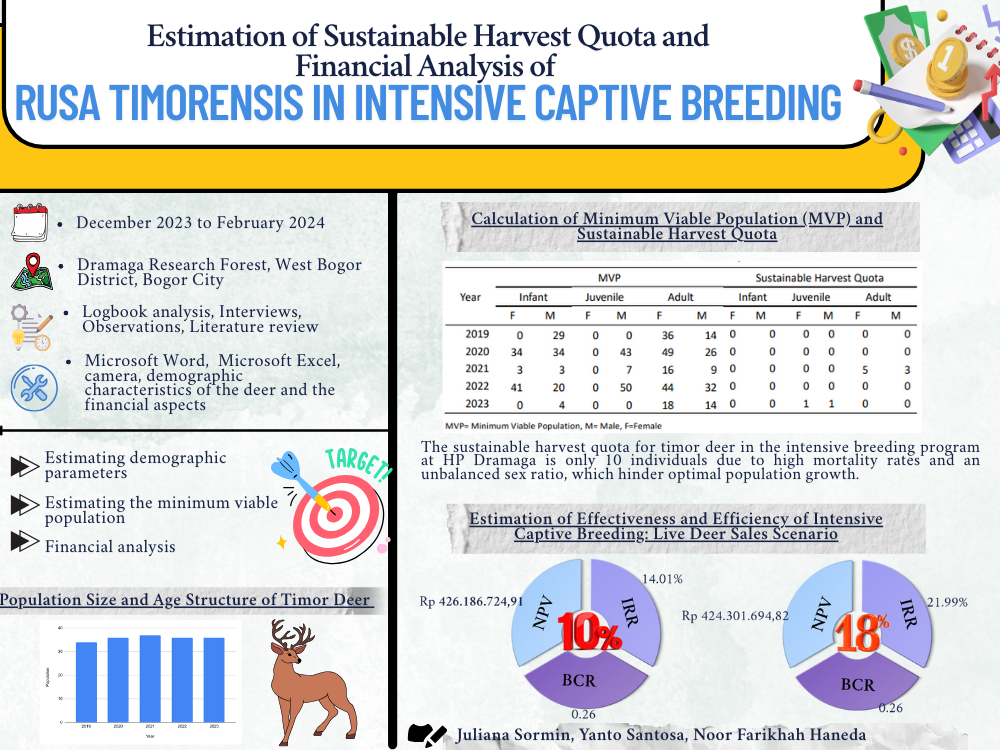
Captive breeding of Rusa timorensis is one of the conservation efforts aimed at maintaining a balance between conservation and sustainable utilization. To effectively manage this balance, it is crucial to establish a utilization level that does not compromise the population's viability, which requires a thorough understanding of its demographic parameters. Furthermore, the sustainability of the breeding program itself is contingent upon its financial feasibility. This study aims to estimate demographic parameters, determine sustainable harvest quotas, and assess the financial feasibility of deer breeding in the Dramaga Research Forest, Indonesia. Methods included logbook analysis, observation, literature review, and interviews. Results show that the sustainable harvest quota under the intensive breeding system is 10 Rusa timorensis over the 2019–2023 period. The financial analysis demonstrates strong economic viability, with a Net Present Value of IDR 643 million at a 10% discount rate. The project demonstrated a Benefit-Cost Ratio exceeding 1, an Internal Rate of Return reaching 54%, and a rapid Payback Period of only 1.68 years. These findings suggest that intensive breeding can support both conservation objectives and economic profitability. Efficient management remains essential to ensure population sustainability and optimize benefits.
Full text article
References
2. Krisna, P.A.N.; Supriatna, J.; Suparmoko, M.; Garsetiasih, R. Sustainability of Timor Deer in Captivity: Captive Breeding Systems in West Java, Indonesia. Trop. Conserv. Sci. 2020, 13, doi:10.1177/1940082920915651.
3. Ilham, Y.O.; Masy’ud, B.; Rahman, D.A. Harvesting Quota and Financial Feasibility of Timor Deer Captive Breeding in Sadhana Arifnusa East Lombok, Indonesia. J. Pengelolaan Sumberd. Alam dan Lingkung. 2024, 14, 48–57, doi:10.29244/jpsl.14.48-57.
4. Santosa, Y.; Kusmardiastuti, K.; Kartono, A.P.; Rahman, D.A. Determination of Long-Tailed Macaca (Macaca fascicularis) Harvesting Quotas Based on Demographic Parameters. Biodiversitas J. Biol. Divers. 2012, 13, 78–85, doi:10.13057/biodiv/d130205.
5. Valle, S.; Collar, N.J.; Harris, W.E.; Marsden, S.J. Trapping Method and Quota Observance are Pivotal to Population Stability in a Harvested Parrot. Biol. Conserv. 2018, 217, 428–436, doi:10.1016/j.biocon.2017.11.001.
6. Fusari, A.; Taylor, A.; Middleton, A.; Jones, B.; Lopes Pereira, C.; Jonga, C.; Demichelis, C.; Cumming, D.; Pariela, F.; Ambwene Ligate, F.; et al. Guidelines for Improving The Administration of Sustainable Hunting in sub-Saharan Africa. 2015, 1–129.
7. Papakonstantinou, G.I.; Voulgarakis, N.; Terzidou, G.; Fotos, L.; Giamouri, E.; Papatsiros, V.G. Precision Livestock Farming Technology: Applications and Challenges of Animal Welfare and Climate Change. Agric. 2024, 14, 1–17, doi:10.3390/agriculture14040620.
8. Dzhumashev, R.; Kazakevitch, G. Production, Environment, and Population Growth. Environ. Resour. Econ. 2025, doi:10.1007/s10640-025-00956-4.
9. Takandjandji, M.; Setio, P. Nilai Finansial Penangkaran Rusa Timor Di Hutan Penelitian Dramaga, Bogor. J. Penelit. Hutan dan Konserv. Alam 2014, 11, 53–76, doi:10.20886/jphka.2014.11.1.53-76.
10. Beissinger, S.R.; Walters, J.R.; Catanzaro, D.G.; Smith, K.G.; Dunning, J.B.; Haig, S.M.; Noon, B.R.; Stith, B.M. Modeling Approaches in Avian Conservation and the Role of Field Biologists. Ornithol. Monogr. 2006, iii–56, doi:10.2307/40166820.
11. Makalingga, P.; Suryantini, A.; Waluyati, L.R. Financial Feasibility of The Vaname Shrimp Farming Business in The Purworejo Regency. Agro Ekon. 2019, 29, 274, doi:10.22146/ae.35979.
12. Jackson, J.; Mar, K.U.; Htut, W.; Childs, D.Z.; Lummaa, V. Changes in Age-Structure Over Four Decades Were a Key Determinant of Population Growth Rate in a Long-Lived Mammal. J. Anim. Ecol. 2020, 89, 2268–2278, doi:10.1111/1365-2656.13290.
13. Bramhall, C. Digital Commons Inthrop Impacts of Urbanization on Demographics and the Stress Level of White-Tailed Deer in the Piedmont of South Carolina. 2024.
14. Converse, S.J.; Moore, C.T.; Armstrong, D.P. Demographics of reintroduced Populations: Estimation, Modeling, and Decision Analysis. J. Wildl. Manage. 2013, 77, 1081–1093, doi:10.1002/jwmg.590.
15. Garrie, J.; Meeker, R. Factors Affecting the Sex Ratio of White-tailed Deer (Odocoileus virginianus) Fetuses in Arkansas. J. Ark. Acad. Sci. 2022, 76, doi:10.54119/jaas.2022.7603.
16. Samsudewa, D.; Capitan, S.S. Reproductive Behaviour of Timor Deer (Rusa timorensis). Wartazoa 2011, 21, 108–113.
17. Ratag, E.; Santosa, Y.; Priyono K, A.; Nitibaskara, T.U. Kajian Ekologi Populasi Rusa Sambar (Cervus unicolor) dalam Pengusahaan Taman Buru Gunung Masigit Kareumbi) (Study on Ecology of Cervus unicolor Population in the Development of Gunung Masigit Kareumbi Hunting Park). Agustus 2006, XI, 39–45.
18. Arulnathan, V.; Heidari, M.D.; Doyon, M.; Li, E.P.H.; Pelletier, N. Economic Indicators for Life Cycle Sustainability Assessment: Going beyond Life Cycle Costing. Sustain. 2023, 15, 1–27, doi:10.3390/su15010013.
19. Williams, S.E.; Hoffman, E.A. Minimizing Genetic Adaptation in Captive Breeding Programs: A review. Biol. Conserv. 2009, 142, 2388–2400, doi:10.1016/j.biocon.2009.05.034.
20. Suhri, A.G.M.I.; Hashifah, F.N.; Hasan, P.A. Dinamika Ekosistem. In Ekologi Hewan; Mubarok, S., Ed.; Eureka Media Aksara: Purbalingga, 2024; pp. 107–133.
21. Purba, R.; Dewi, B.; Harianto, S. Perilaku Seksual Rusa Timor (Cervus timorensis) di Penangkaran Rusa Universitas Lampung. JOFPE J. 2023, 3, 54–63.
22. Natusch, D.J.D.; Lyons, J.A.; Mumpuni; Riyanto, A.; Shine, R. Jungle giants: Assessing Sustainable Harvesting in a Difficult-to-Survey Species (Python reticulatus). PLoS One 2016, 11, 1–14, doi:10.1371/journal.pone.0158397.
23. Bowyer, R.T.; Stewart, K.M.; Bleich, V.C.; Whiting, J.C.; Monteith, K.L.; Blum, M.E.; LaSharr, T.N. Metrics of Harvest for Ungulate Populations: Misconceptions, Lurking Variables, and Prudent Management. Alces 2020, 56, 15–38.
Authors
Copyright (c) 2025 Juliana Sormin, Yanto Santosa, Noor Farikhah Haneda

This work is licensed under a Creative Commons Attribution 4.0 International License.
Media Konservasi is an open access journal, meaning that all content is freely available without charge to the user or their institution. Users are allowed to read, download, copy, distribute, print, search, or link to the full texts of the articles in this journal without needing to request prior permission from the publisher or the author.
All articles published by Media Konservasi are licensed under the Creative Commons Attribution 4.0 International License. This allows for unrestricted use, distribution, and reproduction in any medium, provided proper credit is given to the original authors.
Authors submitting manuscripts should understand and agree that the copyright of published manuscripts is retained by the authors. Copyright encompasses the exclusive rights of authors to reproduce, distribute, and sell any part of the journal articles in all forms and media. Reproduction of any part of this journal, its storage in databases, and its transmission by any form or media is allowed without written permission from Media Konservasi.
Article Details
How to Cite



