
The Sumatran Tiger's Corridor in Agam, West Sumatra: An Initial Analysis of the Metrics Indices Landscape
Article Sidebar
-
corridor, fragmentation, human-wildlife conflict, landscape metrics
Abstract
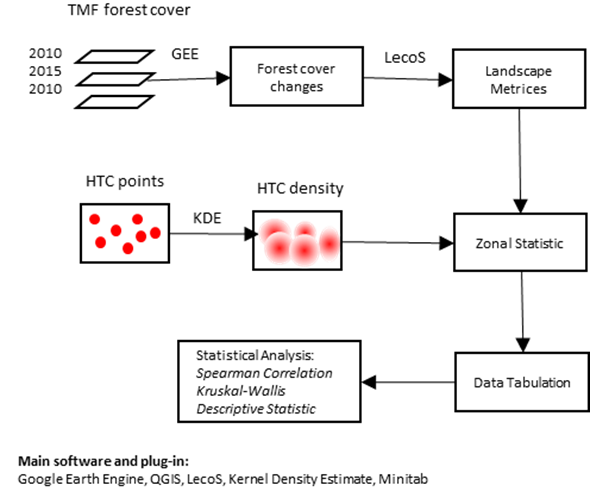
Increased habitat pressure is indicated by high levels of human-tiger conflict (HTC). For Sumatran tigers to survive, structural corridor management is essential to managing the tiger metapopulation. Since 2016, Agam Regency has seen a sharp rise in HTC. This exploratory study aimed to understand variations in the corridor's forest cover and to evaluate the relationship between landscape metric indicators and fluctuations in HTC density. Agam's corridor is separated into 31 grids (3x3km). HTC information was gathered from earlier studies and web searches for incidents from 2000 to 2024. Tropical Forest Monitoring's landcover dataset was obtained through the use of a Google Earth Engine script. The LecoS plug-in is used to calculate landscape metric indices. For non-normally distributed data, the Spearman correlation statistic (95% CI) is employed. Before the HTC series in 2016, there was a twofold increase in deforestation, from 0.56% to 1.1% between 2010 and 2015. Nine landscape metrics, including forest area, forest proportion, NP, PD, GPA, LPI, PCI, and splitting index, exhibited a significant correlation with HTC density (p-value < 0.05). Around the corridor, high HTC density was associated with PD >10 patches km-2, LPI <44%, forest fraction <50.76%, and more disaggregated patches (PCI<9.79%). Since it may not be feasible to reduce HTC to zero incidents in the vicinity of human-dominated tiger habitats, expectations should be moderated, as lower HTC density occurs in wider landscape metric ranges. Improving PCI by aggregating patches and reducing NP while maintaining the remaining forest can potentially reduce HTC incidents and increase corridor function in tiger metapopulation management. The challenges are enormous, as 94% the corridor is in a non-protected area.
Full text article
References
1. Khan, M.M.H.; Chivers, D.J. Habitat Preferences of Tigers Panthera Tigris in the Sundarbans East Wildlife Sanctuary, Bangladesh, and Management Recommendations. Oryx 2007, 41, 463–468, doi:10.1017/S0030605307012094.
2. Wibisono, H.T.; Linkie, M.; Guillera-Arroita, G.; Smith, J.A.; Sunarto; Pusparini, W.; Asriadi; Baroto, P.; Brickle, N.; Dinata, Y.; et al. Population Status of a Cryptic Top Predator: An Island-Wide Assessment of Tigers in Sumatran Rainforests. PLoS One 2011, 6, doi:10.1371/journal.pone.0025931.
3. Sunarto, S.; Kelly, M.J.; Parakkasi, K.; Klenzendorf, S.; Septayuda, E.; Kurniawan, H. Tigers Need Cover: Multi-Scale Occupancy Study of the Big Cat in Sumatran Forest and Plantation Landscapes. PLoS One 2012, 7, doi:10.1371/journal.pone.0030859.
4. Weiskopf, S.R.; McCarthy, J.L.; McCarthy, K.P.; Shiklomanov, A.N.; Wibisono, H.T.; Pusparini, W. The Conservation Value of Forest Fragments in the Increasingly Agrarian Landscape of Sumatra. Environ. Conserv. 2019, 68–108, doi:10.1017/S0376892919000195.
5. Wibisono, H.T.; McCarthy, K.P. Modeling Potential Connectivity of Fragmented Habitats of Sumatran Tiger in West Sumatra, Indonesia. Di Dalam: Wibisono. HT. 2021. An Island-Wide Status of Sumatran Tiger (Panthera Tigris Sumatrae) And Principal Prey in Sumatra, Indonesia. Doctor of Philo. 2021, 68 – 108.
6. Priatna, D.; Santosa, Y.; Prasetyo, L.B.; Kartono, a P. Home Range and Movements of Male Translocated Problem Tigers in Sumatra. Asian J. Conserv. Biol. 2012, 1, 20–30.
7. Seidensticker, J.; McDougal, C. Tiger Predatory Behaviour, Ecology and Conservation. Mamm. as Predators 1993, 105–125, doi:10.1093/oso/9780198540670.003.0006.
8. Kerley, L.L.; Goodrich, J.M.; Miquelle, D.G.; Smirnov, E.N.; Quigley, H.B.; Hornocker, M.G. Reproductive Parameters of Wild Female Amur (Siberian) Tigers (Panthera Tigris Altaica). J. Mammal. 2003, 84, 288–298, doi:10.1644/1545-1542(2003)084<0288:RPOWFA>2.0.CO;2.
9. Singh, R.; Krausman, P.R.; Pandey, P.; Qureshi, Q.; Sankar, K.; Goyal, S.P.; Tripathi, A. First Parturition of Tigers in a Semi-Arid Habitat, Western India. Eur. J. Wildl. Res. 2014, 60, 383–386, doi:10.1007/s10344-013-0784-x.
10. Singh, R.; Nigam, P.; Qureshi, Q.; Sankar, K.; Krausman, P.R.; Goyal, S.P. Strategy of Female Tigers to Avoid Infanticide. Curr. Sci. 2014, 107, 1595–1597.
11. Gaveau, D.L.A.; Curran, L.M.; Paoli, G.D.; Carlson, K.M.; Wells, P.; Besse-Rimba, A.; Ratnasari, D.; Leader-Williams, N. Examining Protected Area Effectiveness in Sumatra: Importance of Regulations Governing Unprotected Lands. Conserv. Lett. 2012, 5, 142–148, doi:10.1111/j.1755-263X.2011.00220.x.
12. Margono, B.A.; Turubanova, S.; Zhuravleva, I.; Potapov, P.; Tyukavina, A.; Baccini, A.; Goetz, S.; Hansen, M.C. Mapping and Monitoring Deforestation and Forest Degradation in Sumatra (Indonesia) Using Landsat Time Series Data Sets from 1990 to 2010. Environ. Res. Lett. 2012, 7, doi:10.1088/1748-9326/7/3/034010.
13. Forum Harimau Kita AUM! ATLAS HARIMAU NUSANTARA; Prijono, A., Kholis, M., Bahaduri, L.D., Eds.; Direktorat Konservasi Keanekaragaman Hayati, Direktorat Jenderal Konservasi Sumber Daya Alam, Kementerian Lingkungan Hidup dan Kehutanan, GEF UNDP. Jakarta, 2019; ISBN 9786020854328.
14. Tejaswi, G.; Holmgren, P. Manual on Deforestation, Degradation, and Fragmentation Using Remote Sensing and GIS. Strengthening Monitoring, Assessment and Reporting on Sustainable Forest Management in Asia (GCP/INT/988/JPN). 2007, 49.
15. Nad, C.; Roy, R.; Roy, T.B. “Human Elephant Conflict in Changing Land-Use Land-Cover Scenario in and Adjoining Region of Buxa Tiger Reserve, India.” Environ. Challenges 2022, 7, 100384, doi:10.1016/j.envc.2021.100384.
16. Ruda, A.; Kolejka, J.; Silwal, T. GIS-Assisted Prediction and Risk Zonation of Wildlife Attacks in the Chitwan National Park in Nepal. ISPRS Int. J. Geo-Information 2018, 7, 1–21, doi:10.3390/ijgi7090369.
17. Wegge, P.; Yadav, S.K.; Lamichhane, B.R. Are Corridors Good for Tigers Panthera Tigris but Bad for People? An Assessment of the Khata Corridor in Lowland Nepal. ORYX 2018, 52, 35–45, doi:10.1017/S0030605316000661.
18. Patana, P.; Alikodra, H.S.; Mawengkang, H.; Hamdani Harahap, R. State of Human Tiger Conflict around Gunung Leuser National Park in Langkat Landscape, North Sumatra, Indonesia. Biodiversitas 2023, 24, 837–846, doi:10.13057/biodiv/d240220.
19. Pusparini, W.; Ariyanto, T.; Sadikin, L.; Widodo, F.A.; Wahyudi, H.A. Report: Sumatran Tiger Population Viability Analysis. Kementeri. Lingkung. Hidup dan Kehutan. 2019.
20. Vásquez-Grandón, A.; Donoso, P.J.; Gerding, V. Forest Degradation: When Is a Forest Degraded? Forests 2018, 9, 1–13, doi:10.3390/f9110726.
21. Supriatna, J.; Dwiyahreni, A.A.; Winarni, N.; Mariati, S.; Margules, C. Deforestation of Primate Habitat on Sumatra and Adjacent Islands, Indonesia. Primate Conserv. 2017, 31, 71–82.
22. Wikramanayake, E.; Dinerstein, E.; Seidensticker, J.; Lumpkin, S.; Pandav, B.; Shrestha, M.; Mishra, H.; Ballou, J.; Johnsingh, A.J.T.; Chestin, I.; et al. A Landscape-Based Conservation Strategy to Double the Wild Tiger Population. Conserv. Lett. 2011, 4, 219–227, doi:10.1111/j.1755-263X.2010.00162.x.
23. Gurung, B.; Nelson, K.C.; Smith, J.L.D. Impact of Grazing Restrictions on Livestock Composition and Husbandry Practices in Madi Valley, Chitwan National Park, Nepal. Environ. Conserv. 2009, 36, 338–347, doi:10.1017/S0376892910000160.
24. Kartika, E.C. Human-Tiger Conflict: An Overview of Incidents, Causes and Resolution. 2013, doi:10.13140/RG.2.1.3754.2808.
25. Kholis, M.; Faisal, A.; A, F.; Widodo; Hasihola, W.; Musabine, S.E.; Kartika, E.C. Pedoman Penanggulangan Konflik Manusia-Harimau. 2017, 1–100.
26. Lamichhane, B.R.; Persoon, G.A.; Leirs, H.; Musters, C.J.M.; Subedi, N.; Gairhe, K.P.; Pokheral, C.P.; Poudel, S.; Mishra, R.; Dhakal, M.; et al. Are Conflict-Causing Tigers Different? Another Perspective for Understanding Human-Tiger Conflict in Chitwan National Park, Nepal. Glob. Ecol. Conserv. 2017, 11, 177–187, doi:10.1016/j.gecco.2017.06.003.
27. Kartika, E. Spatio-Temporal Patterns of Human-Tiger Conflicts in Sumatra 2001-2016. 2017, 31.
28. Rahman, H.; Hidayat, R.A.; Nofrizal, A.Y.; Wilastra, I.; Nasution, A.F.R. Priority Corridor Zone for Human-Tiger Conflict Mitigation: A Landscape Connectivity Approach in West Sumatra Region, Indonesia. J. Nat. Conserv. 2023, 76, 126501, doi:10.1016/j.jnc.2023.126501.
29. Sulistyawan, B.S.; Eichelberger, B.A.; Verweij, P.; Boot, R.G.A.; Hardian, O.; Adzan, G.; Sukmantoro, W. Connecting the Fragmented Habitat of Endangered Mammals in the Landscape of Riau–Jambi–Sumatera Barat (RIMBA), Central Sumatra, Indonesia (Connecting the Fragmented Habitat Due to Road Development). Glob. Ecol. Conserv. 2017, 9, 116–130, doi:10.1016/j.gecco.2016.12.003.
30. Ritonga, R.P.; Novarino, W.; Mahdi Pengaruh Aktifitas Sosial Ekonomi Masyarakat Pada the Influence of Socio-Economic Activities on Extraordinary. Menara Ilmu 2023, XVII, 256–266.
31. Wati, V.W. Pemodelan Potensi Konflik Manusia Dengan Harimau Sumatera (Panthera Tigris Sumatrae) Berdasarkan Data Historis Di Sumatera Barat. Dep. Biol. Andalas Univ. Indones. 2021.
32. Kartika, E.C.; Koopmans, F. Human-Tiger Conflict : An Overview of Incidents , Causes and Resolution Human-Tiger Conflict : An Overview of Incidents , Causes and Resolution. 2016, 1–27, doi:10.13140/RG.2.1.3754.2808.
33. Vancutsem, C.; Achard, F.; Pekel, J.F.; Vieilledent, G.; Carboni, S.; Simonetti, D.; Gallego, J.; Aragão, L.E.O.C.; Nasi, R. Long-Term (1990–2019) Monitoring of Forest Cover Changes in the Humid Tropics. Sci. Adv. 2021, 7, 1–21, doi:10.1126/sciadv.abe1603.
34. McGarigal, K.; Marks, B.J.; Cushman, S.A.; Neel, M.C.; Ene, E. FRAGSTATS: Spatial Pattern Analysis Program for Categorical Maps. Gen. Tech. Rep. PNW-GTR-351. US … 1994, 97331, 134.
35. Tischendorf, L.; Bender, D.J.; Fahrig, L. Evaluation of Patch Isolation Metrics in Mosaic Landscapes for Specialist vs. Generalist Dispersers. Landsc. Ecol. 2003, 18, 41–50, doi:10.1023/A:1022908109982.
36. Wadgave, U.; Ravindra Khairnar, M. Parametric Test for Non-Normally Distributed Continuous Data: For and Against. Electron. physician 2019, 11, 7468–7470, doi:10.19082/7468.
37. Leon, A.C. Descriptive and Inferential Statistics. Compr. Clin. Psychol. 1998, 243–285, doi:10.1016/B0080-4270(73)00264-9.
38. Ostertagová, E.; Ostertag, O.; Kováč, J. Methodology and Application of the Kruskal-Wallis Test. Appl. Mech. Mater. 2014, 611, 115–120, doi:10.4028/www.scientific.net/AMM.611.115.
39. Prasetyo, L.B. Pendekatan Ekologi Lanskap; 2017; ISBN 2013206534.
40. Haidir, I..; Albert. W.r; Pinondang, I.M.R.; Ariyanto, T.; Widodo, F.A.; Ardiantiono Panduan Pemantauan Populasi Harimau Sumatera, Direktorat Konservasi S 2017, 154.
41. Condro, A.A.; Prasetyo, L.B.; Rushayati, S.B.; Santikayasa, I.P.; Iskandar, E. Protected Areas Slow down Tropical Rainforest Disturbance in the Leuser Ecosystem, Indonesia. J. Land Use Sci. 2022, 17, 454–470, doi:10.1080/1747423X.2022.2115571.
42. Lubis, M.I.; Pusparini, W.; Prabowo, S.A.; Marthy, W.; Tarmizi; Andayani, N.; Linkie, M. Unraveling the Complexity of Human–Tiger Conflicts in the Leuser Ecosystem, Sumatra. Anim. Conserv. 2020, 23, 741–749, doi:10.1111/acv.12591.
43. Joshi, A.; Vaidyanathan, S.; Mondo, S.; Edgaonkar, A.; Ramakrishnan, U. Connectivity of Tiger (Panthera Tigris) Populations in the Human-Influenced Forest Mosaic of Central India. PLoS One 2013, 8, doi:10.1371/journal.pone.0077980.
44. Luskin, M.S.; Albert, W.R.; Tobler, M.W. Sumatran Tiger Survival Threatened by Deforestation despite Increasing Densities in Parks. Nat. Commun. 2017, 8, doi:10.1038/s41467-017-01656-4.
45. Goodrich, J.M. Human-Tiger Conflict: A Review and Call for Comprehensive Plans. Integr. Zool. 2010, 5, 300–312.
46. Nugroho, A. wahyu Membaca Arah Perubahan Kehutanan Pasca-Terbitnya Undang-Undang Cipta Kerja. J. Huk. Lingkung. Indones. 2021, 7, 275–296, doi:10.38011/jhli.v7i2.278.
47. Chouksey, S.; Singh, S. Assessment on the Impacts of Human-Tiger Conflict and Community-Based Conservation in Bandhavgarh Tiger Reserve, Madhya Pradesh, India. J. Threat. Taxa 2018, 10, 11844–11849, doi:10.11609/jott.3015.10.7.11844-11849.
48. Thapa, K.; Wikramanayake, E.; Malla, S.; Acharya, K.P.; Lamichhane, B.R.; Subedi, N.; Pokharel, C.P.; Thapa, G.J.; Dhakal, M.; Bista, A.; et al. Tigers in the Terai: Strong Evidence for Meta-Population Dynamics Contributing to Tiger Recovery and Conservation in the Terai Arc Landscape. PLoS One 2017, 12, doi:10.1371/journal.pone.0177548.
49. Linkie, M.; Haidir, I.A.; Nugroho, A.; Dinata, Y. Conserving Tigers Panthera Tigris in Selectively Logged Sumatran Forests. Biol. Conserv. 2008, 141, 2410–2415, doi:10.1016/j.biocon.2008.07.002.
50. McKay, J.E.; St John, F.A.V.; Harihar, A.; Martyr, D.; Leader-Williams, N.; Milliyanawati, B.; Agustin, I.; Anggriawan, Y.; Karlina; Kartika, E.; et al. Tolerating Tigers: Gaining Local and Spiritual Perspectives on Human-Tiger Interactions in Sumatra through Rural Community Interviews. PLoS One 2018, 13, doi:10.1371/journal.pone.0201447.
51. Campbell-Smith, G.; Simanjorang, H.V.P.; Leader-Williams, N.; Linkie, M. Local Attitudes and Perceptions toward Crop-Raiding by Orangutans (Pongo Abelii) and Other Nonhuman Primates in Northern Sumatra, Indonesia. Am. J. Primatol. 2010, 72, 866–876, doi:10.1002/ajp.20822.
52. Dertien, J.S.; Negi, H.; Dinerstein, E.; Krishnamurthy, R.; Negi, H.S.; Gopal, R.; Gulick, S.; Pathak, S.K.; Kapoor, M.; Yadav, P.; et al. Mitigating Human-Wildlife Conflict and Monitoring Endangered Tigers Using a Real-Time Camera-Based Alert System. Bioscience 2023, 73, 748–757, doi:10.1093/biosci/biad076.
53. Lamichhane, B.R.; Persoon, G.A.; Leirs, H.; Musters, C.J.M.; Subedi, N.; Gairhe, K.P.; Pokheral, C.P.; Poudel, S.; Mishra, R.; Dhakal, M.; et al. Are Conflict-Causing Tigers Different? Another Perspective for Understanding Human-Tiger Conflict in Chitwan National Park, Nepal. Glob. Ecol. Conserv. 2017, 11, 177–187, doi:10.1016/j.gecco.2017.06.003.
54. Wibisono, H.T.; Pusparini, W. Sumatran Tiger (Panthera Tigris Sumatrae): A Review of Conservation Status. Integr. Zool. 2010, 5, 313–323, doi:10.1111/j.1749-4877.2010.00219.x.
Authors
Copyright (c) 2026 Kholis Munawar, Syartinilia, Laksmi Datu Bahaduri

This work is licensed under a Creative Commons Attribution 4.0 International License.
Media Konservasi is an open access journal, meaning that all content is freely available without charge to the user or their institution. Users are allowed to read, download, copy, distribute, print, search, or link to the full texts of the articles in this journal without needing to request prior permission from the publisher or the author.
All articles published by Media Konservasi are licensed under the Creative Commons Attribution 4.0 International License. This allows for unrestricted use, distribution, and reproduction in any medium, provided proper credit is given to the original authors.
Authors submitting manuscripts should understand and agree that the copyright of published manuscripts is retained by the authors. Copyright encompasses the exclusive rights of authors to reproduce, distribute, and sell any part of the journal articles in all forms and media. Reproduction of any part of this journal, its storage in databases, and its transmission by any form or media is allowed without written permission from Media Konservasi.
Article Details
How to Cite



