
Non-Destructive Prediction of Oil and Moisture Content in Palm Fresh Fruit Bunches Using Electrical Capacitance
DOI:
https://doi.org/10.19028/jtep.014.2.229-244Keywords:
electrical capacitance, Fresh fruit bunch, oil content, moisture contentAbstract
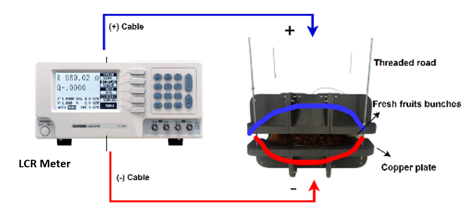
Rapid, non-destructive techniques for evaluating the internal quality of fresh oil palm fruit bunches (FFB) are needed to improve harvesting and postharvest management. This study aimed to develop predictive models for the moisture and oil content of fresh oil palm fruit bunches using electrical capacitance and chemometric analysis. Electrical capacitance (Cp) measurements were obtained using an inductance-capacitance-resistance (LCR) meter from fruit samples representing five maturity levels. The capacitance data were analyzed using Partial Least Squares Regression (PLSR) with several data preprocessing techniques, including Original, Baseline Correction, Standard Normal Variate (SNV), and Multiplicative Scatter Correction (MSC). Model performance was evaluated using the coefficient of determination (R²), the correlation coefficient (r), the standard error of prediction (SEP), the residual predictive deviation (RPD), and the consistency (%) parameter. Among the evaluated preprocessing methods, MSC produced the best model performance. The optimal model for moisture content was obtained using MSC with three latent factors, yielding R² = 0.74 r = 0.86, SEP = 5.02%, RPD = 1.81, and consistency = 86.12%. The optimal model for oil content prediction was also obtained using MSC with four latent variables, achieving R² = 0.88, r = 0.94, SEP = 3.84%, RPD = 2.36 and consistency = 93.84%. These results indicate that electrical capacitance combined with PLSR has potential as a rapid and non-destructive method for the chemical quality evaluation of oil palm FFB, particularly for oil content prediction, while moisture content prediction showed limited predictive capability.
Downloads
Downloads
Published
Issue
Section
License
Copyright (c) 2026 Jurnal Keteknikan Pertanian

This work is licensed under a Creative Commons Attribution-ShareAlike 4.0 International License.
Authors submitting manuscripts should understand and agree that copyright of manuscripts of the article shall be assigned/transferred to Jurnal Keteknikan Pertanian. This work is licensed under a Creative Commons Attribution-ShareAlike 4.0 International License (CC BY-SA) where Authors and Readers can copy and redistribute the material in any medium or format, as well as remix, transform, and build upon the material for any purpose, but they must give appropriate credit (cite to the article or content), provide a link to the license, and indicate if changes were made. If you remix, transform, or build upon the material, you must distribute your contributions under the same license as the original.
Jurnal Keteknikan Pertanian is an open access journal.