
Kalman Filter Stabilization of Multi-Sensor Water Quality Measurements under Turbulent Flow in Eel Aquaculture
DOI:
https://doi.org/10.19028/jtep.014.2.213-228Keywords:
Eel environment, Kalman filter, Noise reduction, Unsteady flow, Water qualityAbstract
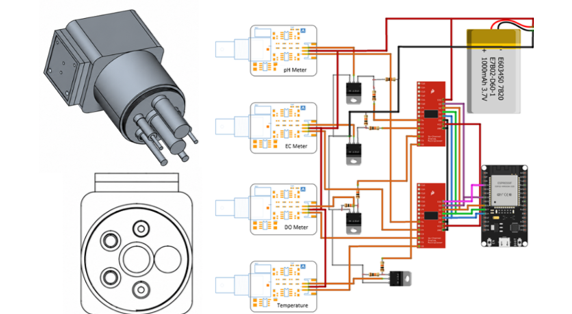
While Kalman Filters are widely used for water quality sensors, most studies focus on static environments, ignoring hydrodynamic noise in continuous-flow systems such as eel aquaculture, where turbulence-induced sensor instability may directly affect automated control decisions. This study evaluated the performance of the Kalman Filter in mitigating multi-sensor reading noise caused by unsteady flow from a wavemaker in a closed aquarium. Experiments simulated an eel environment (salinity 5-7 ppt, flow velocity 0.27 m/s) to measure pH, electrical conductivity (EC), dissolved oxygen (DO), and water temperature in situ. The performance of the Kalman Filter was compared directly with the that of Simple Moving Average (SMA), Exponentially Weighted Moving Average (EWMA), and Butterworth filters. The performance of these filters was assessed using the Standard Deviation, Root Mean Square Error (RMSE), Noise Reduction Ratio (NRR), Signal-to-Noise Ratio (SNR), and Smoothness Index. The results demonstrate that the Kalman Filter not only reduces signal fluctuations but also improves measurement accuracy, as validated by lower RMSE values relative to ground truth references under static conditions. It outperformed the other algorithms by reducing the average standard deviation by 87.65%, lowering the mean RMSE by 28.22%, decreasing the average noise by 13.56%, and increasing the mean SNR by 4.44 dB. This study demonstrates the superiority of the Kalman Filter in stabilizing sensor data against complex hydrodynamic turbulence.
Downloads
Downloads
Published
Issue
Section
License
Copyright (c) 2026 Jurnal Keteknikan Pertanian

This work is licensed under a Creative Commons Attribution-ShareAlike 4.0 International License.
Authors submitting manuscripts should understand and agree that copyright of manuscripts of the article shall be assigned/transferred to Jurnal Keteknikan Pertanian. This work is licensed under a Creative Commons Attribution-ShareAlike 4.0 International License (CC BY-SA) where Authors and Readers can copy and redistribute the material in any medium or format, as well as remix, transform, and build upon the material for any purpose, but they must give appropriate credit (cite to the article or content), provide a link to the license, and indicate if changes were made. If you remix, transform, or build upon the material, you must distribute your contributions under the same license as the original.
Jurnal Keteknikan Pertanian is an open access journal.