Optimization of Foaming and Filling Agents in Foam-Mat Drying Method for Kombucha Powder Production
DOI:
https://doi.org/10.19028/jtep.014.1.49-63Keywords:
CMC, foam-mat drying, kombucha powder, maltodextrin, tween-80Abstract
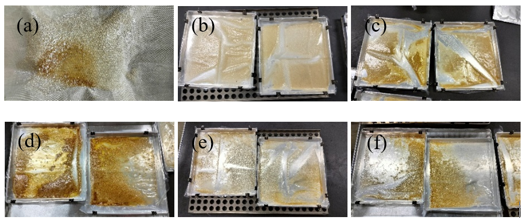
Kombucha is a functional beverage produced by fermenting tea with a symbiotic culture of bacteria and yeast (SCOBY). It is known for its various health benefits but is limited by its short shelf-life. To improve its stability, kombucha can be converted into powder using the foam-mat drying method, the effectiveness of which depends strongly on the formulation of foaming and filling agents. This study aimed to determine the optimal formulation of foaming and filling agents in kombucha. This study evaluated four formulations combining maltodextrin (15% and 20%), Tween-80 (0.25–1%), egg albumen (0–5%), and carboxymethyl cellulose (CMC; 0.3%). The formulation of 500 g kombucha with 15% maltodextrin, 0.3% CMC, 0.5% Tween-80, and 5% egg albumen produced the best results, yielding 14.38% powder with 5.78% moisture, a hue value of 1.32, chroma of 14.80, and whiteness index of 81.84. These findings indicate that the selected formulation is effective in producing kombucha powder with desirable physical properties.
Downloads
Downloads
Published
Issue
Section
License
Copyright (c) 2026 Jurnal Keteknikan Pertanian

This work is licensed under a Creative Commons Attribution-ShareAlike 4.0 International License.
Authors submitting manuscripts should understand and agree that copyright of manuscripts of the article shall be assigned/transferred to Jurnal Keteknikan Pertanian. This work is licensed under a Creative Commons Attribution-ShareAlike 4.0 International License (CC BY-SA) where Authors and Readers can copy and redistribute the material in any medium or format, as well as remix, transform, and build upon the material for any purpose, but they must give appropriate credit (cite to the article or content), provide a link to the license, and indicate if changes were made. If you remix, transform, or build upon the material, you must distribute your contributions under the same license as the original.
Jurnal Keteknikan Pertanian is an open access journal.