Rapid NIR-Based Prediction of Free Fatty Acid and Moisture Content in Intact Oil Palm Fruits Using PLSR and Hybrid PLS–ANN Models
DOI:
https://doi.org/10.19028/jtep.014.1.108-124Keywords:
NIR, Oil palm fruits, PLS-ANN, moisture content, free fatty acidAbstract
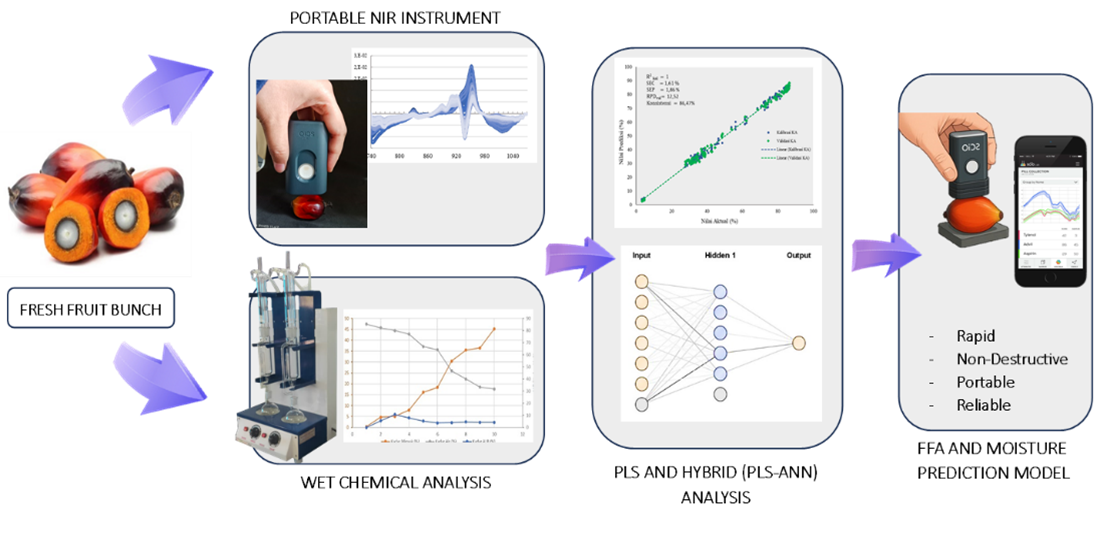
Rapid, non-destructive, and in-situ methods are essential for predicting the chemical composition of oil palm fruit to improve the harvesting efficiency. This study aimed to evaluate the performance of Partial Least Squares Regression (PLSR) and Partial Least Squares Regression-Artificial Neural Network (PLS-ANN) models with different spectral pre-treatments for predicting free fatty acid (FFA) and moisture content of oil palm fruit using a portable NIR spectrometer (740–1070 nm). A total of 408 oil palm fruits of the Tenera variety (Elaeis guineensis Jacq. var. tenera), representing 10 maturity stages (3–6 months), were used in this study. The reflectance spectra of the samples were acquired using a portable NIR Spectrometer and then transformed into absorbance spectra. The samples were then subjected to FFA and moisture content analysis using the chemical method. Some spectral pretreatments were applied to the NIR absorbance data before calibration. PLSR and a hybrid method integrating PLS and ANN were used to build calibration models for predicting FFA and moisture content. Performance evaluation revealed that the best model for predicting FFA was achieved using a combination of first derivative Savitzky-Golay and smoothing Savitzky-Golay pretreatments through PLS-ANN calibration (R² = 0.81, RPD_val = 2.34, and consistency = 87.88%). For moisture content, the best model was obtained using detrending pre-treatment through PLS-ANN calibration (R² = 1, RPD_val = 12.52, and consistency = 86.47%). These results indicate that the FFA prediction model is suitable for rough screening, whereas the moisture prediction model is suitable for various applications. These models demonstrate a strong potential for practical application at both the farmer and industrial levels.
Downloads
Downloads
Published
Issue
Section
License
Copyright (c) 2026 Jurnal Keteknikan Pertanian

This work is licensed under a Creative Commons Attribution-ShareAlike 4.0 International License.
Authors submitting manuscripts should understand and agree that copyright of manuscripts of the article shall be assigned/transferred to Jurnal Keteknikan Pertanian. This work is licensed under a Creative Commons Attribution-ShareAlike 4.0 International License (CC BY-SA) where Authors and Readers can copy and redistribute the material in any medium or format, as well as remix, transform, and build upon the material for any purpose, but they must give appropriate credit (cite to the article or content), provide a link to the license, and indicate if changes were made. If you remix, transform, or build upon the material, you must distribute your contributions under the same license as the original.
Jurnal Keteknikan Pertanian is an open access journal.