
The Optimization of Cropping Pattern Based on Land Water Balance Analysis and Its Spatial Distribution in Rambipuji District, Jember
DOI:
https://doi.org/10.19028/jtep.014.2.178-200Keywords:
cropping pattern; land water balance; soil moisture; spatial analysisAbstract
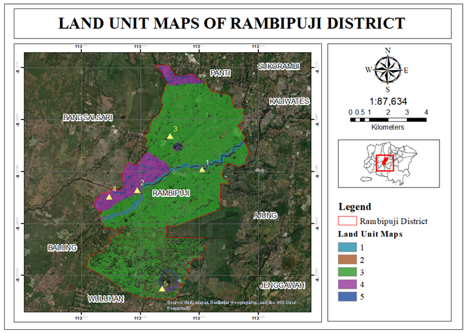
Optimizing cropping patterns under monsoon climates requires accurate information on soil water availability and its spatial variability. This study aimed to optimize cropping patterns and determine the optimal planting onset based on land-water balance analysis using the Thornthwaite-Mather water balance method and its spatial distribution in Rambipuji District, Jember Regency, Indonesia. Monthly land water balance was analyzed using the Thornthwaite–Mather method based on ten-year climatological data (2015–2024), including rainfall and reference evapotranspiration, and soil water holding capacity measurements across five land mapping units (LUMs) differentiated by slope, soil subgroup, and land use. Planting onset was determined using scientific criteria where soil moisture reached water holding capacity, and the effective rainfall to crop evapotranspiration was ≥ 0.75. The results showed a distinct monsoonal pattern, with water surpluses occurring from November to April and pronounced deficits from May to October. Soil texture significantly influenced water holding capacity, resulting in variations in the duration and intensity of water deficits among LUMs. Based on these conditions, LUM 1, 2, and 5 were recommended for planting in December, while LUM 3 and 4 were more suitable for January for the paddy crop. The optimal cropping pattern consisted of paddy cultivation in the first planting season followed by secondary crops in the second and third seasons, reflecting adaptive water-use strategies under declining rainfall. These findings demonstrate that integrating land-water balance analysis with spatial land characteristics provides a reliable basis for precision-oriented cropping calendar planning, supporting sustainable agricultural management.
Downloads
Downloads
Published
Issue
Section
License
Copyright (c) 2026 Jurnal Keteknikan Pertanian

This work is licensed under a Creative Commons Attribution-ShareAlike 4.0 International License.
Authors submitting manuscripts should understand and agree that copyright of manuscripts of the article shall be assigned/transferred to Jurnal Keteknikan Pertanian. This work is licensed under a Creative Commons Attribution-ShareAlike 4.0 International License (CC BY-SA) where Authors and Readers can copy and redistribute the material in any medium or format, as well as remix, transform, and build upon the material for any purpose, but they must give appropriate credit (cite to the article or content), provide a link to the license, and indicate if changes were made. If you remix, transform, or build upon the material, you must distribute your contributions under the same license as the original.
Jurnal Keteknikan Pertanian is an open access journal.