Land Optimization at the Universitas Sains Indonesia to Increase the Percentage of Green Open Space
DOI:
https://doi.org/10.19028/jtep.014.1.125-143Keywords:
Chart; Activity Relationship Diagram; Green Open Space; Layout; Urban farmingAbstract
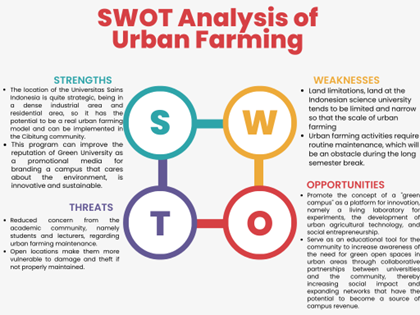
Bekasi Regency is one of the largest industrial areas in Southeast Asia, resulting in high population density and a decline in environmental quality and air availability. Green open spaces are a solution, namely urban farming, which can be applied to minimal land. This requires an optimal layout design so that efficient urban farming can be developed at the Universitas Sains Indonesia as a provision of green open spaces in the Cibitung subdistrict. This study aims to design an optimal urban farming layout at Universitas Sains Indonesia by optimizing limited land resources to increase the green open space. This study employs a mixed-method approach, combining qualitative site analysis and quantitative approaches, including field observation, land potential analysis, facility relationship analysis, and economic feasibility estimation. The proposed urban farming design integrates three main components: an aquaponic cultivation system, a vertical farming system, and a green-learning park. The aquaponic system utilized a 1000-liter fish tank integrated with hydroponic pipes containing 120 planting holes, whereas the vertical farming system provided an additional 60 planting holes to maximize land productivity. The results indicate that the ARC–ARD approach effectively supports spatial planning by organizing facilities into operational zones. Economic feasibility analysis showed that the system requires an initial investment of approximately Rp 12,270,000, with relatively low operational costs. In addition, the system has the potential to produce 37–45 kg of vegetables per month and 30–40 kg of fish per production cycle. Overall, the proposed urban farming model offers a sustainable strategy for optimizing limited urban land, improving environmental quality, and supporting green campus initiatives.
Downloads
Downloads
Published
Issue
Section
License
Copyright (c) 2026 Jurnal Keteknikan Pertanian

This work is licensed under a Creative Commons Attribution-ShareAlike 4.0 International License.
Authors submitting manuscripts should understand and agree that copyright of manuscripts of the article shall be assigned/transferred to Jurnal Keteknikan Pertanian. This work is licensed under a Creative Commons Attribution-ShareAlike 4.0 International License (CC BY-SA) where Authors and Readers can copy and redistribute the material in any medium or format, as well as remix, transform, and build upon the material for any purpose, but they must give appropriate credit (cite to the article or content), provide a link to the license, and indicate if changes were made. If you remix, transform, or build upon the material, you must distribute your contributions under the same license as the original.
Jurnal Keteknikan Pertanian is an open access journal.