Effect of Soy Protein Isolate (SPI) Concentration on Anthocyanin-Based Smart Indicator Labels from Purple Sweet Potato Waste
DOI:
https://doi.org/10.19028/jtep.014.1.1-16Keywords:
Soy Protein Isolate, Anthocyanin, Purple sweet potato, Smart packaging, Indicator labelAbstract
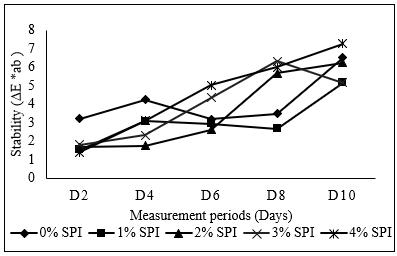
Indonesia has a high level of food waste, with up to 30% of the country’s total fruit production contributing to it. Smart packaging, such as that with anthocyanin based freshness indicator labels and Soy Protein Isolate (SPI), can help reduce waste by providing visual information about the product’s condition within the packaging. This research aims to determine the effect of SPI concentrations on the characteristics of anthocyanin-based smart packaging indicator labels extracted from purple sweet potato waste (Ipomoea batatas (L.) Lam). The indicator label was made using cornstarch (2.5%) as the matrix, glycerol as the plasticizer, and SPI as the crosslinking agent. The researchers employed a simple Completely Randomized Design with SPI concentration variations of 0%, 1%, 2%, 3%, and 4%. The researchers tested several parameters on the indicator labels, including pH sensitivity, color stability against storage temperature (4°C and 25°C), water absorption capacity, color reversibility, and biodegradability. The results indicate that adding SPI affects label characteristics, with 1% SPI concentration yielding the best performance. The 1% SPI concentration obtained the lowest color stability value at cold temperatures (∆E*ab = 5.15), the highest biodegradation rate (97.33% on day 4), the most varied color response to pH, and good physical durability of the label. Therefore, a 1% SPI concentration is recommended as the most effective formulation for an anthocyanin-based freshness indicator label.
Downloads
Downloads
Published
Issue
Section
License
Copyright (c) 2026 Jurnal Keteknikan Pertanian

This work is licensed under a Creative Commons Attribution-ShareAlike 4.0 International License.
Authors submitting manuscripts should understand and agree that copyright of manuscripts of the article shall be assigned/transferred to Jurnal Keteknikan Pertanian. This work is licensed under a Creative Commons Attribution-ShareAlike 4.0 International License (CC BY-SA) where Authors and Readers can copy and redistribute the material in any medium or format, as well as remix, transform, and build upon the material for any purpose, but they must give appropriate credit (cite to the article or content), provide a link to the license, and indicate if changes were made. If you remix, transform, or build upon the material, you must distribute your contributions under the same license as the original.
Jurnal Keteknikan Pertanian is an open access journal.