Sustainable Urban Farming Rack Design Using Eco Friendly Materials with Variety Load
DOI:
https://doi.org/10.19028/jtep.013.4.576-594Keywords:
hydroponics, eco-friendly materials, Rack, urban farming, vertical farmingAbstract
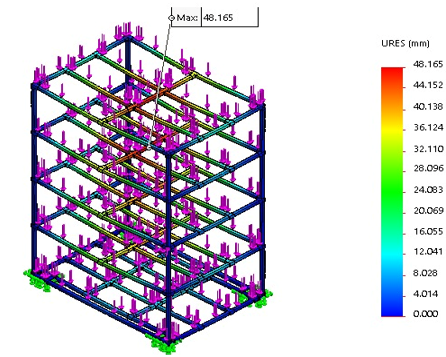
Vertical farming requires a structurally sound and environmentally sustainable racking system; however, existing research largely neglects the evaluation of the structural safety of eco-friendly racking materials under various operational loads. This gap necessitates further rigorous mechanical performance assessments to ensure the long-term reliability of the system. This study aims to develop a vertical farming racking design with an adequate safety factor by examining its structural response to various load scenarios. A design-construction methodology supported by SolidWorks simulations was used to evaluate stress distribution, strain behavior, and deformation patterns. Simulation results using SolidWorks software indicate that the maximum compressive stress at the loaded joint surface is 13.734 MPa, while the minimum stress is 1.149 MPa. The highest load occurs at the fourth (bottom) joint level due to pump-induced water pressure. The maximum strain recorded is 0.00491, with a minimum of 0.00041. The top shelf level exhibits a maximum displacement of 48.165 mm, while the minimum displacement is 0 mm. This shows that the material and shape of the frame that has been made are in the safe category with a safety factor (sf) of 2.4. These findings indicate that the proposed rack design maintains structural integrity within safe limits and is suitable for application in vertical farming systems.
Downloads
Downloads
Published
Issue
Section
License
Copyright (c) 2025 Jurnal Keteknikan Pertanian

This work is licensed under a Creative Commons Attribution-ShareAlike 4.0 International License.
Authors submitting manuscripts should understand and agree that copyright of manuscripts of the article shall be assigned/transferred to Jurnal Keteknikan Pertanian. This work is licensed under a Creative Commons Attribution-ShareAlike 4.0 International License (CC BY-SA) where Authors and Readers can copy and redistribute the material in any medium or format, as well as remix, transform, and build upon the material for any purpose, but they must give appropriate credit (cite to the article or content), provide a link to the license, and indicate if changes were made. If you remix, transform, or build upon the material, you must distribute your contributions under the same license as the original.
Jurnal Keteknikan Pertanian is an open access journal.