Wood Waste Charcoal Briquettes: Physical and Thermal Characteristics Based on Particle Size and Wood Type
DOI:
https://doi.org/10.19028/jtep.013.4.613-626Keywords:
briquette characteristics, charcoal briquette, particle size, wood wasteAbstract
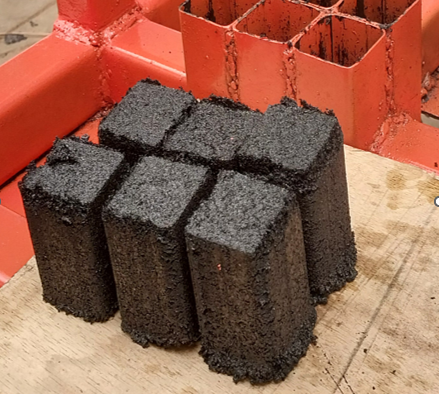
The depletion of fossil fuel reserves and rising fuel costs have highlighted the need for alternative household energy sources. Biomass waste, particularly sawmill residues, has potential for conversion into solid fuel in the form of charcoal briquettes. This study evaluated the physical and thermal characteristics of charcoal briquettes produced from Bus wood (Melaleuca sp.) and Rahai wood (Acacia sp.) sawmill waste at particle sizes of 10, 30, and 60 mesh. Briquettes were produced through carbonization, size reduction, binder mixing, molding, and drying, followed by evaluation of physical and thermal properties. The results showed that Bus wood briquettes had a higher density (0.56–0.60 g/cm³) than Rahai wood briquettes (0.46–0.58 g/cm³). Moisture content ranged from 10% to 13%, with the highest value observed in Rahai briquettes at 60 mesh, which affected combustion stability. Thermal analysis indicated that Bus briquettes at 60 mesh achieved a high peak temperature (608 ᵒC) and a high combustion time efficiency (92.31%), while Rahai briquettes exhibited a higher peak temperature at a coarser particle size (10 mesh, 604 ᵒC). Overall, Bus briquettes with finer particle size showed favorable physical properties and combustion behavior. These findings indicate that Bus wood waste briquettes have potential for further development as household-scale solid fuel.
Keywords: charcoal briquettes, briquette properties, particle size, wood waste biomass
Downloads
Downloads
Published
Issue
Section
License
Copyright (c) 2026 Jurnal Keteknikan Pertanian

This work is licensed under a Creative Commons Attribution-ShareAlike 4.0 International License.
Authors submitting manuscripts should understand and agree that copyright of manuscripts of the article shall be assigned/transferred to Jurnal Keteknikan Pertanian. This work is licensed under a Creative Commons Attribution-ShareAlike 4.0 International License (CC BY-SA) where Authors and Readers can copy and redistribute the material in any medium or format, as well as remix, transform, and build upon the material for any purpose, but they must give appropriate credit (cite to the article or content), provide a link to the license, and indicate if changes were made. If you remix, transform, or build upon the material, you must distribute your contributions under the same license as the original.
Jurnal Keteknikan Pertanian is an open access journal.