Physicochemical Properties of Ambarella Fruit Leather with Variations in Gum Arab Concentration
DOI:
https://doi.org/10.19028/jtep.013.4.627-641Keywords:
ambarella, fruit leather, gum arab, vitamin cAbstract
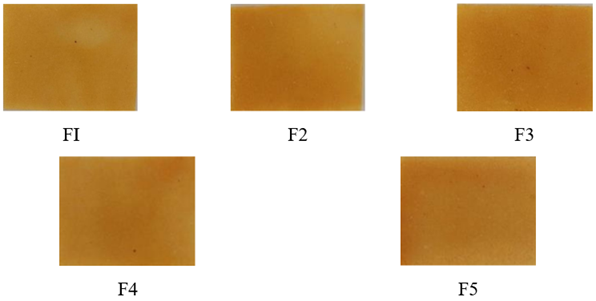
Fruit leather is a thin sheet product made from dried fruit pulp until it has a flexible texture and can be rolled. Ambarella was chosen as the raw material because it has a sour taste and is naturally rich in vitamin C. The elasticity of fruit leather is influenced by the type of binding agent used, one of which is gum arab. Gum arab is a polysaccharide from the sap of Acacia sp. that is stable at pH 2–7 and resistant to acidic conditions and high temperatures. This study aimed to determine the changes in physicochemical characteristics of ambarella fruit leather with the addition of gum arab at different concentrations. The formulation used five gum arab concentrations (0%, 0.6%, 0.8%, 1%, and 1.2%) and three replications. The process included preparing puree, mixing with sugar and gum arab, and drying into sheets. Parameters tested were moisture content, pH, total sugar, total soluble solids, vitamin C, crude fiber, thickness, and texture. The results showed chemical properties which are moisture content 14.10–17.08%; pH 3.09–3.47; sugar 20.00–20.02%; soluble solids 72.43–74.77%; vitamin C 5.57–12.61%; and crude fiber 1.58–2.23%. Physical properties such as thickness 1.27–1.31 mm; tensile strength 0.03–0.16 MPa; elongation 7.01–10.53%; hardness 13.66–78.85 N; gumminess 5.28–57.88 N; and chewiness 3.75–49.20 N. It can be said that the variations in gum arab significantly affected both chemical and physical properties of ambarella fruit leather is a healthy snack.
Keywords: ambarella, fruit leather, gum arab, vitamin C.
Downloads
Downloads
Published
Issue
Section
License
Copyright (c) 2026 Jurnal Keteknikan Pertanian

This work is licensed under a Creative Commons Attribution-ShareAlike 4.0 International License.
Authors submitting manuscripts should understand and agree that copyright of manuscripts of the article shall be assigned/transferred to Jurnal Keteknikan Pertanian. This work is licensed under a Creative Commons Attribution-ShareAlike 4.0 International License (CC BY-SA) where Authors and Readers can copy and redistribute the material in any medium or format, as well as remix, transform, and build upon the material for any purpose, but they must give appropriate credit (cite to the article or content), provide a link to the license, and indicate if changes were made. If you remix, transform, or build upon the material, you must distribute your contributions under the same license as the original.
Jurnal Keteknikan Pertanian is an open access journal.