
Design and Fabrication of a Microcontroller-Based Automatic LED Grow Light Array System for Leafy Vegetables in Indoor Vertical Hydroponic
DOI:
https://doi.org/10.19028/jtep.013.4.559-575Keywords:
Automatic lighting system, LED grow light, Indoor hydroponics, PPFD, ESP32Abstract
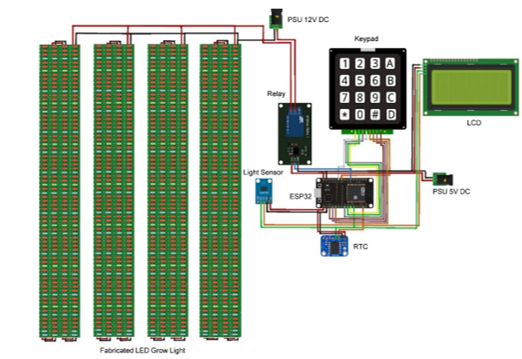
Indoor vertical hydroponic systems require precise and energy-efficient lighting to support optimal growth of leafy vegetables. This study presents the design and fabrication of a microcontroller-based automatic LED grow light system tailored for indoor hydroponics. A tailored LED grow light is necessary because each crop responds uniquely to light quality and intensity, and a customized spectrum ensures optimal growth while minimizing energy use. The system integrates a red–green–blue LED configuration (70:10:20%) with an ESP32 microcontroller, real-time clock (RTC), BH1750 light sensor, keypad interface, and LCD. The lighting cycle was programmed for 12 hours per day and tested continuously over two days. The system demonstrated accurate scheduling, with LED activation at 06:00 and deactivation at 18:00 and a timing deviation of only 1–2 seconds. During operation, the system maintained a stable photosynthetic photon flux density (PPFD) of 260–275 µmol/m²/s, producing an estimated daily light integral (DLI) of about 12 mol/m²/day, which is suitable for leafy vegetable production. Light distribution analysis using cubic interpolation showed that increasing the lamp height from 20 cm to 30 cm improved spatial uniformity, with the most uniform distribution achieved at 30 cm despite a slight reduction in intensity. The system consumed 2.65 kWh per day, covering four LED arrays and the control module. Overall, the proposed system offers a reliable, programmable, and energy-efficient lighting solution for indoor hydroponic environments, supporting sustainable crop production through precise scheduling and an optimized spectral configuration.
Downloads
Downloads
Published
Issue
Section
License
Copyright (c) 2025 Jurnal Keteknikan Pertanian

This work is licensed under a Creative Commons Attribution-ShareAlike 4.0 International License.
Authors submitting manuscripts should understand and agree that copyright of manuscripts of the article shall be assigned/transferred to Jurnal Keteknikan Pertanian. This work is licensed under a Creative Commons Attribution-ShareAlike 4.0 International License (CC BY-SA) where Authors and Readers can copy and redistribute the material in any medium or format, as well as remix, transform, and build upon the material for any purpose, but they must give appropriate credit (cite to the article or content), provide a link to the license, and indicate if changes were made. If you remix, transform, or build upon the material, you must distribute your contributions under the same license as the original.
Jurnal Keteknikan Pertanian is an open access journal.