
The Effectiveness of Cocoa Pod Husk Activated Carbon as an Ethylene Adsorbent for Extending the Shelf Life of Cavendish Bananas
DOI:
https://doi.org/10.19028/jtep.013.3.481-498Keywords:
Activated Carbon, Cocoa Pod Husk, Cavendish Banana, Shelf LifeAbstract
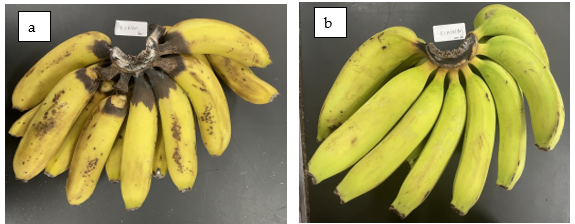
One of the abundant agricultural wastes in Indonesia that has not been optimally utilized is cocoa pod husk (Theobroma cacao L.). Cocoa pod husk is the main by-product of the cocoa bean processing. Cocoa pod husk has a high cellulose content, making it a suitable precursor for activated carbon production. Activated carbon can adsorb ethylene from climacteric fruits, extending fruit shelf life. This research aims to test the effectiveness of activated carbon derived from cocoa pod husk as an ethylene adsorbent to extend the shelf life of fruits, specifically Cavendish bananas. The research procedure consists of preliminary research and primary research. The initial research involved measuring ethylene production, synthesizing activated carbon from cocoa pod husk, testing the characteristics of the cocoa pod husk activated carbon, calculating the activated carbon's capacity for ethylene adsorption, and determining the optimal amount of cocoa pod husk activated carbon. The primary research involved testing Cavendish bananas' storage and display life by applying an ethylene adsorber bag (EAB) using perforated LDPE packaging until spoilage. The Cavendish banana samples originated from Klaten, Central Java, with a maturity level of 1. The test parameters included moisture content, weight loss, firmness, color, total soluble solids (TSS), and Total Titratable Acidity (TTA). The treatments in this study consisted of samples treated with EAB from cocoa pod husk and a control group without EAB. All treatments were performed in triplicate. The experimental design used was a Completely Randomized Design (CRD). The results showed that a well-defined porous structure, a rough surface, and numerous cavities characterize the cocoa pod husk activated carbon. It has an ethylene absorption capacity of 363 ppm/g. The ethylene production rate of Cavendish bananas observed during storage was 1,280 ± 227.5 ppm. The results showed that bananas treated with cocoa pod husk-activated carbon were still green on the 10th day compared to the control treatment, which had already spoiled. During the display period, Cavendish bananas could last up to 5 days before spoilage. Therefore, cocoa pod husk-activated carbon can delay ripening and spoilage, thus extending the shelf life of Cavendish bananas.
Downloads
Downloads
Published
Issue
Section
License
Copyright (c) 2025 Jurnal Keteknikan Pertanian

This work is licensed under a Creative Commons Attribution-ShareAlike 4.0 International License.
Authors submitting manuscripts should understand and agree that copyright of manuscripts of the article shall be assigned/transferred to Jurnal Keteknikan Pertanian. This work is licensed under a Creative Commons Attribution-ShareAlike 4.0 International License (CC BY-SA) where Authors and Readers can copy and redistribute the material in any medium or format, as well as remix, transform, and build upon the material for any purpose, but they must give appropriate credit (cite to the article or content), provide a link to the license, and indicate if changes were made. If you remix, transform, or build upon the material, you must distribute your contributions under the same license as the original.
Jurnal Keteknikan Pertanian is an open access journal.