Optimizing Coffee Flavor Through Roasting and Manual Brewing Using Chemical and Sensory Approach
English
DOI:
https://doi.org/10.19028/jtep.013.3.402-417Keywords:
roasting, manual brew, analysis sensory coffee, biplot, compromise programmingAbstract
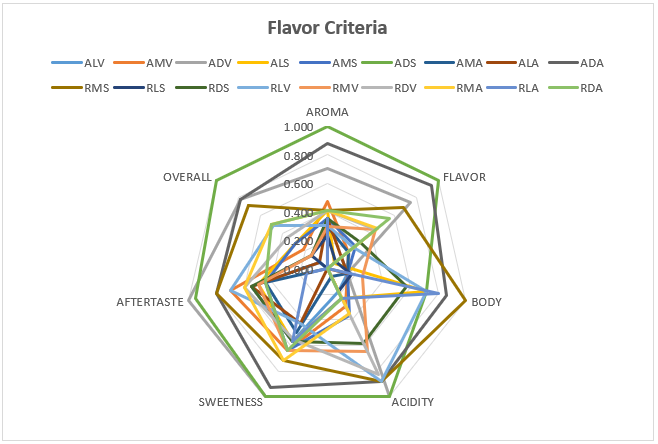
The global popularity of coffee has led to growing attention on how processing and brewing techniques influence its sensory attributes. This study analyzed the chemical content of coffee and assessed the combination of roasting and manual brewing methods on coffee flavor. The coffee types used were Arabica coffee and Robusta coffee. The roasts used were light, medium, and dark roast with AeroPress, Siphon, and V60 manual brewing methods. The experiment was arranged in a factorial arrangement within a Randomized Complete Block Design (RCBD), where coffee varieties served as blocks, and the treatment combinations of roasting and brewing methods were randomly assigned within each block. Data analysis includes two-way analysis of variance, biplot analysis, and the compromise programming method. The results showed that the selection of roast level and brewing method had a significant influence on the coffee's chemical analysis and sensory profile. Light roasting and complex flavors were more acceptable than dark roasting, which tends to be heavy. Based on the panelists' preference analysis using the compromise programming method, RLS (Robusta-Light roast-Siphon) emerged as the optimal choice, indicating that this combination balances all coffee taste criteria. The combinations ALV (Arabica-Light roast-V60), ALA (Arabica-Light roast-Aeropress), and AMA (Arabica-Medium roast-Aeropress) which tends to similar and provide a balanced, complex flavor profile, including aroma, acidity, and high overall quality. Arabica coffee combination ADS (Arabica-Dark roast-Siphon), ADA (Arabica-Dark roast-Aeropress), and ADV (Arabica-Dark roast-V60) which have less optimal visual and balance because dark roasting reduces the sensory criteria of coffee.
Downloads
Downloads
Published
Issue
Section
License
Copyright (c) 2025 Jurnal Keteknikan Pertanian

This work is licensed under a Creative Commons Attribution-ShareAlike 4.0 International License.
Authors submitting manuscripts should understand and agree that copyright of manuscripts of the article shall be assigned/transferred to Jurnal Keteknikan Pertanian. This work is licensed under a Creative Commons Attribution-ShareAlike 4.0 International License (CC BY-SA) where Authors and Readers can copy and redistribute the material in any medium or format, as well as remix, transform, and build upon the material for any purpose, but they must give appropriate credit (cite to the article or content), provide a link to the license, and indicate if changes were made. If you remix, transform, or build upon the material, you must distribute your contributions under the same license as the original.
Jurnal Keteknikan Pertanian is an open access journal.