Shelf-Life Estimation of Dried Sago Noodles Using the Accelerated Shelf-Life Testing (ASLT) Method
DOI:
https://doi.org/10.19028/jtep.013.3.375-386Keywords:
Accelerated Shelf-Life Testing (ASLT), activation energy, Arrhenius equation, sago noodle, shelf-life modelingAbstract
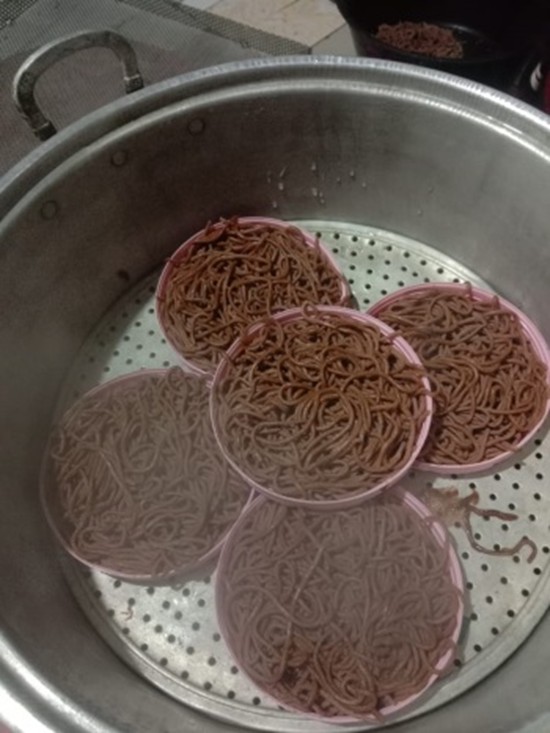
Indonesia holds significant potential for sago (Metroxylon sp.) development, especially in the eastern regions. Sago starch offers an alternative to wheat flour in noodle production, promoting local food diversification. This study aims to estimate the shelf-life of dried sago noodles using the Accelerated Shelf-Life Testing (ASLT) method based on selected quality parameters. Dried sago noodles were produced from sago starch sourced from Merauke, South Papua, and stored at 35°C, 45°C, and 55°C. Quality attributes—moisture content, aroma, and taste—were analyzed during storage to model degradation kinetics and determine activation energy (Ea) using the Arrhenius approach. Among the tested parameters, aroma exhibited the lowest activation energy (636.04 cal/mol), indicating it as the critical parameter for predicting shelf-life. Based on the regression of ln k versus 1/T, the shelf-life at 27°C (room temperature) was estimated at 49 days. The study concludes that aroma degradation is the key factor in determining the shelf-life of dried sago noodles, and that accurate sensory evaluation using trained panelists is crucial for improving the reliability of shelf-life prediction.
Downloads
Downloads
Published
Issue
Section
License
Copyright (c) 2025 Jurnal Keteknikan Pertanian

This work is licensed under a Creative Commons Attribution-ShareAlike 4.0 International License.
Authors submitting manuscripts should understand and agree that copyright of manuscripts of the article shall be assigned/transferred to Jurnal Keteknikan Pertanian. This work is licensed under a Creative Commons Attribution-ShareAlike 4.0 International License (CC BY-SA) where Authors and Readers can copy and redistribute the material in any medium or format, as well as remix, transform, and build upon the material for any purpose, but they must give appropriate credit (cite to the article or content), provide a link to the license, and indicate if changes were made. If you remix, transform, or build upon the material, you must distribute your contributions under the same license as the original.
Jurnal Keteknikan Pertanian is an open access journal.