Renewable Energy from Various Oil Palm Varieties in Penajam Paser Utara, Indonesia
DOI:
https://doi.org/10.19028/jtep.013.2.284-301Keywords:
oil palm, biodiesel, solid biomass, renewable energy, self-sufficient agroindustry, Penajam Paser UtaraAbstract
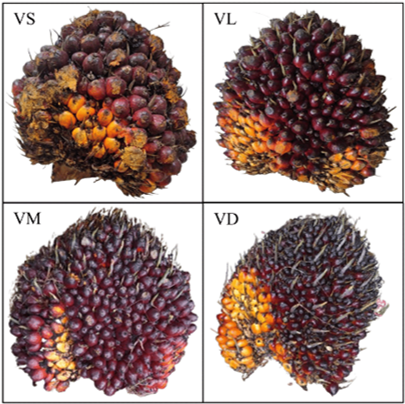
Oil palm has the potential to serve as a strategic energy source for the national energy transition. This study evaluates the potential of four oil palm varieties Sain, Lonsum, Dumpy, and Marihat in Penajam Paser Utara (PPU) Regency as sources of biodiesel, edible oil, and solid biomass. The methods applied include fat content analysis, fatty acid profile evaluation, and utilization scenarios based on 2023 production data of Fresh Fruit Bunches (FFB) and Crude Palm Oil (CPO). The results showed that the Lonsum and Sain varieties, which have high fat content and are predicted to be dominated by saturated fatty acids (palmitic and stearic acids) based on literature-reported fatty acid profiles, are most suitable for biodiesel production. In contrast, the Dumpy and Marihat varieties exhibited lower fat content but are predicted to contain higher proportions of unsaturated fatty acids (oleic and linoleic acids), making them more suitable for edible oil applications. The Dumpy variety also has lower moisture content, making it favorable for solid biomass applications. With proportional allocation and conversion of FFB waste into briquettes, the production potential is approximately ±41,200 tons of biodiesel, ±26,159 tons of edible oil, and ±115,104 tons of solid biomass annually. The total energy potential reaches approximately ±3.49 million GJ per year. These findings indicate significant opportunities for the development of self-sufficient energy agroindustry based on oil palm to support energy security and sustainable development in the buffer zones of Indonesia’s new capital city (IKN).
Downloads
Downloads
Published
Issue
Section
License
Authors submitting manuscripts should understand and agree that copyright of manuscripts of the article shall be assigned/transferred to Jurnal Keteknikan Pertanian. This work is licensed under a Creative Commons Attribution-ShareAlike 4.0 International License (CC BY-SA) where Authors and Readers can copy and redistribute the material in any medium or format, as well as remix, transform, and build upon the material for any purpose, but they must give appropriate credit (cite to the article or content), provide a link to the license, and indicate if changes were made. If you remix, transform, or build upon the material, you must distribute your contributions under the same license as the original.
Jurnal Keteknikan Pertanian is an open access journal.