
Software Development of Palm Oil Seed Authentication System Based on Ultrasonic Waves
DOI:
https://doi.org/10.19028/jtep.013.1.115-131Keywords:
Palm oil seed, Ultrasound, Arduino uno, Software, Fake SeedsAbstract
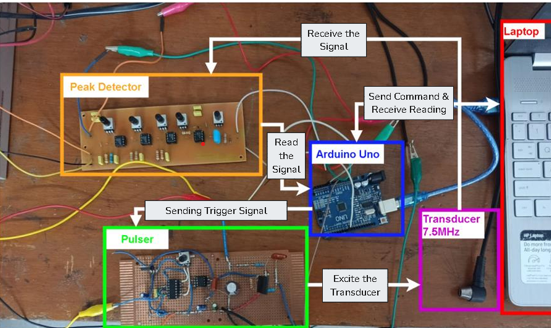
Fake palm oil seeds pose a substantial economic threat, which makes their authentication crucial. However, distinguishing between genuine and fake seeds remains a challenge. This study explored the potential of ultrasonic technology to measure shell thickness as a distinguishing factor based on the reported variations between the two types. Ultrasonic wave measurement software was developed using Arduino Uno to facilitate the analysis. The results highlight the complexity of accurately measuring the seed shell thickness owing to high attenuation. Micro-CT imaging confirmed the presence of pores within the seed structure, which significantly scattered and absorbed ultrasonic waves, limiting the penetration depth and accuracy. Despite these obstacles, the developed software exhibited promising capabilities, accurately determining the thickness or propagation speed with a high-resolution time-of-flight measurement of up to 62.5 nanoseconds. Additionally, the software is capable of sampling ultrasonic signals at frequencies up to 178 kHz. Although the software performs well under specific conditions, further advancements in ultrasonic technology are necessary to mitigate porosity-related limitations and enhance the effectiveness of seed authentication methods, particularly in transducer selection and measurement techniques such as Harmonic or QSC testing.
Downloads
Downloads
Published
Issue
Section
License
Authors submitting manuscripts should understand and agree that copyright of manuscripts of the article shall be assigned/transferred to Jurnal Keteknikan Pertanian. This work is licensed under a Creative Commons Attribution-ShareAlike 4.0 International License (CC BY-SA) where Authors and Readers can copy and redistribute the material in any medium or format, as well as remix, transform, and build upon the material for any purpose, but they must give appropriate credit (cite to the article or content), provide a link to the license, and indicate if changes were made. If you remix, transform, or build upon the material, you must distribute your contributions under the same license as the original.
Jurnal Keteknikan Pertanian is an open access journal.