Rice Husk Availability Mapping as Biomass Cofiring Material at Power Plant in Indramayu
DOI:
https://doi.org/10.19028/jtep.012.2.284-300Keywords:
biomass cofiring, Indramayu, rice husk, rice mill, QGISAbstract
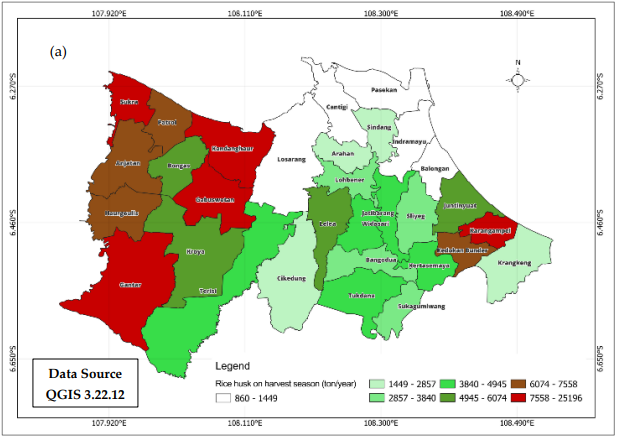
Indonesia plans to reduce greenhouse gas (GHG) emissions by 29% by 2030 to address its high fossil energy use. One strategy involves PT PLN (Persero) implementing biomass cofiring technology in 52 power plants by 2025. As the 4th global rice producer, rice husk become a potential source for this strategy in Indonesia. However, sustainability of supply is a challenge, with inadequate research and only 33.52% recording at the rice mills. This study aims to quantify the rice husk availability for biomass cofiring in Indramayu Regency, the Indonesia's largest rice-producing area. Using a spatial approach, surveys, interviews, and Quantum GIS (QGIS) version 3.22.12, a visual map of rice husk availability was created. The result of the research is 95 data of rice mills (79 small, 12 medium, 4 large) which showed daily husk potentials of 0.87, 4.83, and 10.74 tons, respectively. National production data estimated theoretically an annual availability of 272,106 tons of rice husk. Spatial analysis from surveys and interviews indicated 601,669 tons/year, while distribution by milling scale suggested 588,861 tons/year. Competition for rice husk use was high in industries like roof tile, brick, and cement, with recovery fractions (α) of 13.23%, 17.50%, and 23.33% during harvest, and 3.90%, 10%, and 15% in the off-season. With information of operational days from each mill scale during the harvesting and the off-season, the mobilizable of rice husk was calculated as 77,102.17 tons/year. Policies promoting the use and management of rice husk in rice-producing areas are necessary to enhance biomass cofiring implementation.
Downloads
Downloads
Published
Issue
Section
License
Authors submitting manuscripts should understand and agree that copyright of manuscripts of the article shall be assigned/transferred to Jurnal Keteknikan Pertanian. This work is licensed under a Creative Commons Attribution-ShareAlike 4.0 International License (CC BY-SA) where Authors and Readers can copy and redistribute the material in any medium or format, as well as remix, transform, and build upon the material for any purpose, but they must give appropriate credit (cite to the article or content), provide a link to the license, and indicate if changes were made. If you remix, transform, or build upon the material, you must distribute your contributions under the same license as the original.
Jurnal Keteknikan Pertanian is an open access journal.