Material Flow-Based Assessment of Hybrid Waste-to-Energy and Solar Photovoltaic Systems for Supporting Electric Vehicle Charging Infrastructure in Bali, Indonesia
Article Sidebar
-
waste-to-energy, municipal solid waste, solar photovoltaic, electric vehicle charging stations, greenhouse gas emissions
Abstract
Rapid tourism development and urban growth in Bali have increased municipal solid waste (MSW) generation while simultaneously raising the demand for sustainable energy infrastructure. Although waste-to-energy (WtE) and solar photovoltaic (PV) technologies
have been widely studied, integrated assessments linking waste management, renewable energy generation, and electric vehicle charging infrastructure in tourism-intensive regions remain limited. This study evaluates the potential of a hybrid WtE–PV system to
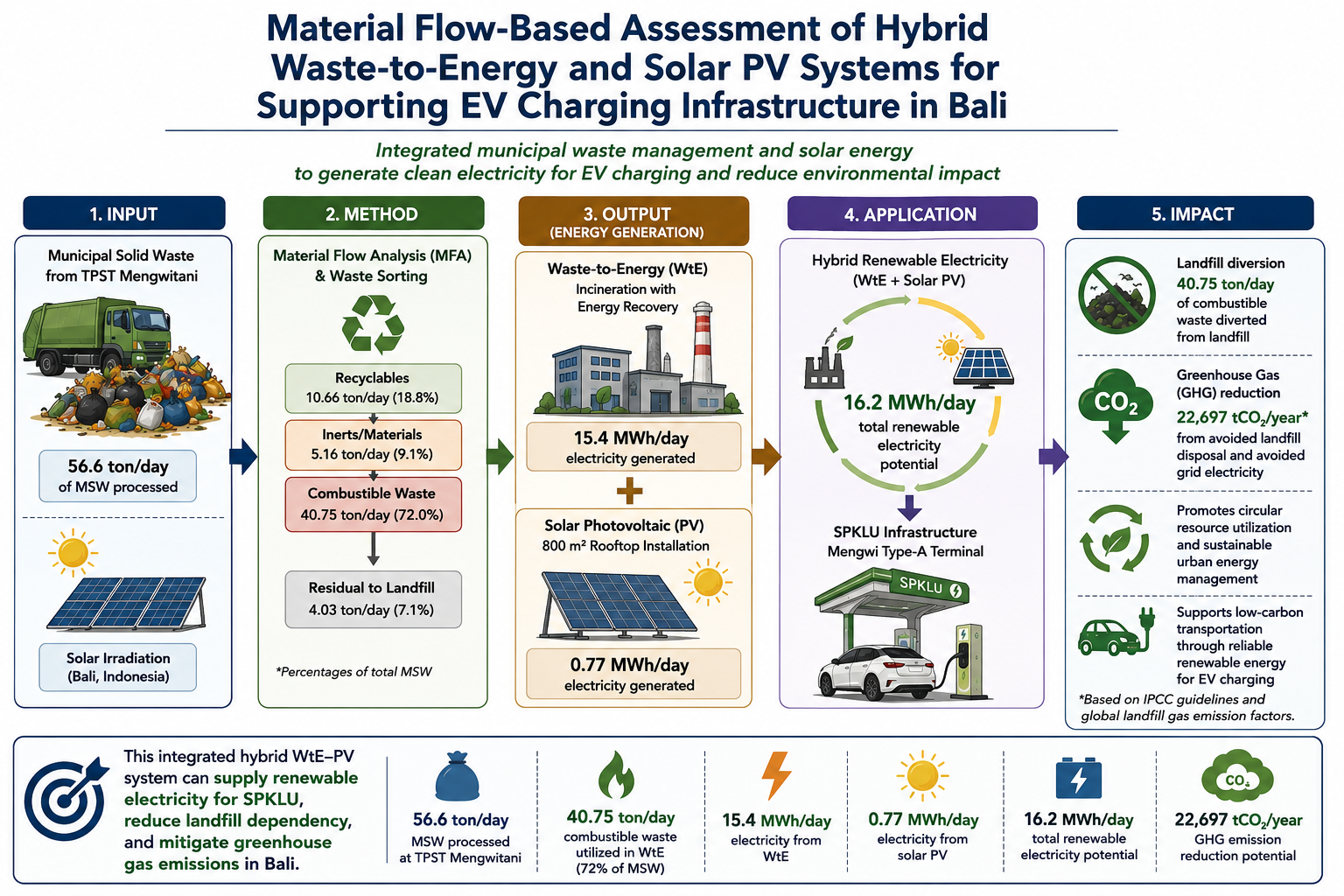
support Stasiun Pengisian Kendaraan Listrik Umum (SPKLU) at the Mengwi Type-A Terminal, Bali, using municipal waste supplied from Tempat Pengolahan Sampah Terpadu (TPST) Mengwitani. A material flow analysis (MFA) approach was employed to quantify
waste availability and energy recovery potential. Electricity generation from waste incineration and solar PV systems was estimated using energy conversion models, while environmental performance was evaluated through landfill diversion and greenhouse gas
(GHG) emission reduction indicators. The results show that TPST Mengwitani processes approximately 56.6 tons of MSW per day, with 72% of the waste stream suitable for thermal conversion. The WtE system can utilize 40.75 tons day⁻¹ of combustible waste and
generate approximately 15.4 MWh day⁻¹ of electricity. An 800 m² PV installation contributes an additional 0.77 MWh day⁻¹, resulting in a total renewable electricity potential of 16.2 MWh day⁻¹. The hybrid system also reduces landfill dependency and contributes to GHG emission mitigation. This study demonstrates that integrating WtE and PV systems can support low-carbon transportation infrastructure while promoting resource recovery and circular urban energy management in tourism-oriented regions.
Full text article
References
1. World Bank. What a Waste 2.0: A Global Snapshot of Solid Waste Management to 2050; World Bank: Washington, DC, 2018.
2. Kaza, S.; Woerden, F. Van; Yao, L.; Bhada-Tata, P. What a Waste 2.0: A Global Snapshot of Solid Waste Management to 2050; World Bank Publications: Washington DC, 2018.
3. Intergovernmental Panel on Climate Change Global Warming of 1.5°C; Masson-Delmotte, V., Pörtner, H.-O., Skea, J., Zhai, P., Roberts, D., Shukla, P.R., Eds.; Intergovernmental Panel on Climate Change: Jenewa, 2019.
4. Izharsyah, J.R. Strategic Analysis of Medan City Government in Implementing an Open Dumping-Based Waste Management System into a Sanitary Landfill. Muqoddimah Sci. J. J. Soc. Polit. Humanit. Sci. 2020, 4, 109–117.
5. United Nations Environment Programme Global Waste Management Outlook 2024: Beyond an Age of Waste – Turning Rubbish into a Resource; United Nations Environment Programme: Nairobi, 2024.
6. Mahajan, M.S.; Prasad, E. Waste to Energy Market Size, Share, Competitive Landscape and Trend Analysis Report, Technology: Global Opportunity Analysis and Industry Forecast (2023–2032); Allied Market Research: Portland, 2023.
7. Trinh, V.L.; Chung, C.K. Renewable Energy for SDG-7 and Sustainable Electricity Production, Integration, Industrial Applications, and Globalization: Review. Clean. Eng. Technol. 2023, 15, 1–22.
8. Adiyasa, I.W.; Rasid, M.A.H. Bin; Warsita, I.W.; Arifin, Z.; Dwipayana, A.D.; Suteja, R.P. Identification of Computation of Solar and Wind Energy Potential for Off-Grid Electric Motorcycle Battery Charging Stations. In Proceedings of the 2023 International Conference on Smart-Green Technology in Electrical and Information Systems (ICSGTEIS); IEEE: Badung, 2023; pp. 208–213.
9. Kurniawan, T.A.; Yudiar, H.; Handayani, W. Evaluation of Waste Processing into Refuse Derived Fuel at TPST Mengwitani Badung, Bali. J. Environ. Pollut. Control 2024, 6, 94–100, doi:10.35970/jppl.v6i1.2247.
10. Sun, H.; Li, W.; Wang, J.; Qin, X.; Jin, L.; Tian, F.; Yang, T.; Zhang, F.; Chen, L.; Shi, Y.; et al. Integrated Assessment of Environmental and Economic Impact of Municipal Solid Waste Incineration for Power Generation: A Case Study in China. Heliyon 2024, 10, 1–12, doi:10.1016/j.heliyon.2024.e33700.
11. United Nations Environment Programme (UNEP). Global Waste Management Outlook; UNEP: Nairobi, 2015.
12. Delgado, F.J.; Freire-González, J.; Presno, M.J. Environmental Taxation in the European Union: Are There Common Trends? Econ. Anal. Policy 2022, 73, 670–682, doi:10.1016/j.eap.2021.12.019.
13. Lee, D.-S.; Lee, S.-T.; Chen, Y.-T.; Su, P.-Y. Artificial Intelligence Technique Development for Energy-Efficient Waste-to-Energy: A Case Study of an Incineration Plant. Case Stud. Therm. Eng. 2024, 61, 1–15, doi:10.1016/j.csite.2024.105071.
14. Chelazzi, E. Emission factors for landfill methane and grid electricity were obtained from the United Nations Environment Program (UNEP) and the World Bank global waste and energy databases (2024) (IEA Bioenergy Task 36); The International Energy Agency Bioenergy: Paris, 2021.
15. Prasaja, B.K.; Edifikar, W.; Abdullah, T. Renewable Energy (EBT) Education and Training at University Level in Indonesia. JE-Unisla 2020, 5, 353–358.
16. Qonitan, F.D.; Suryawan, I.W.K.; Rahman, A. Overview of Municipal Solid Waste Generation and Energy Utilization Potential in Major Cities of Indonesia. J. Phys. Conf. Ser. 2021, 1858, 1–10.
17. Oo, P.Z.; Prapaspongsa, T.; Strezov, V.; Huda, N.; Oshita, K.; Takaoka, M.; Ren, J.; Halog, A.; Gheewala, S.H. The Role of Global Waste Management and Circular Economy towards Carbon Neutrality. Sustain. Prod. Consum. 2024, 52, 498–510.
18. Putra, D.P.Y. Waste-to-Energy Plant (Waste as Education, Waste as Living, Waste as Energy) in Bantul District in Yogyakarta, Universitas Atma Jaya Yogyakarta, 2018.
19. Casti, T. Waste to Energy in Denmark: Danish Legal Pathway to a Clean Waste to Energy; Reno Sam: København, 2020;
20. Samsinar, R.; Anwar, K. Study of Planning for a 115 KW Capacity Waste Power Plant (Case Study of Tegal City). eLEKTUM 2018, 15, 33–40.
21. Mehedi, T.H.; Gemechu, E.; Kumar, A. Life Cycle Greenhouse Gas Emissions and Energy Footprints of Utility-Scale Solar Energy Systems. Appl. Energy 2022, 314, 118918.
22. Zentani, A.; Almaktoof, A.; Kahn, M.T. A Comprehensive Review of Developments in Electric Vehicles Fast Charging Technology. Appl. Sci. 2024, 14, 4728.
23. Widyantoro, M.; Suprihatin, S.; Indrasti, N.S.; Bantacut, T. Conceptual Model for Sustainable Planning and Development of Waste Management with Material Flow Analysis (MFA) and Analytical Hierarchy Process (AHP) Methods. Int. J. Sustain. Dev. Plan. 2025, 20, 109–117.
24. Amen, R.; Hameed, J.; Albashar, G.; Kamran, H.W.; Hassan Shah, M.U.; Zaman, M.K.U.; Mukhtar, A.; Saqib, S.; Ch, S.I.; Ibrahim, M.; et al. Modelling the Higher Heating Value of Municipal Solid Waste for Assessment of Waste-to-Energy Potential: AAsustainable Case Study. J. Clean. Prod. 2021, 287, 125575.
25. Powell, J.T.; Townsend, T.G.; Zimmerman, J.B. Estimates of Solid Waste Disposal Rates and Reduction Targets for Landfill Gas Emissions. Nat. Clim. Chang. 2016, 6, 162–165.
26. Mazzanti, M.; Mazzarano, M.; Zecca, E. A Selection Bias Approach in the Circular Economy Context: The Case of Organic Municipal Solid Waste in Italy. J. Clean. Prod. 2022, 348, 131266.
27. Logothetis, I.; Kerchoulas, A.; Kourkoumpas, D.-S.; Mitsotakis, A.; Grammelis, P. An Integrated Approach to Air Quality and Waste Management Optimization for Sustainable Islands: A Case Study of Chalki, Southeast Aegean. Sustainability 2025, 17, 10842.
28. Armoo, E.A.; Baidoo, T.; Mohammed, M.; Agyenim, F.B.; Kemausuor, F.; Narra, S. Environmental Assessment of Hybrid Waste-to-Energy System in Ghana. Energies 2025, 18, 595.
29. Bamisile, O.; Kun, S.; Ukwuoma, C.C.; Cai, D.; Ukwuoma, C.D.; Otuka, C.I.; Ukwuoma, C.O.; Bamisile, O. Enhancing Photovoltaic Power Generation Nowcasting with Sky Image Analysis Using Multi-Modal Attention Networks. Sol. Energy 2026, 303, 114117.
30. Wijaya, M.W.; Wiratama, G.N.M.; Putra, K.A.; Aris, A. Refuse Derived Fuel Potential Production from Temple Waste as Energy Alternative Resource in Bali Island. J. Ecol. Eng. 2023, 24, 288–296.
31. Afrane, S.; Ampah, J.D.; Agyekum, E.B.; Amoh, P.O.; Yusuf, A.A.; Fattah, I.M.; Agbozo, E.; Elgamli, E.; Shouran, M.; Mao, G.; et al. Integrated AHP-TOPSIS under a Fuzzy Environment for the Selection of Waste-to-Energy Technologies in Ghana: A Performance Analysis and Socio-Enviro-Economic Feasibility Study. Int. J. Environ. Res. Public Health 2022, 19, 8428.
32. Mishra, M.V.; Sivasamy, S.; Whig, A.; Shinde, R. Chapter 23 - Waste Management and Future Implications. In; Kulkarni, S., Trois, C.B.T.-S.S. for E.P., Eds.; Elsevier, 2026; pp. 535–563.
33. Wang, F.; Pang, Y.; Bai, L.; Godin, M. Researching the Landscape of Predictive Emissions Monitoring System: A Review of Literature and Technology Trends. Environ. Syst. Res. 2025, 14, 11.
Authors
Copyright (c) 2026 I Wayan Yudhi Martha Wiguna, Arif Devi Dwipayana

This work is licensed under a Creative Commons Attribution 4.0 International License.
Authors who publish with this journal agree to the following terms:
- Authors retain copyright and grant the journal right of first publication with the work simultaneously licensed under a Creative Commons Attribution License that allows others to share the work with an acknowledgement of the work's authorship and initial publication in this journal.
- Authors are able to enter into separate, additional contractual arrangements for the non-exclusive distribution of the journal's published version of the work (e.g., post it to an institutional repository or publish it in a book), with an acknowledgement of its initial publication in this journal.
- Authors are permitted and encouraged to post their work online (e.g., in institutional repositories or on their website) prior to and during the submission process, as it can lead to productive exchanges, as well as earlier and greater citation of published work (See The Effect of Open Access).
Article Details
How to Cite



