
Modeling and Projecting Rainfall Patterns in the Jakarta Ciliwung Watershed Using SARIMA and GIS for Flood Risk Assessment
Article Sidebar
-
climate change, rainfall, jakarta ciliwung watershed, SARIMA, GIS
Abstract
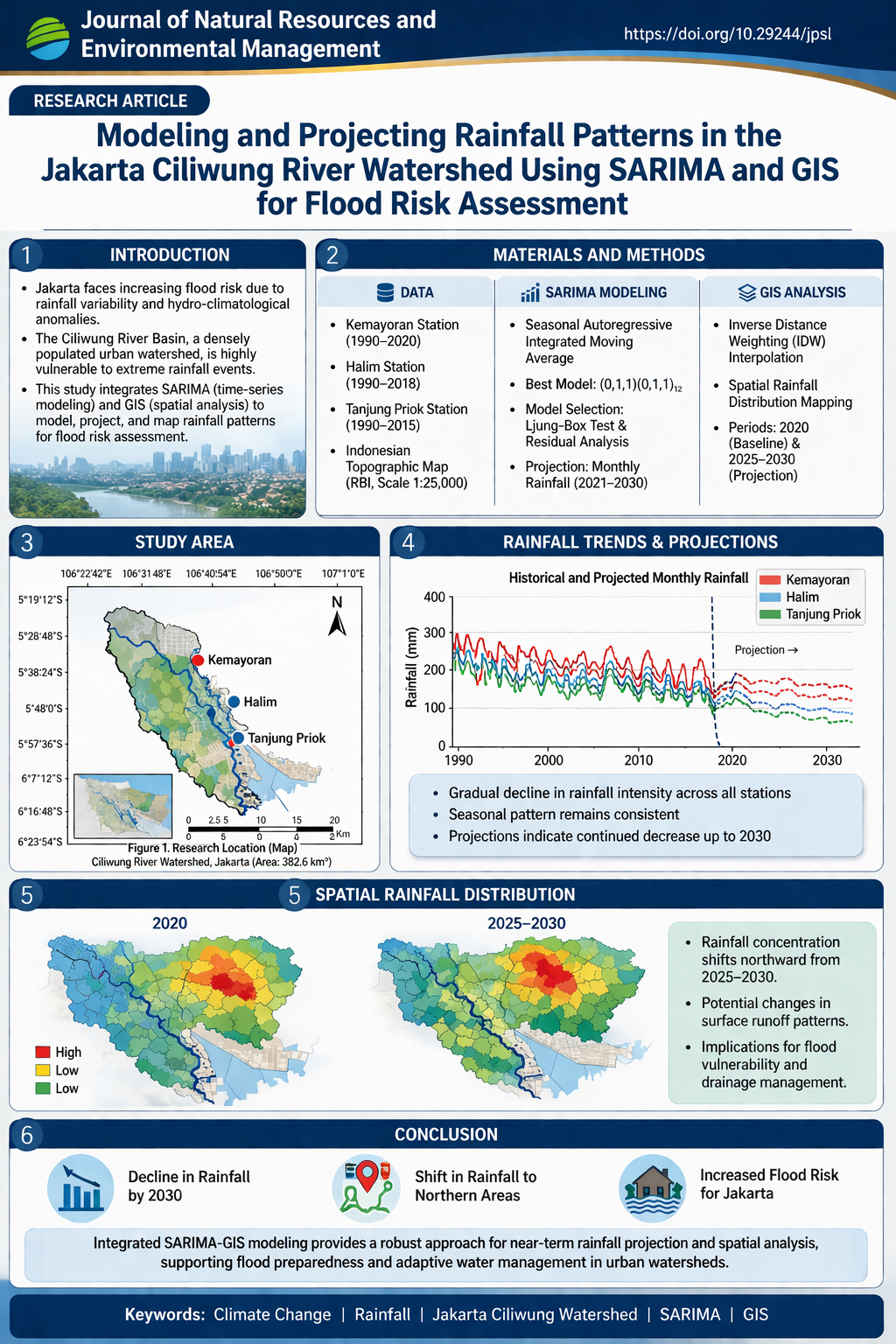
In recent years, a broad consensus has emerged that global hydroclimatic anomalies have increased rainfall variability in tropical cities. Addressing this, we simulated and predicted rainfall patterns in Jakarta’s Ciliwung River Basin using a hierarchical framework that integrates Seasonal Autoregressive Integrated Moving Average (SARIMA) time series modeling with GIS spatial interpolation. Monthly rainfall records from three stations, Kemayoran (1990–2020), Halim (1990–2018), and Tanjung Priok (1990–2015), were analyzed. Following Ljung-Box and residual tests, the SARIMA (0,1,1)(0,1,1)₁₂ model was selected. Accuracy verification yielded Mean Absolute Percentage Error (MAPE) values below 10% for all stations: 8.4% (Kemayoran), 7.9% (Halim), and 8.1% (Tanjung Priok). Core predictions indicate that by 2030, rainfall intensity will continue declining across all stations, while seasonal rainfall rhythms remain stable. Spatial rainfall pattern comparison between 2025 and 2030 reveals a northward shift of the high rainfall concentration zone. This study has two limitations: only three sample stations were used, and no formal uncertainty quantification was performed for spatial predictions, making the reliability of spatial patterns weaker than suggested by visualizations. Despite these constraints, the proposed statistical-spatial modeling approach supports flood preparedness and adaptive water resource management in data-constrained urban watersheds, provided users account for the stated methodological limitations.
Full text article
References
1 M. Bilgili, S. Tumse, and S. Nar, “Comprehensive Overview on the Present State and Evolution of Global Warming , Climate Change , Greenhouse Gasses and Renewable Energy,” Arab. J. Sci. Eng., vol. 49, no. 11, pp. 14503–14531, 2024, doi: 10.1007/s13369-024-09390-y.
2 R. F. Lubis, I. P. Santikayasa, M. Taufik, and G. U. Nugraha, “Groundwater recharge modeling with integration of land use / land cover and climate change projections in Surakarta City , Indonesia,” vol. 13, pp. 352–370, 2025, doi: 10.26599/JGSE.2025.9280059.
3 F. Karim, M. Mainuddin, M. Hasan, and M. Kirby, “Assessing the potential impacts of climate changes on rainfall and evapotranspiration in the northwest region of Bangladesh,” Climate, vol. 8, no. 8, 2020, doi: 10.3390/CLI8080094.
4 Y. E. Miassi, S. Akdemir, and K. F. Dossa, “Investigating global warming’s influence on food security in Benin: in-depth analysis of potential implications of climate variability on maize production,” J. Taibah Univ. Sci., vol. 18, no. 1, 2024, doi: 10.1080/16583655.2024.2316361.
5 S. Shahid, “Trends in extreme rainfall events of Bangladesh,” Theor. Appl. Climatol., vol. 104, no. 3–4, pp. 489–499, 2011, doi: 10.1007/s00704-010-0363-y.
6 S. Nowreen, S. B. Murshed, A. K. M. S. Islam, B. Bhaskaran, and M. A. Hasan, “Changes of rainfall extremes around the haor basin areas of Bangladesh using multi-member ensemble RCM,” Theor. Appl. Climatol., vol. 119, no. 1–2, pp. 363–377, 2015, doi: 10.1007/s00704-014-1101-7.
7 N. V. Shah, Y. S. Patel, and P. D. Bhangaonkar, “Assessing impact of climate change on rainfall patterns of Vadodara District, Gujarat, India,” J. Phys. Conf. Ser., vol. 1714, no. 1, 2021, doi: 10.1088/1742-6596/1714/1/012046.
8 H. A. Pratikasiwi, E. Dwi, P. Sinaga, H. Nirwani, M. Royna, and A. Faqih, “Stochastics Modelling of Rainfall Process in Asia Region : A Systematics Review †,” Environ. Sci., pp. 1–7, 2022, doi: https://doi.org/10.3390/ ecas2022-12816.
9 H. H. Setiawan and Y. F. Wismayanti, The green economy to support women’s empowerment: social work approach for climate change adaptation toward sustainability development. INC, 2023. doi: 10.1016/B978-0-443-18707-0.00012-6.
10 I. D. G. A. Putra et al., “The Use of Laser Precipitation Monitor (LPM) of Disdrometer and Weather Radar to Determine the Microphysics Characteristics of Extreme Rainfall in Jakarta. (Jakarta Flood Case Study February 25, 2020),” IOP Conf. Ser. Earth Environ. Sci., vol. 893, no. 1, 2021, doi: 10.1088/1755-1315/893/1/012017.
11 S. W. Lubis et al., “Record-Breaking Precipitation in Indonesia’s Capital of Jakarta in Early January 2020 Linked to the Northerly Surge, Equatorial Waves, and MJO,” Geophys. Res. Lett., vol. 49, no. 22, pp. 1–16, 2022, doi: 10.1029/2022GL101513.
12 D. Maheng, B. Bhattacharya, C. Zevenbergen, and A. Pathirana, “Changing Urban Temperature and Rainfall Patterns in Jakarta: A Comprehensive Historical Analysis,” Sustain., vol. 16, no. 1, pp. 1–20, 2024, doi: 10.3390/su16010350.
13 S. Lestari, A. King, C. Vincent, D. Karoly, and A. Protat, “Seasonal dependence of rainfall extremes in and around Jakarta , Indonesia,” Weather Clim. Extrem., vol. 24, no. December 2018, p. 100202, 2019, doi: 10.1016/j.wace.2019.100202.
14 M. Farid, D. Saputra, T. R. Maitsa, T. N. A. Kesuma, A. A. Kuntoro, and A. Chrysanti, “Relationship between extreme rainfall and design flood-discharge of the Ciliwung river,” IOP Conf. Ser. Earth Environ. Sci., vol. 708, no. 1, 2021, doi: 10.1088/1755-1315/708/1/012031.
15 I. Khalik, A. Sapei, S. Hariyadi, and E. Anggraeni, “The Water Quality Characteristics and Quality Status of Bengkulu River and Nelas River, Bengkulu Province: Conditions for the Last Six Years,” IOP Conf. Ser. Earth Environ. Sci., vol. 950, no. 1, 2022, doi: 10.1088/1755-1315/950/1/012038.
16 M. Murat, I. Malinowska, M. Gos, and J. Krzyszczak, “Forecasting daily meteorological time series using ARIMA and regression models,” Int. Agrophysics, vol. 32, no. 2, pp. 253–264, 2018, doi: 10.1515/intag-2017-0007.
17 H. V. T. Minh et al., “Modelling and predicting annual rainfall over the Vietnamese Mekong Delta (VMD) using SARIMA,” Discov. Geosci., vol. 2, no. 1, 2024, doi: 10.1007/s44288-024-00018-0.
18 T. K. Samson and F. O. Aweda, “Mathematical Modelling of Engineering Problems Seasonal Autoregressive Integrated Moving Average Modelling and Forecasting of Monthly Rainfall in Selected African Stations,” vol. 11, no. 1, pp. 159–168, 2024.
19 S. O. Adams, B. Mustapha, and A. I. Alumbugu, “Seasonal Autoregressive Integrated Moving Average ( SARIMA ) Model for the Analysis of Frequency of Monthly Rainfall in Osun State , Nigeria,” vol. 22, no. 4, pp. 1–9, 2019, doi: 10.9734/PSIJ/2019/v22i430139.
20 T. Dimri, S. Ahmad, and M. Sharif, “Time series analysis of climate variables using seasonal ARIMA approach,” J. Earth Syst. Sci., vol. 129, no. 1, 2020, doi: 10.1007/s12040-020-01408-x.
21 K. Hamidi Machekposhti, H. Sedghi, A. Telvari, and H. Babazadeh, “Modeling Climate Variables of Rivers Basin using Time Series Analysis (Case Study: Karkheh River Basin at Iran),” Civ. Eng. J., vol. 4, no. 1, p. 78, 2018, doi: 10.28991/cej-030970.
22 W. M. Ridwan, M. Sapitang, A. Aziz, K. Faizal, A. Najah, and A. El-shafie, “Rainfall forecasting model using machine learning methods : Case study,” Ain Shams Eng. J., vol. 12, no. 2, pp. 1651–1663, 2021, doi: 10.1016/j.asej.2020.09.011.
23 A. Q. Munir, H. Ismanto, T. Informasi, U. R. Yogyakarta, and U. M. Merauke, “RAINFALL PREDICTION USING SEASONAL AUTOREGRESSIVE INTEGRATED MOVING AVERAGE AND GEOGRAPHIC INFORMATION,” vol. 9, no. 1, pp. 30–39, 2023, doi: 10.33480/jitk.v9i1.4180.INTRODUCTION.
24 R. Melo, S. Oliveira, R. Tomé, A. M. Ramos, and S. C. Oliveira, “MethodsX Validation of 3-day rainfall forecast at the regional scale,” MethodsX, vol. 10, no. September 2022, p. 102071, 2023, doi: 10.1016/j.mex.2023.102071.
25 P. Tomczyk, M. Wiatkowski, R. Kasperek, and Ł. Gruss, “Floods as a Consequence of Climate Change : Comprehensive Meteorological and Hydrological Analysis of the 2024 Flood Course in the Bóbr River Basin ( Southwestern Poland ),” pp. 1–29, 2025, doi: https://doi.org/10.3390/su172310640.
26 N. Alahacoon, M. Edirisinghe, M. Simwanda, E. N. C. Perera, V. R. Nyirenda, and M. Ranagalage, “Rainfall Variability and Trends over the African Continent Using TAMSAT Data ( 1983 – 2020 ): Towards Climate Change Resilience and Adaptation,” pp. 1–26, 2022, doi: https://doi.org/10.3390/rs14010096.
27 S. Mulla, C. B. Pande, and S. K. Singh, “Times Series Forecasting of Monthly Rainfall using Seasonal Auto Regressive Integrated Moving Average with EXogenous Variables (SARIMAX) Model,” Water Resour. Manag., vol. 38, no. 6, pp. 1825–1846, 2024, doi: 10.1007/s11269-024-03756-5.
28 A. L. Schaffer, T. A. Dobbins, and S. A. Pearson, “Interrupted time series analysis using autoregressive integrated moving average (ARIMA) models: a guide for evaluating large-scale health interventions,” BMC Med. Res. Methodol., vol. 21, no. 1, pp. 1–12, 2021, doi: 10.1186/s12874-021-01235-8.
29 P. P. Dabral and M. Z. Murry, “Modelling and Forecasting of Rainfall Time Series Using SARIMA,” 2017, doi: 10.1007/s40710-017-0226-y.
Authors
Copyright (c) 2026 Baba Barus, Asep Sapei, Bambang Pramudya Noorachmat, Mohamad Mahfudz

This work is licensed under a Creative Commons Attribution 4.0 International License.
Authors who publish with this journal agree to the following terms:
- Authors retain copyright and grant the journal right of first publication with the work simultaneously licensed under a Creative Commons Attribution License that allows others to share the work with an acknowledgement of the work's authorship and initial publication in this journal.
- Authors are able to enter into separate, additional contractual arrangements for the non-exclusive distribution of the journal's published version of the work (e.g., post it to an institutional repository or publish it in a book), with an acknowledgement of its initial publication in this journal.
- Authors are permitted and encouraged to post their work online (e.g., in institutional repositories or on their website) prior to and during the submission process, as it can lead to productive exchanges, as well as earlier and greater citation of published work (See The Effect of Open Access).
Article Details
How to Cite



