
Bird Community Responses to Edge Areas in Sengon (Paraserianthes falcataria) Plantation in Kediri, Indonesia
Article Sidebar
-
bird community, edge effects, sengon plantation
Abstract
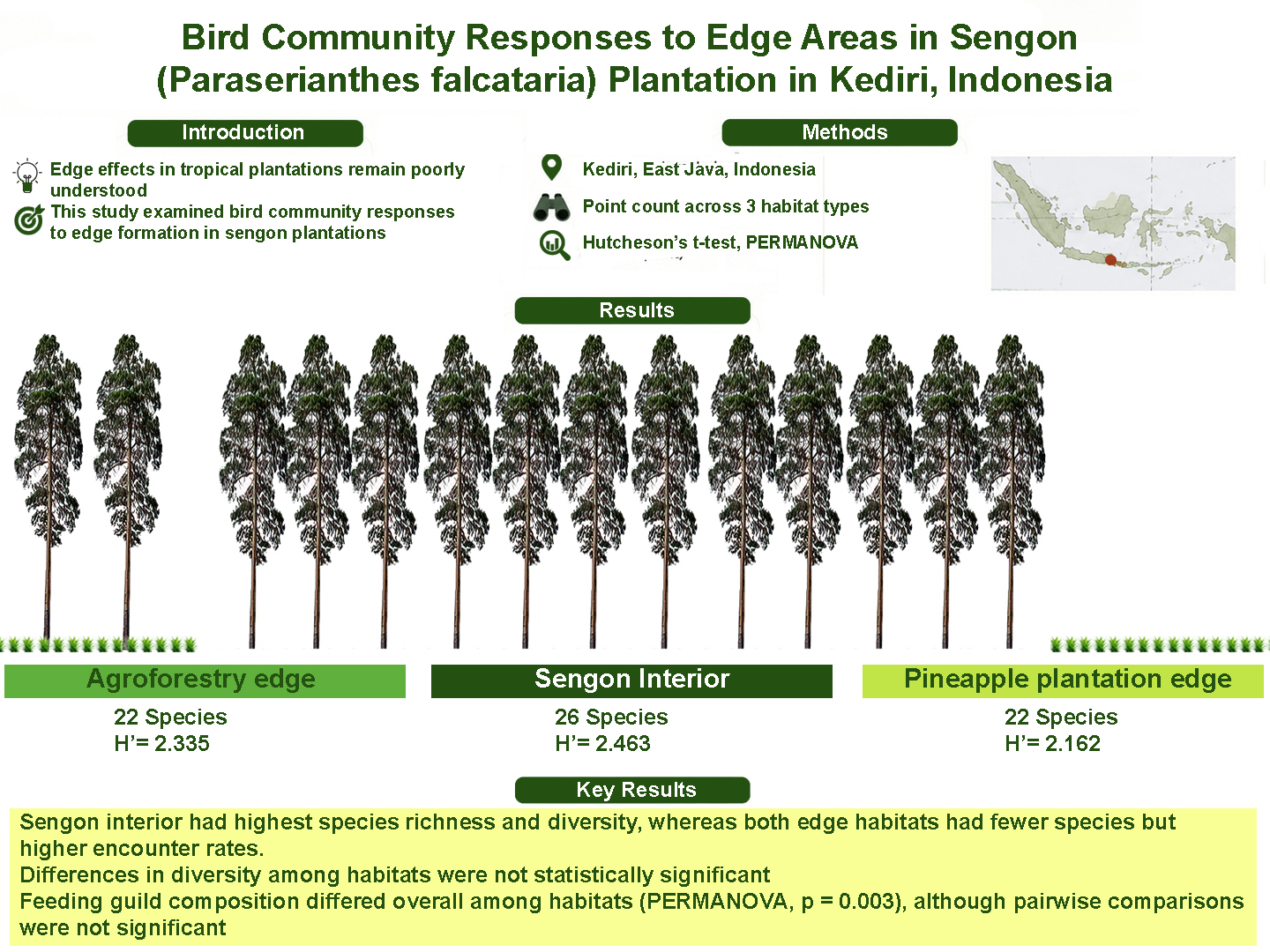
Habitat edges modify environmental conditions and species interactions; nonetheless, their impact on bird communities in tropical plantation landscapes is still not well comprehended. This study examined bird community responses to edge formation in sengon (Paraserianthes falcataria) plantations in Kediri, East Java, Indonesia. Bird surveys were conducted using point counts across sengon interior, agroforestry edge, and pineapple plantation edge. Species diversity was compared using Hutcheson’s t-test, and feeding guild was analyzed using PERMANOVA. A total of 30 bird species from 20 families and 2,338 individuals were detected. The sengon interior supported the highest species richness (26 species) and diversity (H′ = 2.463), compared with 22 species (H′ = 2.335) at the agroforestry edge and 22 species (H′ = 2.162) at the pineapple edge, though not significantly different (p > 0.05). The lowest encounter rates occurred in the interior (75.3 ± 6.9 individuals/hour), and higher rates occurred at the agroforestry edge (81.2 ± 9.5) and the pineapple edge (79.7 ± 7.4). Feeding guild differed among habitats(PERMANOVA, p = 0.003), although pairwise comparisons were not statistically significant (p = 0.100–0.106). Arboreal insectivores prevailed at the agroforestry edge (22.7%), aerial insectivores at the pineapple edge (18.2%), and both guilds were equally dominant in the interior (19.2%). These results indicate that sengon plantation areas maintain ecological importance for supporting both taxonomic and functional aspects of bird diversity in agricultural environments. Preserving habitat quality and supplementary habitat resources in neighboring areas might further strengthen the ecological function of sengon plantation patches in bird conservation.
Full text article
References
1. Baker, J.; French, K.; Whelan, R. The edge effect and ecotonal species: Bird communities across a natural edge in southeastern Australia. Ecology 2002, 83, 3048–3059, doi:10.1890/00129658(2002)083[3048:TEEAES]2.0.CO;2.
2. Murcia, C. Edge effects in fragmented forests: Implications for conservation. Trends Ecol. Evol. 1995, 10, 58–62, doi:10.1016/S0169-5347(00)88977-6.
3. Pfeifer, M.; Lefebvre, V.; Peres, C.A.; Banks-Leite, C.; Wearn, O.R.; Marsh, C.J.; et al. Creation of forest edges has a global impact on forest vertebrates. Nature 2017, 551, 187–191, doi:10.1038/nature24457.
4. Magura, T.; Lövei, G.L.; Tóthmérész, B. Edge responses are different in edges under natural versus anthropogenic influence: A meta-analysis using ground beetles. Ecol. Evol. 2017, 7, 1009–1017, doi:10.1002/ece3.2722.
5. Fraixedas, S.; Lindén, A.; Piha, M.; Cabeza, M.; Gregory, R.; Lehikoinen, A. A state-of-the-art review on birds as indicators of biodiversity: Advances, challenges, and future directions. Ecol. Indic. 2020, 118, 106728, doi:10.1016/j.ecolind.2020.106728.
6. Karimnejad, M.; Malekian, M.; Pourmanafi, S.; Mobarakeh, Z.M.; Keramati, S.; Ghased, R.; Ahmadi, M. Forest edge encroachment by rural orchards shifts bird communities in favor of understory birds: Forest birds as indicators of landscape changes in agroecosystems. Ecol. Indic. 2024, 167, 112698, doi:10.1016/j.ecolind.2024.112698.
7. Hasui, É.; Martensen, A.C.; Uezu, A.; Pimentel, R.G.; Ramos, F.N.; Ribeiro, M.C.; Metzger, J.P. Populations across bird species distribution ranges respond differently to habitat loss and fragmentation: Implications for conservation strategies. Perspect. Ecol. Conserv. 2024, 22, 43–54, doi:10.1016/j.pecon.2023.11.003.
8. Vallejos, L.M.; Prevedello, J.A.; Vecchi, M.B.; Alves, M.A.S. Species traits and latitude mediate bird responses to forest edges globally. Landsc. Ecol. 2024, 39, 53, doi:10.1007/s10980-024-01845-9.
9. Yilangai, R.M.; Abalaka, J.; Nsor, C.A.; Babale, A.; Karau, S.D.; Ivande, S. Effect of disturbance on bird feeding guilds in a West African dry forest. Afr. J. Ecol. 2023, 61, 461–468, doi:10.1111/aje.13136.
10. Wang, C.; Zhang, W.; Li, X.; Wu, J. A global meta-analysis of the impacts of tree plantations on biodiversity. Glob. Ecol. Biogeogr. 2022, 31, 576–587, doi:10.1111/geb.13440.
11. Lemessa, D.; Mewded, B.; Legesse, A.; Atinfau, H.; Alemu, S.; Maryo, M.; Tilahun, H. Do Eucalyptus plantation forests support biodiversity conservation? For. Ecol. Manag. 2022, 520, 120492, doi: 10.1016/j.foreco.2022.120492.
12. Ónodi, G.; Botta-Dukát, Z.; Winkler, D.; Rédei, T. Endangered lowland oak forest steppe remnants keep unique bird species richness in central Hungary. J. For. Res. 2022, 33, 343–355, doi:10.1007/s11676-021-01317-9.
13. Santana, L.D.; Prado-Junior, J.A.; Ribeiro, J.H.C.; Ribeiro, M.A.S.; Pereira, K.M.G.; Antunes, K.; Carvalho, F.A.; van den Berg, E. Edge effects in forest patches surrounded by native grassland are also dependent on patch size and shape. For. Ecol. Manag. 2021, 482, 118842, doi:10.1016/j.foreco.2020.118842.
14. Fahrig, L.; Arroyo-Rodriguez, V.; Bennett, J.R.; Boucher-Lalonde, V.; Cazetta, E.; Currie, D.J.; Eigenbrod, F.; Ford, A.T.; Harrison, S.P.; Jaeger, J.A.G.; et al. Is habitat fragmentation bad for biodiversity? Biol. Conserv. 2019, 230, 179–286, doi:10.1016/j.biocon.2018.12.026.
15. Chetcuti, J.; Kunin, W.E.; Bullock, J.M. Habitat fragmentation increases overall richness, but not of habitat-dependent species. Front. Ecol. Evol. 2020, 8, 607619, doi:10.3389/fevo.2020.607619.
16. Rybicki, J.; Abrego, N.; Ovaskainen, O. Habitat fragmentation and species diversity in competitive communities. Ecol. Lett. 2020, 23, 506–517, doi:10.1111/ele.13450.
17. Riva, F.; Fahrig, L. Landscape-scale habitat fragmentation is positively related to biodiversity, despite patch-scale ecosystem decay. Ecol. Lett. 2023, 26, 268–277, doi:10.1111/ele.14145.
18. Basuki, A.; Awaludin, A.; Suhendro, B.; Siswosukarto, S. Compression and tension creep behaviour of LVL sengon (Paraserianthes falcataria). ASEAN Eng. J. 2021, 11, 73–87, doi:10.11113/aej.v11.16668.
19. Nuroniah, H.S.; Tata, H.L.; Mawazin; Martini, E.; Dewi, S. Assessment on the suitability of planting non-native peatland species Falcataria moluccana (Miq.) Barneby & Grimes in rewetted peatlands. Sustainability 2021, 13, 7015, doi:10.3390/su13137015.
20. Rahmah, H.; Wijayanto, N.; Wulandari, A.S. The growth of sengon (Paraserianthes falcataria) and citronella (Cymbopogon nardus) productivity performance in agroforestry system. Biodiversitas 2023, 24, 3114–3119, doi:10.13057/biodiv/d240503.
21. Setyawan, Y.P.; Hidayat, P.; Triwidodo, H.; Puliafico, K. Keanekaragaman serangga fitofag pada sengon Falcataria moluccana (Miq.) Barneby & J.W. Grimes dari Jawa dan Hawaii di persemaian di Bogor. J. Ilmu Pertan. Indones. 2021, 26, 490–498, doi:10.18343/jipi.26.4.490.
22. Sutrisno, Y.A.; Triyogo, A.; Suryanto, P. Insect community in sengon (Falcataria moluccana) stands damaged by stem borers at various altitudes. Biodiversitas 2022, 23, 3234–3242, doi:10.13057/biodiv/d230651.
23. Ashari, H.; Sulistyadi, E.; Widodo, W. Potensi fauna burung sebagai daya tarik wisata birdwatching di hutan Taman Nasional Gunung Merapi, Suaka Margasatwa Sermo dan sekitarnya (Yogyakarta). Zoo Indones. 2019, 28, 8–20, doi:10.52508/zi.v28i1.3953.
24. Mardiastuti, A. Urban trees to attract wild birds in a tropical urban residential complex in Sentul, West Java, Indonesia. IOP Conf. Ser. Earth Environ. Sci. 2021, 918, 012003, doi:10.1088/1755-1315/918/1/012003.
25. Maulidya, A.L.; Dasumiati, D.; Widodo, W. Keragaman dan kepadatan populasi burung di kawasan hijau Cibinong Science Center (CSC) LIPI, Jawa Barat. Al-Kauniyah: J. Biol. 2021, 14, 325–334, doi:10.15408/kauniyah.v14i2.19942.
26. Bibby, C.; Jones, M.; Marsden, S. Teknik-teknik Ekspedisi Lapangan: Survei Burung; BirdLife International–Indonesia Programme: Bogor, ID, 2000; ISBN 979-95794-3-0.
27. Magurran, A. E. 1988. Ecological Diversity and Its Measurement. Croom Helm: London, UK. ISBN 978-0691084916.
28. Magurran, A. E. 2004. Measuring Biological Diversity. Blackwell Publishing: Oxford, UK. ISBN 978-0632056330.
29. Ghosh, M.; Chongder, I.; Dutta, A.; Saha, G.K.; Banerjee, S. Species composition and classification of guilds in birds with respect to food and feeding behavior: Evidences from suburban landscape in Hooghly district, West Bengal. Asian J. Conserv. Biol. 2022, 11, 143–153, doi:10.53562/ajcb.67216.
30. Anderson, M.J. Permutational multivariate analysis of variance (PERMANOVA). Wiley StatsRef: Stat. Ref. Online 2017, 1–15, doi:10.1002/9781118445112.stat07841.
31. AviList Core Team. AviList: The Global Avian Checklist, Version 2025; AviList: Online Database, 2025; doi:10.2173/avilist.v2025. Available online: https://www.avilist.org/checklist/v2025/ (accessed on 11 November 2025).
32. Willmer, J.; Püttker, T.; Prevedello, J.A. Global impacts of edge effects on species richness. Biol. Conserv. 2022, 272, 109654, doi:10.1016/j.biocon.2022.109654.
33. Bennett, R.E.; Sillett, T.S.; Rice, R.A.; Marra, P.P. Impact of cocoa agricultural intensification on bird diversity and community composition. Conserv. Biol. 2022, 36(1), e13889, doi:10.1111/cobi.13779.
34. Vallejos, L.M.; Prevedello, J.A.; Vecchi, M.B.; Alves, M.A.S. Species traits and latitude mediate bird responses to forest edges globally. Landsc. Ecol. 2024, 39, 53, doi:10.1007/s10980-024-01845-9.
35. Kim, H.; McComb, B.; Frey, S.; Bell, D.; Betts, M. Forest microclimate and composition mediate long‐term trends of breeding bird populations. Glob. Change Biol. 2022, 28, 6180–6193, doi:10.1111/gcb.16353.
36. Lindsey, B.; Bochio, G.; Anjos, L. Bird species that occupy river edge in continuous forest tend to be less sensitive to forest fragmentation. Rev. Bras. Ornitol. 2019, 27, 172–186, doi:10.1007/bf03544468.
37. McGinn, K.; Peery, M.; Zulla, C.; Berigan, W.; Wilkinson, Z.; Barry, J.; Keane, J.; Zuckerberg, B. A climate-vulnerable species uses cooler forest microclimates during heat waves. Biol. Conserv. 2023, 283, 110175, doi:10.1016/j.biocon.2023.110132.
38. Holopainen, S.; Selonen, V.; Krüger, H.; Kotanen, J.; Laaksonen, T.; Miettinen, E.; Nurmi, A.; Uushikala, L.; Väänänen, V.M. Forest habitat loss and human land use alter predation of artificial ground nests. For. Ecol. Manag. 2024, 561, 121933, doi:10.1016/j.foreco.2024.121858.
39. Li, W.; Zhu, C.; Grass, I.; Vázquez, D.P.; Wang, D.; Zhao, Y.; Zeng, D.; Kang, Y.; Ding, P.; Si, X. Plant–frugivore network simplification under habitat fragmentation leaves a small core of interacting generalists. Commun. Biol. 2022, 5, 380, doi:10.1038/s42003-022-04198-8.
40. Chen, T.; Xu, M.; Tu, J.; Wang, H.; Niu, X. Relationship between omnibus and post-hoc tests: An investigation of performance of the F test in ANOVA. Shanghai Arch. Psychiatry 2018, 30, 60–64, doi:10.11919/j.issn.1002-0829.218014.
41. Alekseyenko, A.V. Multivariate Welch t-test on distances. Bioinformatics 2016, 32, 3552–3558, doi:10.1093/bioinformatics/btw524.
42. Sauder, D.C.; DeMars, C.E. An updated recommendation for multiple comparisons. Adv. Methods Pract. Psychol. Sci. 2019, 2, 26–44, doi:10.1177/2515245918808784.
43. Rahayu, S.; Triyogo, A.; Widyastuti, S.M.; Ardianyah, F. Pests and diseases on Falcataria moluccana trees in agroforestry systems with pineapple in East Java, Indonesia. Biodiversitas 2021, 22, 2779–2788, doi:10.13057/biodiv/d220541.
44. Cheke, R.; Mann, C. Scarlet-headed Flowerpecker (Dicaeum trochileum), Version 1.0. In Birds of the World; del Hoyo, J., Elliott, A., Sargatal, J., Christie, D.A., de Juana, E., Eds.; Cornell Lab of Ornithology: Ithaca, NY, USA, 2020; doi:10.2173/bow.schflo1.01. Available online: https://birdsoftheworld.org/bow/species/schflo1/cur/introduction (accessed on 12 November 2025).
45. Krishnan, A. Coppersmith Barbet (Psilopogon haemacephalus), Version 2.0. In Birds of the World; Sly, N.D., Ed.; Cornell Lab of Ornithology: Ithaca, NY, USA, 2023; doi:10.2173/bow.copbar1.02. Available online: https://birdsoftheworld.org/bow/species/copbar1/cur/introduction (accessed on 12 November 2025).
46. Kumar, S.; Sohil, A.; Kichloo, M.A.; Sharma, N. Landscape heterogeneity affects diurnal raptor communities in a sub-tropical region of northwestern Himalayas, India. PLoS ONE 2022, 17, e0266804, doi:10.1371/journal.pone.0246555.
47. Coetzee, A.; Barnard, P.; Pauw, A. Urban nectarivorous bird communities in Cape Town, South Africa, are structured by ecological generalisation and resource distribution. J. Avian Biol. 2018, 49, e01565, doi:10.1111/jav.01526.
Authors
Copyright (c) 2026 Hammam As-shidqi Muhammad, Ani Mardiastuti, Yeni Aryati Mulyani

This work is licensed under a Creative Commons Attribution 4.0 International License.
Authors who publish with this journal agree to the following terms:
- Authors retain copyright and grant the journal right of first publication with the work simultaneously licensed under a Creative Commons Attribution License that allows others to share the work with an acknowledgement of the work's authorship and initial publication in this journal.
- Authors are able to enter into separate, additional contractual arrangements for the non-exclusive distribution of the journal's published version of the work (e.g., post it to an institutional repository or publish it in a book), with an acknowledgement of its initial publication in this journal.
- Authors are permitted and encouraged to post their work online (e.g., in institutional repositories or on their website) prior to and during the submission process, as it can lead to productive exchanges, as well as earlier and greater citation of published work (See The Effect of Open Access).
Article Details
How to Cite



