
On-Site Emission Inventory for Port Areas Along Soai Rap Navigation Channel, Vietnam
Article Sidebar
-
Carbon dioxide, emission inventory, Vietnam seaport, anchorage emissions, greenport adoption, site emission inventory, Soai Rap channel
Abstract
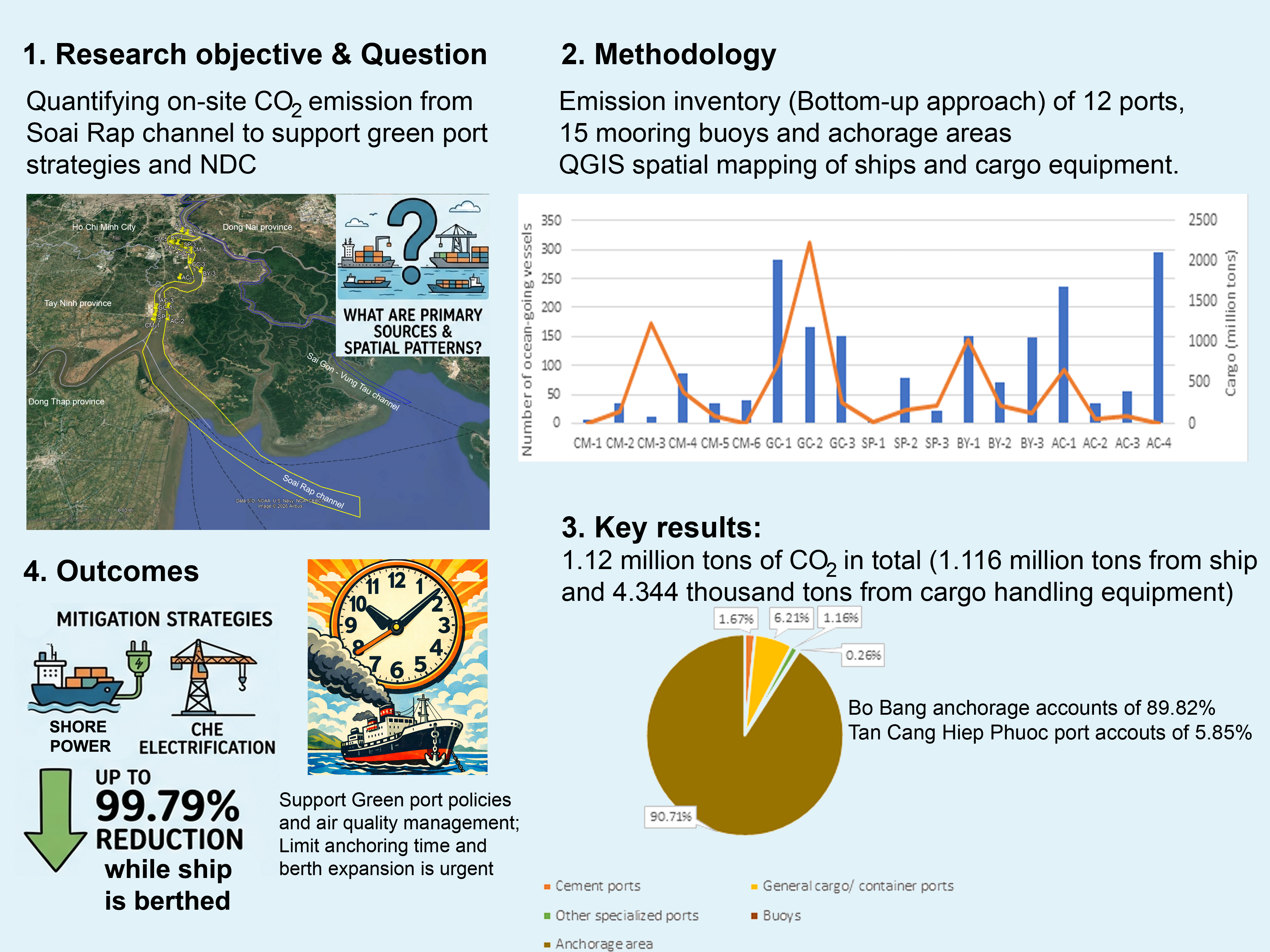
The Soai Rap navigation channel in southern Vietnam, spanning 66.6 km and hosting 12 ports and 15 mooring buoys, is undergoing expansion to support regional socioeconomic development. This study aimed to quantify the on-site CO2 emissions from maritime and port activities along the channel. A combination of bottom-up and top-down emission inventory approaches was applied,
focusing on ships (anchoring and maneuvering) and cargo handling equipment, with spatial analysis conducted using QGIS. The results show that ships are the dominant emission source, contributing 1.116 million tons of CO2, compared with 4.344 thousand tons from cargo handling equipment, out of a total of 1.12 million tons. Bo Bang anchorage accounted for most of the emissions (89.82%),
followed by Tan Cang Hiep Phuoc Port (5.85%). Scenario analysis indicates that introducing shore power could reduce emissions by 35.09–99.79%, whereas the electrification of cargo handling equipment could reduce emissions by 0.53–64.53%. Combining both measures yields reductions of 93.03–99.79%. These findings provide evidence for green port development strategies and local air
quality improvements. This study highlights the urgent need to expand berth capacity and implement electrification measures and management policies to effectively mitigate port-related emissions.
Full text article
References
1. Prime Minister. Decision no.1579/QD-TTg Approval of the Detailed Planning for Seaport Groups for the Period 2021-2030, vision to 2050; Prime Minister: Ha Noi, Vietnam, 2025;
2. Pham, TT; Ho, Q.B.; Ho, M.D.; Nguyen, T.T. Air pollution emission inventory in Ho Chi Minh City seaport, Forecast up to 2050. IOP Conf. Ser.: Earth Environ. Sci. 2025, 012009, doi:10.1088/1755-1315/1501/1/012009.
3. Woo, D.; Im, N. Estimation of the Efficiency of Vessel Speed Reduction to Mitigate Gas Emission in Busan Port Using the AIS Database. Journal of Marine Science and Engineering 2022, 10, 1–14, doi:10.3390/jmse10030435.
4. Isinkaralar, O. QGIS-based modeling and analysis of urban dynamics affecting land surface temperature towards climate hazards in coastal zones of Portugal. Nat Hazards 2024, 120, 7749–7764, doi:10.1007/s11069-024-06519-y.
5. Shirakawa, Y.; Ozaki, K.; Kasuya, Y.; Nguyen, T.H.; Nhan, L.T.T.; Pham, T.T. Greenhouse gas mitigation measures for seaport subsector in Ho Chi Minh City. Journal of Transportation Science and Technology 2022, 11, 78–89, doi:10.55228/JTST.11(1).78-89.
6. Nguyen, C.L.; Notteboom, T. Dry Ports As Extensions of Maritime Deep-Sea Ports: A Case Study of Vietnam. Journal of International Logistics and Trade 2016, 14, 65–88, doi:10.24006/jilt.2016.14.1.65.
7. Truong, H.T.; Nguyen, N.K. Quản trị vùng đô thị: lý thuyết và kinh nghiệm quốc tế cho Việt Nam. Review of Social Sciences (HCMC) 2023, 2, 59–73.
8. IMO (International Maritime Organization). Fourth Greenhouse Gas Study 2020; IMO: London, UK, 2020;
9. Kwon, Y.; Lim, H.; Lim, Y.; Lee, H. Implication of activity-based vessel emission to improve regional air inventory in a port area. Atmospheric Environment 2019, 203, 262–270, doi:10.1016/j.atmosenv.2019.01.036.
10. Ju, Y.; Hargreaves, C.A. The impact of shipping CO2 emissions from marine traffic in Western Singapore Straits during COVID-19. Science of The Total Environment 2021, 789, 148063, doi:10.1016/j.scitotenv.2021.148063.
11. Lee, J.U.; Lee, W.J.; Jeong, E.S.; Noh, J.H.; Kim, J.S.; Lee, J.W. Algorithm for Monitoring Emissions Based on Actual Speed of Ships Participating in the Korean Vessel Speed Reduction Program. Energies 2022, 15, 1–24, doi:10.3390/en15249555.
12. Ministry of Transport. National Shipping Procedure Declaration Portal; Ministry of Transport: Ha Noi, Vietnam, 2022;
13. Starcrest Consulting Group. 2016 Puget Sound Maritime Emissions Inventory; Starcrest Consulting Group: Poulsbo, Washington, USA, 2018;
14. Okşaş, O. Carbon emission strategies for container handling equipment using the activity-based method: A case study of Ambarlı container port in Turkiye. Marine Policy 2023, 149, 105480, doi:10.1016/j.marpol.2023.105480.
15. Rosas-Chavoya, M.; Gallardo-Salazar, J.L.; López-Serrano, P.M.; Alcántara-Concepción, P.C.; LeónMiranda, A.K. QGIS a constantly growing free and open-source geospatial software contributing to scientific development. Cuadernos De Investigación Geográfica 2022, 48, 197–213, doi:10.18172/cig.5143.
16. Ho, Q.B.; Vu, H.N.K.; Nguyen, T.T.; Nguyen, T.T.H.; Nguyen, T.T.T. A combination of bottom-up and topdown approaches for calculating of air emission for developing countries: a case of Ho Chi Minh City, Vietnam. Air Qual Atmos Health 2019, 12, 1059–1072, doi:10.1007/s11869-019-00722-8.
17. Mahmud, K.K.; Chowdhury, M.M.H.; Shaheen, M.M.A. Green port management practices for sustainable port operations: a multi method study of Asian ports. Maritime Policy & Management 2023, 51, 1902–1937, doi:10.1080/03088839.2023.2258125.
18. Densberger, N.L.; Bachkar, K. Towards accelerating the adoption of zero emissions cargo handling technologies in California ports: Lessons learned from the case of the Ports of Los Angeles and Long Beach. Journal of Cleaner Production 2022, 347, 131255, doi:10.1016/j.jclepro.2022.131255.
19. Åström, S.; Yaramenka, K.; Winnes, H.; Fridell, E.; Holland, M. The costs and benefits of a nitrogen emission control area in the Baltic and North Seas. Transportation Research Part D: Transport and Environment 2018, 59, 223–236, doi:10.1016/j.trd.2017.12.014.
20. González, M.J.C. Analysis and measurement of SOx, CO2, PM and NOx emissions in port auxiliary vessels. Environmental Monitoring and Assessment 2021, 193, 374, doi:10.1007/s10661-021-09145-4.
21. Innes, A.; Monios, J. Identifying the unique challenges of installing cold ironing at small and medium ports - The case of aberdeen. Transportation Research Part D: Transport and Environment 2018, 62, 298–313, doi:10.1016/j.trd.2018.02.004.
22. Forrest, K.; Mac Kinnon, M.; Torroja, B.; Samuelsen, S. Estimating the technical feasibility of fuel cell and battery electric vehicles for the medium and heavy duty sectors in California. Applied Energy 2020, 276, 115439, doi:10.1016/j.apenergy.2020.115439.
23. Bjerkan, K.Y.; Seter, H. Policy and Politics in Energy Transitions. A Case Study on Shore Power in Oslo. Energy Policy. 2021, 153, 112259, doi:10.1016/j.enpol.2021.112259.
24. Wan, Z.; Zhang, T.; Sha, M.; Guo, W.; Jin, Y.; Guo, J.; Liu, Y. Evaluation of emission reduction strategies for berthing containerships: A case study of the Shekou Container Terminal. Journal of Cleaner Production 2021, 299, 126820, doi:10.1016/j.jclepro.2021.126820.
25. Schiavoni, S.; Baldinelli, G.; Presciutti, A; D’Alessandro, F. Acoustic mitigation of noise in ports: an original methodology for the identification of intervention priorities. Noise Mapping 2022, 9, 211–226, doi:10.1515/noise-2022-0159.
26. Cui, R.; Liu, Z.; Wang, X.; Yang, Z.; Fan, S.; Shu, Y. The impact of marine engine noise exposure on seafarer fatigue: A China case. Ocean Engineering 2022, 266, 112943, doi:10.1016/j.oceaneng.2022.112943.
27. The Vietnamese Goverment. Decree no.06/2021/ND-CP on Mitigation of Greenhouse Gas Emissions and Protection of Ozone Layer; The Vietnamese Government: Ha Noi, Vietnam, 2021;
28. Argüello, G.; Krabbe, N.; Langlet, D.; Hassellöv, I.M.; Martinson, C.; Helmstad, A. Regulation of ships at
anchor: Safety and environmental implications. Marine Policy 2022, 140, 105052, doi:10.1016/j.marpol.2022.105052.
29. Lalla-Ruiz, E.; Shi, X.; Voß, S. The waterway ship scheduling problem. Transportation Research Part D: Transport and Environment 2018, 60, 191–209, doi:10.1016/j.trd.2016.09.013.
30. Lee, H.; Park, D.; Choo, S.; Pham, H.T. Estimation of the Non-Greenhouse Gas Emissions Inventory from Ships in the Port of Incheon. Sustainability 2020, 12, 1–18, doi: 10.3390/su12198231.
31. Xia, Z.; Guo, Z.; Wang, W.; Jiang, Y. Joint optimization of ship scheduling and speed reduction: A new strategy considering high transport efficiency and low carbon of ships in port. Ocean Engineering 2021, 233, 109224, doi:10.1016/j.oceaneng.2021.109224.
32. Pham, T.T.; Ho, Q.B.; Ho, M.D.; Nguyen, T.T. Traffic organization function of VTS system in reducing air pollution from ships at Sai Gon - Vung Tau channel. Transport and Communications Science Journal 2024, 75, 2252–2263, doi:10.47869/tcsj.75.9.2.
33. Mahpour, A.; Nazifi, A.; Amiri, A.M. Development of Optimization Model to Reduce Unloading and Loading Time at Berth in Container Ports. Iran J Sci Technol Trans Civ Eng. 2021, 45, 2831–2840, doi:10.1007/s40996-021-00590-2.
Authors
Copyright (c) 2026 Thanh Tuan Pham, Quoc Bang Ho, Minh Dung Ho, Quoc Bao Ho, Thi Nguyet Minh Tran

This work is licensed under a Creative Commons Attribution 4.0 International License.
Authors who publish with this journal agree to the following terms:
- Authors retain copyright and grant the journal right of first publication with the work simultaneously licensed under a Creative Commons Attribution License that allows others to share the work with an acknowledgement of the work's authorship and initial publication in this journal.
- Authors are able to enter into separate, additional contractual arrangements for the non-exclusive distribution of the journal's published version of the work (e.g., post it to an institutional repository or publish it in a book), with an acknowledgement of its initial publication in this journal.
- Authors are permitted and encouraged to post their work online (e.g., in institutional repositories or on their website) prior to and during the submission process, as it can lead to productive exchanges, as well as earlier and greater citation of published work (See The Effect of Open Access).
Article Details
How to Cite



