
Optimizing Resource Use in Upland Rice Farming: A Cobb-Douglas ProductivityAnalysis in Caraga Region, Philippines
Article Sidebar
-
resource productivity, upland rice, farm efficiency, rural agriculture
Abstract
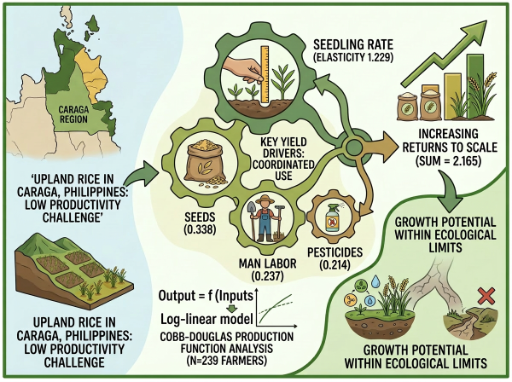
Upland rice farming sustains rural livelihoods in geographically constrained areas but remains lowproductivity. This study examines the determinants of upland rice productivity in the Caraga Region, Philippines, using cross-sectional data from 239 farmers and estimating a log-linear Cobb-Douglas production function by ordinary least squares. The results show that seed use (β = 0.338), pesticide application (β = 0.214), man labor (β = 0.237), and seedling rate (β = 1.229) significantly and positively influence output, with seedling rate exhibiting the largest elasticity. Farmer age (β = 0.587), years of schooling (β = 0.173), and family labor (β = 0.240) also have positive and significant effects, whereas household size (β = −0.585) has a negative effect on productivity. Fertilizer use (β = 0.005), man-animal labor, and institutional variables such as extension contact were not statistically significant. The model explains a substantial proportion of the variation in output (R² = 0.828; Adjusted R² = 0.686). The estimated sum of elasticities, 2.165, indicates increasing returns to scale, implying that a 1% increase in all inputs leads to a 2.17% increase in output. Diagnostic tests confirmed no severe multicollinearity and no significant heteroskedasticity. While the findings highlight the importance of coordinated input use and human capital in improving productivity, the analysis relies on cross-sectional survey data and assumes input exogeneity, which may not fully capture technical inefficiency or unobserved biophysical factors. These results provide an empirical basis for understanding input responsiveness in environmentally sensitive upland rice systems.
Full text article
References
2. Jose, M.; Manuel, M.; Dela Cruz, R. Harnessing Nitrogen Use Efficiency for Enhancing Productivity in Rice: A Review. Asian J. Soil Sci. Plant Nutr. 2024, 10, 101–111.
3. Zhang, F.; Wang, X.; Wu, D.; Huang, J.; Liu, L. Towards Sustainable Management of Agricultural Resources: A Framework to Assess the Relationship Between Water, Soil, Economic Factors, and Grain Production. J. Environ. Manag. 2023, 345, 118–129.
4. Billah, M.A. Measurement of Technical Efficiency of Paddy Farms at Jhenaidah District in Bangladesh: A Case Study by Using Cobb Douglas Production Function. J. Pharm. Neg. Results 2022, 13, 652–658. doi:10.47750/pnr.2022.13.04.087.
5. Kiron, Md.A. Profitability Analysis of Boro Rice Farming: The Case of Naogaon District of Bangladesh. Food Agribus. Manag. 2023, 4, 53–65. doi:10.26480/fabm.01.2023.53.65.
6. Ojo, M.P.; Ayanwale, A.B. Estimating Farm-Level Financing Gap: A Technical Efficiency Approach. Agric. Finance Rev. 2019, 79, 174–191. doi:10.1108/afr-02-2018-0008.
7. Kusumaningsih, N. The Technical Efficiency of Rice Farming and Mobile Phone Usage: A Stochastic Frontier Analysis. Food Res. 2023, 7, 244–253.
8. Saxena, A.; Arora, D.; Tan, C.H. Advancing Sustainable Agriculture through Resource Efficiency. E3S Web Conf. 2024, 398, 04006.
9. Ayoola, J.; Dangbegnon, C. Socio-Economic Factors Influencing Rice Production among Male and Female Farmers in Northern Guinea Savanna Nigeria. Afr. J. Biotechnol. Nat. Appl. 2011, 2, 1010–1014.
10. Baron, J.V. Climate Change Awareness and Adaptation by Rice Farmers in Surallah, South Cotabato. J. Soc. Human. Educ. 2024, 2, 81–92.
11. Becker, M.; Johnson, D.E. [No Title Found]. Nutr. Cycl. Agroecosyst. 2001, 59, 107–117. doi:10.1023/a:1017551529813.
12. Suyanto, S.; Tomich, T.P.; Otsuka, K. [No Title Found]. Agrofor. Syst. 2001, 52, 145–160. doi:10.1023/a:1010625019030.
13. Rayos, J. Determinants of Production and Technical Efficiency of Tilapia Farming in the Philippines. Asian J. Fish. Aquat. Res. 2024, 15, 90–101.
14. Acierto, A.J.; Vargas, D. Farmers’ Adoption of Upland PalayCheck System under Upland Rice Development Program (URDP) Implementation in Northern Philippines. SSRN Electron. J. 2020, doi:10.2139/ssrn.3756669.
15. Choudhary, D.; Thapa, S.; Adhikari, S. Rice Subsector Development and Farmer Efficiency in Nepal: Implications for Further Transformation and Food Security. Front. Sustain. Food Syst. 2022, 6, 105.
16. Chandel, R.; Sharma, R.; Tyagi, P. Farm-Level Technical Efficiency and Its Determinants of Rice Production in Indo-Gangetic Plains: A Stochastic Frontier Model Approach. Sustainability 2022, 14, 2184.
17. Sari, D.P.; Puspita, I.; Wulandari, E. The Optimization of Rice Production in Kubu Raya: Input and Allocative Efficiency. JIA: J. Ilm. Agribisnis 2024, 7, 34–45.
18. Belay, K.; Abebaw, D. Challenges Facing Agricultural Extension Agents: A Case Study from South‐Western Ethiopia. Afr. Dev. Rev. 2004, 16, 139–168. doi:10.1111/j.1467-8268.2004.00087.x.
19. Roder, W. Slash-and-Burn Rice Systems in the Hills of Northern Lao PDR: Description, Challenges, and Opportunities; International Rice Research Institute: Los Baños, Philippines, 2001. ISBN 978-971-22-0153-0.
20. John, S.A.; Krishnan, A. Optimization of Environmental and Other Variables in the Application of Arbuscular Mycorrhizal Fungi for Sustainable Paddy Cultivation. J. Appl. Microbiol. 2023, 135, 445–460.
21. Affholder, F.; Poeydebat, C.; Corbeels, M.; Scopel, E.; Tittonell, P. The Yield Gap of Major Food Crops in Family Agriculture in the Tropics. Field Crops Res. 2013, 143, 106–118. doi:10.1016/j.fcr.2012.10.021.
22. Ogundari, K. Resource-Productivity, Allocative Efficiency and Determinants of Technical Efficiency of Rainfed Rice Farmers. Agric. Econ. Czech 2008, 54, 224–233.
23. Tiongco, M.; Dawe, D. Long-Term Evolution of Productivity in a Sample of Philippine Rice Farms. World Dev. 2002, 30, 891–898. doi:10.1016/S0305-750X(02)00011-6.
24. Yahia Bapari, Md. Productivity, Profitability and Resource Use Efficiency: A Comparative Analysis between Conventional and High Yielding Rice. PoS 2016, 2, 5.1–5.10. doi:10.22178/pos.15-10.
25. Nainggolan, S.; Putri, D. Assessment of the Efficiency of Palm Plantations Using a Stochastic Frontier Approach. Agric. Resour. Econ. 2024, 25, 23–34.
26. Wassmann, R.; Jagadish, S.V.K.; Heuer, S.; Ismail, A.; Redona, E.; Serraj, R.; Singh, R.K.; Howell, G.; Pathak, H.; Sumfleth, K. Chapter 2: Climate Change Affecting Rice Production. In Advances in Agronomy; Elsevier: Amsterdam, Netherlands, 2009; Volume 102, pp. 59–122. ISBN 978-0-12-374817-1.
27. Nguyen, N.V. Global Climate Changes and Rice Food Security. Food Secur. 2010, 2(1), 5–17. https://doi.org/10.1007/s12571-009-0009-2.
28. Gollin, D.; Lagakos, D.; Waugh, M.E. The Agricultural Productivity Gap. Q. J. Econ. 2014, 129(2), 939–993. https://doi.org/10.1093/qje/qju002.
29. Mottaleb, K.A.; Rejesus, R.M.; Murty, M.V.R.; Mohanty, S. Benefits of High-Yielding Rice Varieties in Bangladesh: A Meta-Analysis Approach. Food Policy 2018, 81, 10–20. https://doi.org/10.1016/j.foodpol.2018.10.001.
30. Fujisaka, S.; Gregorio, G.; Gines, H.; Mercado, A.; Garrity, D. Rainfed Rice Farmers and Sustainable Livelihoods in Southeast Asia: Key Issues and Future Directions. Agric. Syst. 2003, 76(2), 775–793. https://doi.org/10.1016/S0308-521X(02)00013-2.
Authors
Copyright (c) 2026 Nancy S. Doloriel

This work is licensed under a Creative Commons Attribution 4.0 International License.
Authors who publish with this journal agree to the following terms:
- Authors retain copyright and grant the journal right of first publication with the work simultaneously licensed under a Creative Commons Attribution License that allows others to share the work with an acknowledgement of the work's authorship and initial publication in this journal.
- Authors are able to enter into separate, additional contractual arrangements for the non-exclusive distribution of the journal's published version of the work (e.g., post it to an institutional repository or publish it in a book), with an acknowledgement of its initial publication in this journal.
- Authors are permitted and encouraged to post their work online (e.g., in institutional repositories or on their website) prior to and during the submission process, as it can lead to productive exchanges, as well as earlier and greater citation of published work (See The Effect of Open Access).
Article Details
How to Cite



