
Evaluation of Leaf Spot and Blight Diseases in Mahogany (Swietenia mahagoni) Seedlings in Rumpin Nursery, Bogor Regency, Indonesia
Article Sidebar
-
leaf blight, leaf spot, Swietenia mahagoni, forest seedlings, nursery management, pathogenic fungi
Abstract
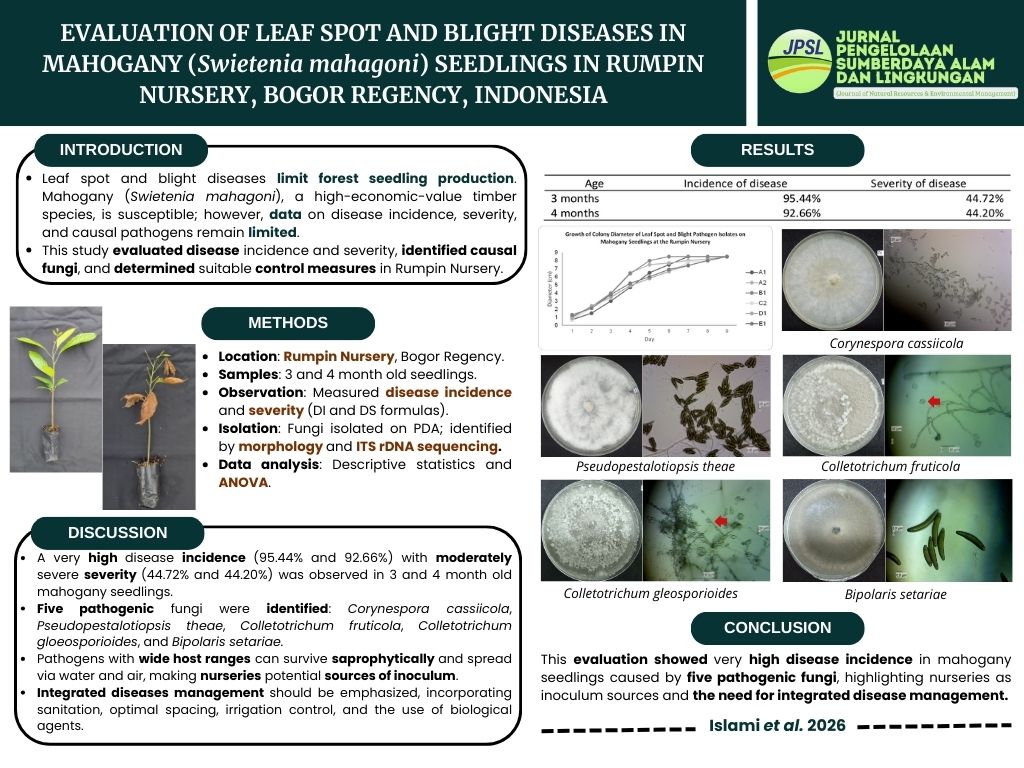
Seedling propagation in nurseries often faces problems such as disease attack. Leaf spot and blight are the main threats that usually hamper the growth of small-leaf mahogany (Swietenia mahagoni (L.) Jacq.) seedlings in the nursery. This study aims to determine the incidence and severity of disease, factors affecting the development of leaf spot and blight on small-leaf mahogany seedlings, and identify the causative pathogen. The research method included observations of disease incidence and severity in two sample plots representing the nursery with a sampling intensity of 10%. Leaf samples showing disease symptoms were isolated and tested for Koch’s Postulates. The result showed that the incidence of leaf spot and blight reached 95,44% and the disease severity was lower (44,72%). The environmental conditions at Rumpin Nursery, including high rainfall and humidity, as well as moderate temperatures (22-30 °C), favored the spread of disease. There were four types of fungal pathogens of leaf spot and blight on small-leaf mahogany seedlings, namely Pestalotiopsis sp., Rhizoctonia sp., Colletotrichum sp., and Bipolaris sp., with an incubation period of 1-2 days. This incubation period indicates rapid infectious ability under favorable environmental conditions.
Full text article
References
2. Ahmadpour, A; Heidarian, Z; Ghosta, Y; Alavi, Z; Alavi, F; Manamgoda, D.S; Kumla, J; Karunarathna, S.C; Rampelotto, P.H; Suwannarach, N. Morphological and Phylogenetic Analyses of Bipolaris Species Associated with Poales and Asparagales Host Plants in Iran. Frontiers in Cellular and Infection Microbiology. 2025, 1–28, doi:10.3389/fcimb.2025.1520125.
3. Aisah, A.R; Soekarno, B.W.P; Achmad. Isolation and Identification of Fungi Associated with Impotence Disease in Jabon Seedlings (Anthocephalus cadamba). Journal of Plant Forest Research. 2015, 12, 153–163, doi:10.20886/jpht.2015.12.3.153-163.
4. Barnett, H.L. Illustrated Genera of Imperfect Fungi, Second Edition. Mineapolis: Burges Publishing Company, USA, 1960.
5. Benatar, G.V; Nurhayati, Y; Febryani, N. Identification of Colletotrichum asianum Causes Anthracnose Mango Cultivar in Indramayu. Agricultural Media. 2023, 8, 1–13, doi:10.37058/mp.v8i1.6900.
6. [BPS] Central Statistics Agency. Production of Logs and Processed Timber by Type of Production 2023. 2023.
7. Deviana, S; Susilawati; Rachmawati, N. Identification of Damage to Mahogany Seedlings (Swietenia mahagoni (L.) Jacq) at the Forestry Plant Seedling Center (BPTH) of the South Kalimantan Provincial Forestry Service. Sylva Scienteae Journal. 2023, 6, 652–668, doi:10.20527/jss.v6i4.10015.
8. Febbiyanti, T.R. Abiotic Influence on the Development of Rubber Disease and Epidemic Forecasting Methods. Warta Perkaretan. 2020, 39, 95–114, doi:10.22302/ppk.wp.v39i2.729.
9. Febbiyanti, T.R; Tistama, R; Sarsono, Y. Characteristics of Pestalotiopsis sp. in Rubber (Hevea brasiliensis) Using Morphological and Molecular Characters. Journal of Rubber Research. 2022, 40, 15–26, doi:10.22302/ppk.jpk.v39i2.798.
10. Firmansyah, M.A; Alfarisi, M.H. Pathogenicity Test of Leaf Blight Pathogens in African Wood Plants (Maesopsis eminii Engl.) at the Permanent Nursery of BPDAS Bogor. Journal of Tropical Silviculture. 2016, 7, 115–124, doi:10.29244/j-siltrop.7.2.%25p.
11. Hartman, G.L; Sinclair, J.B; Rupe, J.C. Compendium of Soybean Diseases: Fourth Edition. Minnesota: APS Press, 1999.
12. Herliyana, E.N; Sakbani, L; Herdiyeni, Y; Munif, A. Identification of Pathogenic Fungi that Cause Disease in Red Jain (Anthocephalus macrophyllus (ROXB.) HAVIL). Journal of Tropical Silviculture. 2020, 11, 154–162, doi:10.29244/j-siltrop.11.3.154-162.
13. Irawan, A; Anggraeni, I; Christita, M. Identification Causes Leaf Spot Disease in Cempaka (Magnolia elegans (Blume.) H.Keng) Seedling and its Control Techniques. Jurnal Wasian. 2015, 2, 87–94, doi:10.62142/mhayeq96.
14. Istikorini, Y; Sari, O.Y. Survey and Identification of the Causes of Damping-Off Disease in Sengon (Paraserianthes falcataria) in the IPB Permanent Nursery. Sylva Lestari Journal. 2020, 8, 32–41, doi:10.23960/jsl1832-41.
15. Kusdiana, A.P.J; Sinaga, M.S; Tondok, E.T. Diagnosis of the Cause of the New Disease of Rubber Leaf Fall (Hevea brasiliensis Muell. Arg.). Journal of Rubber Research. 2020, 38, 165–178, doi:10.22302/ppk.jpk.v2i38.728.
16. Lelana, N.E; Wiyono, S; Giyanto, G; Siregar, I.Z. Cultivation Factors and Their Relationship with the Severity of Puru Rust Disease in Sengon (Falcataria moluccana (Miq.) Barneby & J.W. Grimes). Journal of Plantation Forest Research, Research, Development and Innovation Agency, Ministry of Environment and Forestry. 2018,15, 29–41, doi:10.20886/jpht.2018.15.1.29-41.
17. Manamgoda, D.S; Rossman, A.Y; Castlebury, L.A; Crous, P.W; Madrid, H; Chukeatirote, E; Hyde, K.D. The Genus Bipolaris. Studies in Mycology. 2014, 79, 221–288, doi:10.1016/j.simyco.2014.10.002.
18. Nurjasmi, R; Suryani, S. Testing of Actinomycetes Antagonists Against the Pathogen Colletotrichum capsici that Causes Anthracnose Disease in Cayenne Pepper Fruits. Respati Scientific Journal. 2020, 11, 1–12, doi:10.52643/jir.v11i1.843.
19. Sulistyowati, R; Zuhroh, M.U; Febrianti, R.D. Acceleration of the Growth of Mahogany Seedlings (Swietenia macrophylla King.) by Dosing of Azolla and Scarification of Seeds. AGRIFOR Journal. 2023, 22, 253–262, doi:10.31293/agrifor.v22i2.6729.
20. Sushardi, S. The Impact of the Forest Products Industry on Community Welfare. Journal of Tropical Forests. 2016, 6.
21. Watanabe, T. Pictorial Atlas of Soil and Seed Fungi Morphologies of Cultured Fungi and Key to Species. London: CRC Press, 2002.
22. Zainudin, N.A.I.M; Sattar, M.M. Characterization of Pathological Diversity of Colletotrichum Species Associated with Anthracnose Disease on Mango in Peninsular Malaysia. Asian Journal of Agriculture and Biology. 2019, 7, 261–270, doi:10.35495.
Authors
Copyright (c) 2026 Naluri Siyasah Islami, Yunik Istikorini, Neo Endra Lelana, Arum Sekar Wulandari

This work is licensed under a Creative Commons Attribution 4.0 International License.
Authors who publish with this journal agree to the following terms:
- Authors retain copyright and grant the journal right of first publication with the work simultaneously licensed under a Creative Commons Attribution License that allows others to share the work with an acknowledgement of the work's authorship and initial publication in this journal.
- Authors are able to enter into separate, additional contractual arrangements for the non-exclusive distribution of the journal's published version of the work (e.g., post it to an institutional repository or publish it in a book), with an acknowledgement of its initial publication in this journal.
- Authors are permitted and encouraged to post their work online (e.g., in institutional repositories or on their website) prior to and during the submission process, as it can lead to productive exchanges, as well as earlier and greater citation of published work (See The Effect of Open Access).
Article Details
How to Cite



