Environmental Impact Mitigation Through Biofiltration of Mercury (Hg) fromGold Mining Effluent Using Parupuk (Phragmites karka) Pendekatan Fitoremediasi Berbasis Tanaman Lokal dalam Pengolahan Air Limbah Tambang
Article Sidebar
-
mining wastewater, heavy metals, parupuk plant (Phragmites karka), biofiltration
Abstract
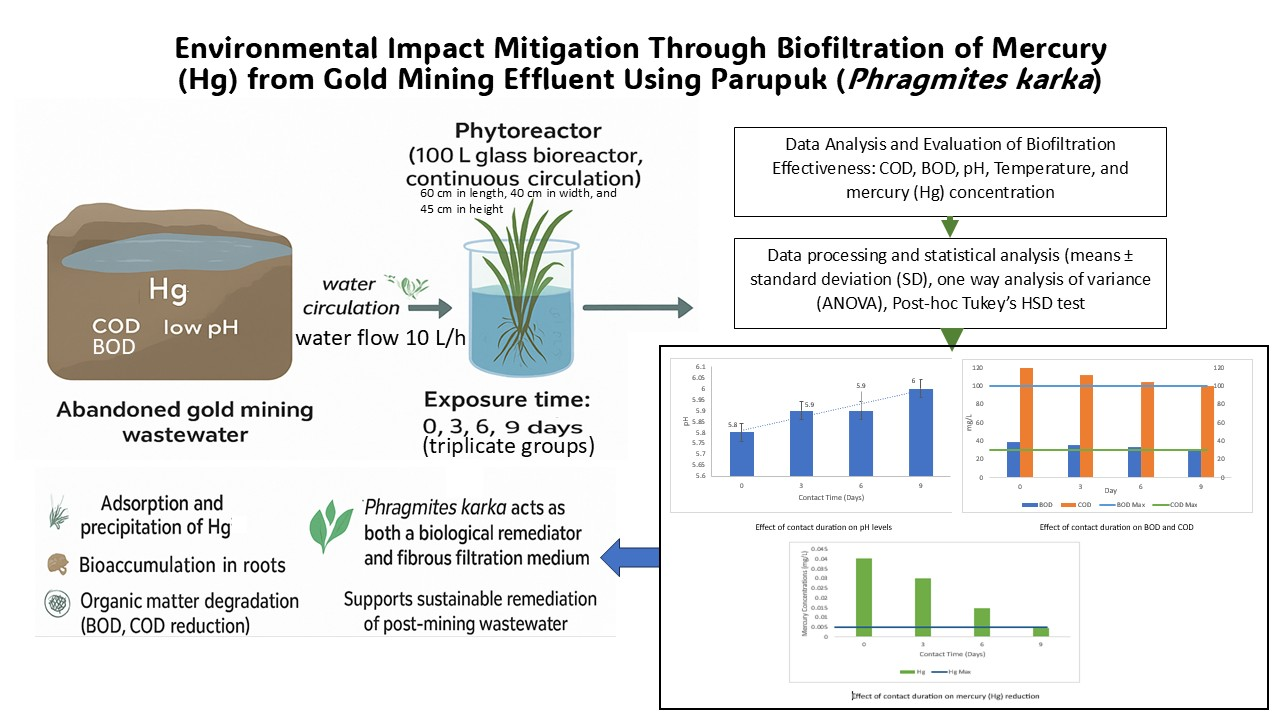
Mercury pollution from gold mining wastewater remains a major environmental concern due to its persistence and toxicity, driving interest in sustainable, low cost phytoremediation using native wetland plants. This research examines the phytoremediation capacity of Phragmites karka (locally referred to as Parupuk) in mitigating mercury contamination, with a particular focus on mercury (Hg), from wastewater derived from abandoned gold mining sites. A quasi experimental approach was implemented with exposure periods of 0, 3, 6, and 9 days. Approximately 1.5 kg (8 clumps) of live biomass was placed into custom designed 100 L glass bioreactors equipped with continuous water circulation. Key water quality indicators including pH, Chemical Oxygen Demand (COD),
Biological Oxygen Demand (BOD), and Hg concentrations were systematically evaluated. Results indicated an increase in pH from 5.8 to 6.0, a 23.17% reduction in BOD (8.9 mg/L), and an 16.67% decline in COD (20 mg/L). The residual Hg concentration reached 0.0044 mg/L, which is below the permissible limit of 0.005 mg/L set by the Indonesian Water Quality Standard (Regulation No. 5/2022). These outcomes demonstrate the dual role of Phragmites karka as both a biological remediator and a fibrous filtration medium for water quality enhancement. Although the system is capable of meeting regulatory thresholds, further research is needed to clarify how Hg
sequestration works and to determine the significant and specific contributions to plant structural attributes. This work establishes a scientific basis for further studies aimed at optimizing and scaling phytoremediation technologies for sustainable application in post-mining environments.
Full text article
References
2. Fashola, M.O.; Ngole-Jeme, V.M.; Babalola, O.O. Heavy Metal Pollution from Gold Mines: Environmental Effects and Bacterial Strategies for Resistance. Int. J. Environ. Res. Public Health 2016, 13, 1047, doi:10.3390/IJERPH13111047.
3. Liu, L.; Li, W.; Song, W.; Guo, M. Remediation Techniques for Heavy Metal-Contaminated Soils: Principles and Applicability. Sci. Total Environ. 2018, 633, 206–219, doi:10.1016/j.scitotenv.2018.03.161.
4. Yeshiwas, A.G.; Bayeh, G.M.; Tsega, T.D.; Tsega, S.S.; Gebeyehu, A.A.; Alamrie Asmare, Z.; Anteneh, R.M.; Ejigu, A.G.; Ahmed, A.F.; Yigzaw, Z.A.; et al. Scoping Review on Mitigating the Silent Threat of Toxic Industrial Waste: Eco-Rituals Strategies for Remediation and Ecosystem Restoration. Environ. Health Insights 2025, 19, 11786302251329796, doi:10.1177/11786302251329795.
5. Maulidah, M. (Maulidah); Priatmadi, B.J. (Bambang); Asmawi, S. (Suhaili); Sofarini, D. (Dini) Kajian Indeks Pencemaran Air Pada Areal Pertambangan Rakyat Intan Dan Emas Di Kecamatan Cempaka Kota Banjarbaru. Enviroscienteae 2015, 11, 102–110.
6. Kafle, A.; Timilsina, A.; Gautam, A.; Adhikari, K.; Bhattarai, A.; Aryal, N. Phytoremediation: Mechanisms, Plant Selection and Enhancement by Natural and Synthetic Agents. Environ. Adv. 2022, 8, 100203, doi:10.1016/J.ENVADV.2022.100203.
7. Hu, Y.; Wang, J.; Yang, Y.; Li, S.; Wu, Q.; Nepovimova, E.; Zhang, X.; Kuca, K. Revolutionizing Soil Heavy Metal Remediation: Cutting-Edge Innovations in Plant Disposal Technology. Sci. Total Environ. 2024, 918, 170577, doi:10.1016/J.SCITOTENV.2024.170577.
8. Prasetyo, R.A. Review Jurnal Teknologi Fitoremediasi Untuk Pemulihan Lahan Tercemar Minyak. PETROJurnal Ilm. Tek. Perminyakan 2021, 10, 53–59, doi:10.25105/petro.v10i2.9249.
9. Fadzil, F.N.M.; Mohamad, M.A.N.; Repin, R.; Harumain, Z.A.S. Metal Uptake and Tolerance in Hyperaccumulator Plants: Advancing Phytomining Strategies. Rhizosphere 2024, 29, 100836, doi:10.1016/J.RHISPH.2023.100836.
10. Islam, M.M.; Saxena, N.; Sharma, D. Phytoremediation as a Green and Sustainable Prospective Method for Heavy Metal Contamination: A Review. RSC Sustain. 2024, 2, 1269–1288, doi:10.1039/D3SU00440F.
11. Ramadhania, A.R.; Rachmadiarti, F.; Biologi, J.; Matematika, F.; Pengetahuan, I.; Universitas, A.; Surabaya, N. Keanekaragaman Tumbuhan Akumulator Logam Berat (Pb) Di Sungai Sudimoro, Mojokerto Diversity of Heavy Metal Accumulator Macrophytes in Sudimoro River, Mojokerto. 2021, 10, 329–338.
12. Sabreena; Hassan, S.; Bhat, S.A.; Kumar, V.; Ganai, B.A.; Ameen, F. Phytoremediation of Heavy Metals: An Indispensable Contrivance in Green Remediation Technology. Plants 2022, Vol. 11, Page 1255 2022, 11, 1255, doi:10.3390/PLANTS11091255.
13. Sur, I.M.; Hegyi, A.; Micle, V.; Molnar, H.; Gabor, T. Remediation of Soils Polluted with Metals by Phytoextraction Using Hordeum Vulgare L. Int. J. Environ. Sci. Technol. 2025, 1–14, doi:10.1007/S13762-025-06566-3/METRICS.
14. Mukherjee, S.; Sarkar, B.; Aralappanavar, V.K.; Mukhopadhyay, R.; Basak, B.B.; Srivastava, P.; Marchut-Mikołajczyk, O.; Bhatnagar, A.; Semple, K.T.; Bolan, N. Biochar-Microorganism Interactions for Organic Pollutant Remediation: Challenges and Perspectives. Environ. Pollut. 2022, 308, 119609, doi:10.1016/J.ENVPOL.2022.119609.
15. Pachaiappan, R.; Cornejo-Ponce, L.; Rajendran, R.; Manavalan, K.; Femilaa Rajan, V.; Awad, F. A Review on Biofiltration Techniques: Recent Advancements in the Removal of Volatile Organic Compounds and Heavy Metals in the Treatment of Polluted Water. Bioengineered 2022, 13, 8432, doi:10.1080/21655979.2022.2050538.
16. Sharma, R.; Malaviya, P. Enhanced Textile Wastewater Remediation in Phragmites Karka-Based Vertical Flow Constructed Wetlands Using Phragmites-Derived Biochar. Chemosphere 2024, 366, doi:10.1016/J.CHEMOSPHERE.2024.143529.
17. Bui, V.K.H.; Nguyen, T.P.; Tran, T.C.P.; Nguyen, T.T.N.; Duong, T.N.; Nguyen, V.T.; Liu, C.; Nguyen, D.D.; Nguyen, X.C. Biochar-Based Fixed Filter Columns for Water Treatment: A Comprehensive Review. Sci. Total Environ. 2024, 954, 176199, doi:10.1016/J.SCITOTENV.2024.176199.
18. Aguirre-Sierra, A.; Bacchetti-De Gregoris, T.; Salas, J.J.; De Deus, A.; Esteve-Núñez, A. A New Concept in Constructed Wetlands: Assessment of Aerobic Electroconductive Biofilters. Environ. Sci. Water Res. Technol. 2020, 6, 1312–1323, doi:10.1039/C9EW00696F.
19. Narayanan, M.; Ma, Y. Metal Tolerance Mechanisms in Plants and Microbe-Mediated Bioremediation. Environ. Res. 2023, 222, 115413, doi:10.1016/J.ENVRES.2023.115413.
20. Hrynkiewicz, K.; Złoch, M.; Kowalkowski, T.; Baum, C.; Buszewski, B. Efficiency of Microbially Assisted Phytoremediation of Heavy-Metal Contaminated Soils. Environ. Rev. 2018, 26, 316–332, doi:10.1139/ER-2018-0023;SUBPAGE:STRING:ABSTRACT;REQUESTEDJOURNAL:JOURNAL:ER;JOURNAL:JOURNAL:ER;WEBSITE:WEBSITE:NRC-SITE;ISSUE:ISSUE:10.1139/ER.2018.2603;WGROUP:STRING:CSP.
21. Liu, Z. Bin; Liu, X.H.; Zhou, T.; Zhang, S.Y.; Li, J.M.; Yang, Q. Effect of Temperature on Performance and Microbial Community Structure of Anaerobic Biofilter-Treated Domestic Wastewater. Huanjing Kexue/Environmental Sci. 2020, 41, 4141–4149, doi:10.13227/J.HJKX.202001014,.
22. Mielcarek, A.; Rodziewicz, J.; Janczukowicz, W.; Ostrowska, K. The Kinetics of Pollutant Removal through Biofiltration from Stormwater Containing Airport De-Icing Agents. Appl. Sci. 2021, Vol. 11, Page 1724 2021, 11, 1724, doi:10.3390/APP11041724.
23. Kazmi, S.S.U.H.; Wang, Y.Y.L.; Cai, Y.E.; Wang, Z. Temperature Effects in Single or Combined with Chemicals to the Aquatic Organisms: An Overview of Thermo-Chemical Stress. Ecol. Indic. 2022, 143, 109354, doi:10.1016/J.ECOLIND.2022.109354.
24. Kennedy, V.S. Thermal Pollution. Encycl. Energy 2004, 79–89, doi:10.1016/B0-12-176480-X/00416-2.
25. Suriasni, P.A.; Faizal, F.; Panatarani, C.; Hermawan, W.; Joni, I.M. A Review of Bubble Aeration in Biofilter to Reduce Total Ammonia Nitrogen of Recirculating Aquaculture System. Water (Switzerland) 2023, 15, doi:10.3390/W15040808.
26. Mallick, S.; Pradhan, T.; Das, S. Bacterial Biomineralization of Heavy Metals and Its Influencing Factors for Metal Bioremediation. J. Environ. Manage. 2025, 373, 123977, doi:10.1016/J.JENVMAN.2024.123977.
27. Miranda, L.S.; Wijesiri, B.; Ayoko, G.A.; Egodawatta, P.; Goonetilleke, A. Water-Sediment Interactions and Mobility of Heavy Metals in Aquatic Environments. Water Res. 2021, 202, 117386, doi:10.1016/J.WATRES.2021.117386.
28. Zaimee, M.Z.A.; Sarjadi, M.S.; Rahman, M.L. Heavy Metals Removal from Water by Efficient Adsorbents. Water 2021, Vol. 13, Page 2659 2021, 13, 2659, doi:10.3390/W13192659.
29. Mederos, M.; Pla, C.; Valdes-Abellan, J.; Benavente, D. Evaluating Nickel Removal Efficacy of Filtralite under Laboratory Conditions: Implications for Sustainable Urban Drainage Systems. J. Water Process Eng. 2024, 63, 105416, doi:10.1016/J.JWPE.2024.105416.
30. Hosseinahli, N.; Hasanov, M.; Abbasi, M. Heavy Metals’ Removal from Aqueous Environments Using Silica Sulfuric Acid. Water Reuse 2021, 11, 508–519, doi:10.2166/WRD.2021.085.
31. Ávila, F.G.; Cabrera-Sumba, J.; Valdez-Pilataxi, S.; Villalta-Chungata, J.; Valdiviezo-Gonzales, L.; Alegria-Arnedo, C. Removal of Heavy Metals in Industrial Wastewater Using Adsorption Technology: Efficiency and Influencing Factors. Clean. Eng. Technol. 2025, 24, 100879, doi:10.1016/J.CLET.2025.100879.
32. Acharya, A.; Perez, E.; Maddox-Mandolini, M.; De, H.; Fuente, L. The Status and Prospects of Phytoremediation of Heavy Metals. 2023.
33. Montreemuk, J.; Stewart, T.N.; Prapagdee, B. Bacterial-Assisted Phytoremediation of Heavy Metals: Concepts, Current Knowledge, and Future Directions. Environ. Technol. Innov. 2024, 33, 103488, doi:10.1016/J.ETI.2023.103488.
34. Zhang, J.; Yan, Q.; Bai, G.; Guo, D.; Chi, Y.; Li, B.; Yang, L.; Ren, Y. Inducing Root Redundant Development to Release Oxygen: An Efficient Natural Oxygenation Approach for Subsurface Flow Constructed Wetland. Environ. Res. 2023, 239, 117377, doi:10.1016/J.ENVRES.2023.117377.
35. Sun, H.; Zhou, Y.; Jiang, C. Regulating Denitrification in Constructed Wetlands: The Synergistic Role of Radial Oxygen Loss and Root Exudates. Water 2024, Vol. 16, Page 3706 2024, 16, 3706, doi:10.3390/W16243706.
36. Bai, S.; Chen, J.; Guo, M.; Ren, N.; Zhao, X. Vertical-Scale Spatial Influence of Radial Oxygen Loss on Rhizosphere Microbial Community in Constructed Wetland. Environ. Int. 2023, 171, doi:10.1016/j.envint.2022.107690.
37. Alengebawy, A.; Abdelkhalek, S.T.; Qureshi, S.R.; Wang, M.Q. Heavy Metals and Pesticides Toxicity in Agricultural Soil and Plants: Ecological Risks and Human Health Implications. Toxics 2021, Vol. 9, Page 42 2021, 9, 42, doi:10.3390/TOXICS9030042.
38. Mosquera Chaverra, L.; Paredes Cuervo, D.; López Gutiérrez, A.; Arias, C.A.; Carvalho, P.N. Phytoremediation of Mercury Contamination: Bibliometric Analysis. Sustain. 2024, 16, 9408, doi:10.3390/SU16219408/S1.
39. Tiodar, E.D.; Văcar, C.L.; Podar, D. Phytoremediation and Microorganisms-Assisted Phytoremediation of Mercury-Contaminated Soils: Challenges and Perspectives. Int. J. Environ. Res. Public Health 2021, 18, 1–38, doi:10.3390/IJERPH18052435,.
40. Sitarska, M.; Traczewska, T.; Hołtra, A.; Zamorska-Wojdyła, D.; Filarowska, W.; Hanus-Lorenz, B. Removal of Mercury from Water by Phytoremediation Process with Salvinia Natans(L.) All. Environ. Sci. Pollut. Res. Int. 2023, 30, 85494, doi:10.1007/S11356-023-27533-W.
41. Robles, M.E.; Oh, Y.; Haque, M.T.; Jeon, M.; Kim, L.-H. Soil Mercury Pollution in Nature-Based Solutions Across Various Land Uses: A Review of Trends, Treatment Outcomes, and Future Directions. Appl. Sci. 2025, Vol. 15, Page 6502 2025, 15, 6502, doi:10.3390/APP15126502.
Authors
Copyright (c) 2025 Lailan Ni`mah; Agus Suryani, Muhammad Adzhari Anshari, Hari Apriyan Saputra

This work is licensed under a Creative Commons Attribution 4.0 International License.
Authors who publish with this journal agree to the following terms:
- Authors retain copyright and grant the journal right of first publication with the work simultaneously licensed under a Creative Commons Attribution License that allows others to share the work with an acknowledgement of the work's authorship and initial publication in this journal.
- Authors are able to enter into separate, additional contractual arrangements for the non-exclusive distribution of the journal's published version of the work (e.g., post it to an institutional repository or publish it in a book), with an acknowledgement of its initial publication in this journal.
- Authors are permitted and encouraged to post their work online (e.g., in institutional repositories or on their website) prior to and during the submission process, as it can lead to productive exchanges, as well as earlier and greater citation of published work (See The Effect of Open Access).
Article Details
How to Cite



