
Assessment of Mangrove Species Composition, Biomass, and Carbon Stock Potential for Climate Change Mitigation in Pekalongan, Indonesia
Article Sidebar
-
carbon, conservation, coastal, environment, silvofishery
Abstract
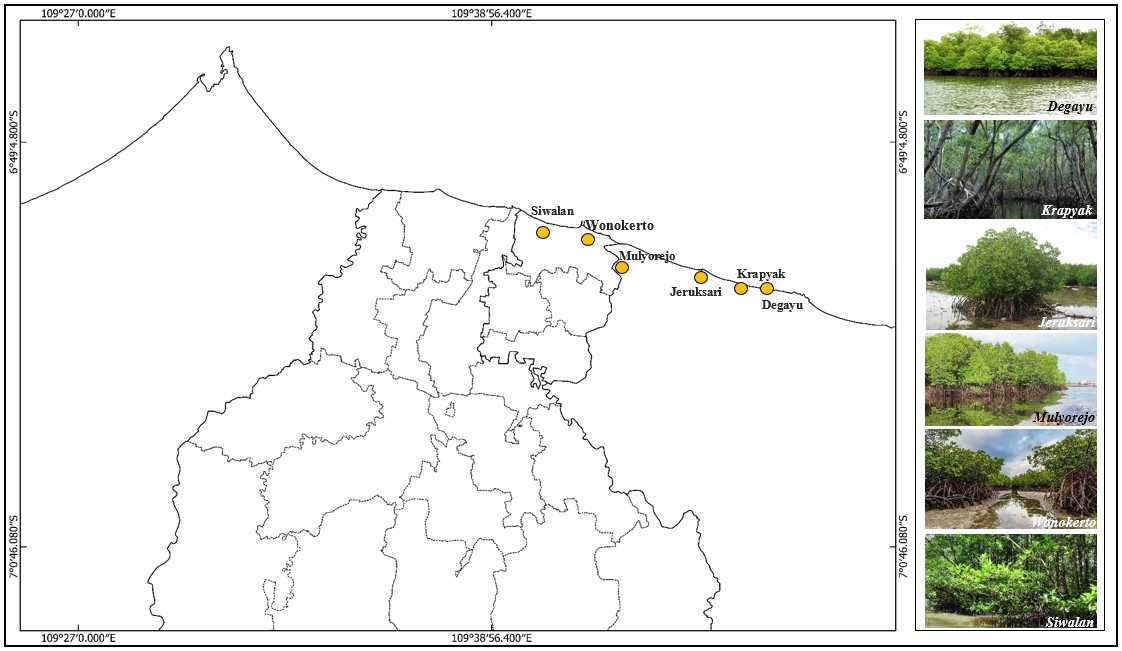
Mangrove forests are vital coastal ecosystems that support biodiversity and deliver key ecological services, particularly in tropical regions. In Pekalongan, Central Java, rapid coastal development and land-use change threaten their ecological integrity, particularly their role in carbon sequestration. This study assessed mangrove species richness, biomass, and carbon stock in both conservation and non-conservation areas to evaluate their ecological status and contribution to climate change mitigation. Six sampling sites, comprising protected and unprotected areas, were surveyed using 60 nested square plots to record tree and sapling populations. Biomass estimates, including above and below ground components, were calculated through specific allometric models. Results showed that conservation areas stored higher carbon (248.82 tC ha⁻¹) than non-conservation sites, though Degayu which an unprotected area had the second-highest carbon stock (159.66 tC ha⁻¹). Among species, Sonneratia alba contributed the most carbon, while dense saplings of Rhizophora apiculata and Bruguiera gymnorhiza suggest potential shifts in species dominance. The mean carbon stock (125.02 tC ha⁻¹, equivalent to 495.07 t CO₂e ha⁻¹) indicates substantial emission risks if degradation occurs. These findings underscore the critical role of both conservation and non-conservation mangroves in climate regulation and align with Indonesia’s current policy focus on blue carbon ecosystems, coastal resilience, and community-based conservation.
Full text article
References
1. Adame, M. F.; Connolly, R. M.; Turschwell, M. P.; Lovelock, C. E.; Fatoyinbo, T.; Lagomasino, D.; Goldberg, L. A.; Holdorf, J.; Friess, D. A.; Sasmito, S. D.; Sanderman, J. Future carbon emissions from global mangrove forest loss. Global Change Biology. 2021, 27(12), 2856–2866. https://doi.org/10.1111/gcb.15571
2. Alongi, D. M. Carbon sequestration in mangrove forests. Carbon Management. 2012, 3(3), 313–322. https://doi.org/10.4155/cmt.12.20
3. Alongi, D. M.; Murdiyarso, D.; Fourqurean, J. W.; Kauffman, J. B.; Hutahaean, A.; Crooks, S.; Lovelock, C. E.; Howard, J.; Herr, D.; Fortes, M.; Pidgeon, E. Indonesia’s blue carbon: a globally significant and vulnerable sink for seagrass and mangrove carbon. Wetland Ecology Management. 2016, 24(1), 3–13.
4. Apriyanto, E.; Nugroho, P. B. A.; Siswahyono. Species composition, diversity and biomass of mangroves forest in Pulau Bai-Pantai Panjang natural conservation park of Bengkulu, Indonesia. AACL Bioflux. 2021, 14(4), 2012–2020.
5. BAPPENAS, National Development Agency. A snapshot of regional action plan on reducing greenhouse gases emissions. 2014. http://ranradgrk.bappenas.go.id/ rangrk/admincms/downloads/publications/Potret_RAD-GRK.pdf.
6. Bismark, M.; Subiandono, E.; Heriyanto, N. M.; [Diversity, potential species and carbon content of mangrove forest at Subelen River, Siberut, West Sumatera]. Jurnal Penelitian Hutan dan Konservasi Alam. 2008, 5(3), 297–306.
7. BSN, National Standardization Agency. SNI 7724:2011. Measurement and calculation of carbon stock–Field measurement for forest carbon stock estimation (ground-based forest carbon accounting). 2011.
8. Cameron, C.; Hutley, L. B.; Friess, D. A.; Brown, B. High greenhouse gas emissions mitigation benefits from mangrove rehabilitation in Sulawesi, Indonesia. Ecosystem Services. 2019, 40, 101035.
9. Dharmawan, I. W. E.; Pramudji. Guide for mangrove ecosystem monitoring. CRITC COREMAP CTI LIPI; Bogor, Indonesia, 2014; 35 p.
10. Dharmawan, I. W. S.; Siregar, C. A. [Soil carbon and carbon estimation of Avicennia marina (Forsk.) Vierh. stand at Ciasem, Purwakarta]. Jurnal Penelitian Hutan dan Konservasi Alam. 2008, 5(4), 317-328. [In Indonesian].
11. Dinilhuda, A.; Akbar, A. A.; Jumiati.; Herawati, H. Potentials of mangrove ecosystem as storage of carbon for global warming mitigation. Biodiversitas. 2020, 21(11), 5353 5362.
12. Donato, D. C.; Kauffman, J. B.; Murdiyarso, D.; Kurnianto, S.; Stidham, M.; Kanninen, M. Mangroves among the most carbon-rich forests in the tropics. Nature Geoscience. 2011, 4(5), 293–297.
13. Duarte, C. M.; Losada, I. J.; Hendriks, I. E.; Mazarrasa, I.; Marbà, N. The role of coastal plant communities for climate change mitigation and adaptation. Nature Climate Change. 2013, 3(11), 961–968.
14. Efriyeldi, E.; Mulyadi, A.; Samiaji, J. [The growth of Api-api (Avicennia alba) and benthic epifauna abundance of mangrove rehabilitated areas in Kedaburapat Village, Kepulauan Meranti District]. Dinamika Lingkungan Indonesia. 2021, 8(2), 113-122. [In Indonesian].
15. Farahisah, H.; Yulianda, F.; Effendi, H. [Community structure, carbon stock, and mangrove economic valuation in Musi estuary]. Jurnal Ilmu Pertanian Indonesia. 2021, 26(2), 228–234. [In Indonesian].
16. Giesen, W.; Wulffraat, S.; Zierren, M.; Scolten, L. Mangrove guidebook for Southeast Asia. FAO and Wetland International. RAP Publication, 2007, Bangkok, 769 p.
17. Hoque, M. M.; Kamal, A. H. M.; Idris, M. H.; Ahmed, O. H.; Saifullah, A. S. M.; Billah, M. M. Status of some fishery resources in a tropical mangrove estuary of Sarawak, Malaysia. Marine Biology Research. 2015, 11(8), 834-846.
18. Heriyanto, N. M.; Silvaliandra, V. [Mangrove diversity and carbon stock in Lepar Pongok Islands, South Bangka District]. Buletin Plasma Nutfah. 2019, 25(2), 123–132. [In Indonesian].
19. Ilman, M.; Dargusch, P.; Dart, P.; Onrizal. A historical analysis of the drivers of loss and degradation of Indonesia’s mangroves. Land Use Policy. 2016, 54, 448–459.
20. Istomo.; Kusmana, C.; Naibaho, B. D. Biomass potential on several mangrove planting models in Java Island, Indonesia. AACL Bioflux. 2017, 10(4), 754–767.
21. Kangkuso, A.; Sharma, S.; Jamili.; Septiana, A.; Sahidin, I.; Rianse, U.; Rahim, S.; Nadaoka, K. Trends in allometric models and aboveground biomass of family Rhizophoraceae mangroves in the Coral Triangle ecoregion, Southeast Sulawesi. Journal of Sustainable Forestry. 2018, 37(7), 691–711.
22. Kauffman, J. B.; Donato, D. C. Protocols for the measurement, monitoring and reporting of structure, biomass and carbon stocks in mangrove forests. Working Paper 86; CIFOR: Bogor, Indonesia, 2012; 40 p.
23. Kesuma, R. A.; Kustanti, A.; Hilmanto, R. [Diameter increment growth of Bakau kurap (Rhizophora mucronata) in Lampung Mangrove Center]. Jurnal Sylva Lestari. 2016, 4(3), 97–106. [In Indonesian].
24. Komiyama, A.; Ong, J. E.; Poungparn, S. Allometry, biomass, and productivity of mangrove forests: A review. Aquatic Botany, 2008, 89(2), 128–137.
25. Komiyama, A.; Poungparn, S.; Kato, S. Common allometric equations for estimating the tree weight of mangroves. Journal of Tropical Ecology, 2005, 21(4), 471–477.
26. Krisnawati, H.; Adinugroho, W. C.; Imanuddin, R. Monograph: Allometric models for tree biomass estimation in various type of forest ecosystems in Indonesia. Center for Research and Development of Conservation and Rehabilitation, Forest Research and Development Institute, Ministry of Forestry, Bogor, Indonesia, 2012.
27. Kusmana, C.; Sabiham, S.; Abe, K.; Watanabe, H. An estimation of above ground tree biomass of a mangrove forest in East Sumatra, Indonesia. Tropics, 1992, 1(4), 243–257.
28. Lee, S. Y.; Primavera, J. H.; Dahdouh-guebas, F.; Mckee, K.; Bosire, J. O.; Cannicci, S.; Diele, K.; Fromard, F.; Koedam, N.; Marchand, C.; Mendelsshon, I. Ecological role and services of tropical mangrove ecosystems: a reassessment. Global Ecology and Biogeography, 2014, 23(7), 726–743.
29. LIPI, Indonesian Institute of Sciences. The potency of carbon stock and sequestration of mangrove and seagrass community in Indonesia. 2018. http://oseanografi.lipi.go.id/haspen/01.%20Summary%20for%20policy%20maker layout-20%20Juli-versi%20alfa%201.0%20release.pdf. Summary for policy maker.
30. Mandari, D. Z.; Gunawan, H.; Isda, M. N. [Biomass and carbon stock estimation of mangrove ecosystem in Bandar Bakau Dumai]. Jurnal Riau Biologia, 2016, 1(3), 17–23. [In Indonesian].
31. Manuri, S.; Putra, C. A. S.; Saputra, A. D. Technique of Forest Carbon Stock Estimation. Merang REDD Pilot Project; German International Cooperation – GIZ: Palembang, Indonesia, 2011; 91 p.
32. MEA, Millennium Ecosystem Assessment. Ecosystems and Human Well-being: Biodiversity synthesis. World Resources Institute, Washington DC, USA, 2005; 136 p.
33. MoE, Ministry of Environment of Indonesia. Ministerial decree No. 201/2004: Criteria and technical guide for evaluating mangrove forest in Indonesia. 2004.
34. MoFE, Ministry of Forestry and Environment of Indonesia. Report on greenhouse gases inventory and monitoring, reporting, verification (MRV) 2019]. Ministry of Forestry and Environment of Republic of Indonesia, Jakarta, 2020.
35. Murdiyarso, D.; Purbopuspito, J.; Kauffman, J. B.; Warren, M. W.; Sasmito, S. D.; Donato, D. C.; Manuri, S.; Krisnawati, H.; Taberima, S.; Kurnianto, S., The potential of Indonesian mangrove forests for global climate change mitigation. Nature Climate Change, 2015, 5(12):1089–1092.
36. Njana, M. A. Indirect methods of tree biomass estimation and their uncertainties. Southern Forest: a Journal of Forest Science, 2016, 79(1), 41–49.
37. Noor, Y. R.; Khazali, M.; Suryadiputra I. N. N., A Guidebook on mangrove in Indonesia. PHKA/WI-IP, 3rd ed., Bogor, Indonesia, 2012; 220 p.
38. Rahardian, A.; Prasetyo, L. B.; Setiawan, Y.; Wikantika, K. [A historical review of data and information of Indonesian mangrove area]. Media Konservasi, 2019, 24(2), 163–178. [in Indonesian].
39. Rosoman, G.; Sheun, S. S.; Opal, C.; Anderson, P.; Trapshah, R. The HCS approach toolkit. Module 1: The HCS approach: An introduction, overview and summary. HCS Approach Steering Group: Singapore, 2017; 27 p.
40. Salsabilli, Rh. C. P. S.; Widiastuti, E. L.; Wahyuningsih, S. Carbon stock estimation due to changes in mangrove Labuhan Maringgai District, East Lampung Regency. International Conference on Sustainable Biomass (ICSB 2019). Atlantis Press, 2021, 6–10. doi: 10.2991/aer.k.210603.002
41. Senoaji, G.; Hidayat, M. F. [The role of mangrove ecosystem in the coastal city of Bengkulu in mitigating global warming through carbon sequestration]. Jurnal Manusia dan Lingkungan, 2016, 23(3), 327-333 [In Indonesian].
42. Sidik, F.; Supriyanto, B.; Krisnawati, H.; Muttaqin, M. Z. Mangrove conservation for climate change mitigation in Indonesia. Wiley Interdisciplinary Reviews: Climate Change, 2018, 9(5), 1e529.
43. Srifitriani, A.; Parwito, P.; Supriyono, S.; Oktalia, L. Mangrove density analysis using Landsat 8 the Operational Land Imager (OLI) a case study Bengkulu City. Sumatra Journal of Disaster, Geography and Geography Education, 2020, 4(2), 234-241.
44. Sugara, A.; Lukman, A. H.; Hidayat, M. F.; Nugroho, F.; Muslih, A. M.; Suci, A. N. N.; Anggoro, A.; Zuhendri, R. Spatial distribution mapping and estimation of mangrove carbon stock using Sentinel 2B satellite image in Bengkulu City. Geosfera Indonesia, 2022, 7(3), 219–235. https://doi.org/10.19184/geosi.v7i3.30294.
45. Tiryana T.; Rusolono T.; Siahaan H.; Kunarso A.; Sumantri H.; Haasler B. Forest carbon stock and floristic diversity in South Sumatera. Biodiversity and Climate Change (BIOCLIME) Project; GIZ BIOCLIME: Palembang, Indonesia, 2016; 70 p.
46. UNEP. The importance of mangroves to people: A call to action. van Bochove J., Sullivan E., Nakamura T. (eds). United Nations Environment Programme World Conservation Monitoring Centre (UNEP-WCMC); Cambridge, England, 2014; 128 p.
47. Wahyudi, A.J.; Afdal.; Prayudha, B.; Dharmawan, I.W.E.; Irawan, A.; Abimanyu, H.; Meirinawati, H.; Surinati, D.; Syukri, A.F.; Yuliana, C.I.; Yuniati, P.I. Carbon sequestration index as a determinant for climate change mitigation: Case study of Bintan Island. IOP Conference Series: Earth and Environmental Science. 2018, 118(1), 1–5. doi :10.1088/1755-1315/118/1/012050
48. Windarni, C.; Setiawan, A.; Rusita. [Carbon stock estimation of mangrove forest in Margasari Village, Labuhan Maringgai Subdistrict, Lampung Timur District]. Jurnal Sylva Lestari, 2018, 6(1), 66. [In Indonesian].
49. Zanne, A. E.; Lopez-Gonzalez, G.; Coomes, D. A.; Ilic, J.; Jansen, S.; Lewis, S. L.; Miller, R. B.; Swenson, N. G.; Wiemann, M. C.; Chave, J. Global wood density database. 2009. https://datadryad.org/stash/dataset/doi:10.5061/dryad.234
50. Zurba, N.; Effendi, H.; Yonvitner. [Management of mangrove ecosystem potency in Kuala Langsa, Aceh]. Jurnal Ilmu dan Teknologi Kelautan Tropis, 2017, 9(1), 281–300. [In Indonesian].
Authors
Copyright (c) 2026 Heri Ariadi, Abdul Wafi, Benny Diah Madusari, M. Bahrus Syakirin; Linayati Linayati; Tri Yusufi Mardiana

This work is licensed under a Creative Commons Attribution 4.0 International License.
Authors who publish with this journal agree to the following terms:
- Authors retain copyright and grant the journal right of first publication with the work simultaneously licensed under a Creative Commons Attribution License that allows others to share the work with an acknowledgement of the work's authorship and initial publication in this journal.
- Authors are able to enter into separate, additional contractual arrangements for the non-exclusive distribution of the journal's published version of the work (e.g., post it to an institutional repository or publish it in a book), with an acknowledgement of its initial publication in this journal.
- Authors are permitted and encouraged to post their work online (e.g., in institutional repositories or on their website) prior to and during the submission process, as it can lead to productive exchanges, as well as earlier and greater citation of published work (See The Effect of Open Access).
Article Details
How to Cite



