Comparative Life Cycle Assessment of Robusta Green Coffee Cultivation Systems and Post-Harvest Processing in Pagar Alam, South Sumatra, Indonesia
Article Sidebar
-
Environmental impact, life cycle assessment, robusta coffee
Abstract
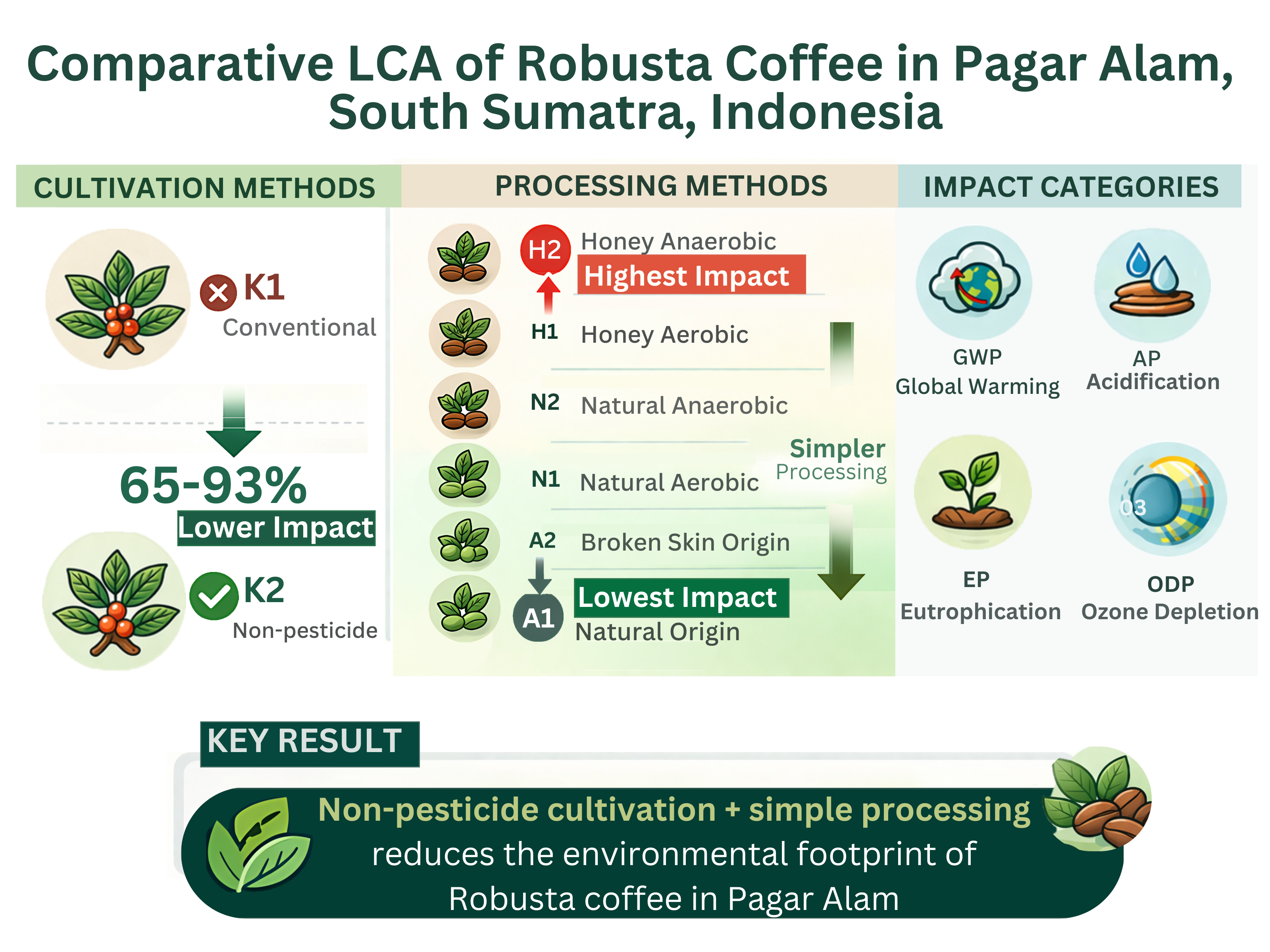
Pagar Alam Robusta coffee contributes significantly to the regional economy. Its cultivation and processing systems pose environmental challenges. This study compares the environmental performance of two cultivation methods (conventional-K1 and non-pesticide-K2) and six processing methods (natural origin-A1, broken skin origin-A2, natural aerobic-N1, natural anaerobic-N2, honey aerobic-H1, and honey anaerobic-H2). A cradle-to-gate Life Cycle Assessment (LCA) was conducted using a functional unit of 100 kg of green coffee beans, covering four impact categories: global warming potential (GWP), ozone depletion potential (ODP), acidification potential (AP), and eutrophication potential (EP). In the cultivation subsystem, K1 produced emissions of 85.70–117.00 kg CO₂-eq (GWP), 3.53×10⁻⁶–4.80×10⁻⁶ kg CFC-11-eq (ODP), 0.37–0.50 kg SO₂-eq (AP), and 0.16–0.22 kg PO₄-eq (EP), while K2 produced much lower emissions: 23.00–31.30 kg CO₂-eq (GWP), 2.22×10⁻⁷–3.03×10⁻⁷ kg CFC-11-eq (ODP), 0.09–0.13 kg SO₂-eq (AP), and 0.03–0.04 kg PO₄-eq (EP). In the processing subsystem, H2 had the highest emissions: 14.77 kg CO₂-eq (GWP), 6.48 kg CFC-11-eq (ODP), 0.04 kg SO₂-eq (AP), and 0.02 kg PO₄-eq (EP), while A1 had the lowest emissions: 5.23 kg CO₂-eq (GWP), 3.87 kg CFC-11-eq (ODP), 0.01 kg SO₂-eq (AP), and 0.001 kg PO₄-eq (EP). Implementing an improvement scenario based on non-pesticide cultivation (K2) could reduce emissions by approximately 65–93% across all impact categories. These findings demonstrate that adopting pesticide-free cultivation combined with simpler processing methods can significantly reduce the environmental footprint of Robusta coffee production in Pagar Alam and support more sustainable coffee management practices.
Full text article
References
2. FAO Markets and Trade, Commodities, Coffee Available online: https://www.fao.org/markets-and-trade/commodities/coffee/en/.
3. ICO Coffee Report and Outlook. Int. Coffee Organ. ICO 2023, 1, 1–39.
4. Ditjenbun Statistik Perkebunan Jilid I 2022-2024. Angew. Chemie Int. Ed. 6(11), 951–952. 2023, 5–24.
5. Fardinatri, I.D.; Condro, A.A.; Hayati, D.; Anhar, A. Environmental Dynamics in The Sumatran Coffee Landscapes: Opportunities and Challenges Through Spatial Perspectives. J. Pengelolaan Sumberd. Alam dan Lingkung. 2024, 14, 438, doi:10.29244/jpsl.14.3.438.
6. BPS (Badan Pusat Statistik) Volume 8, 2024. Stat. Kopi Indones. 2024, 8, 69.
7. DJKI No Title Available online: https://dgip.go.id/menu-utama/indikasi-geografis/listing.
8. Adiwinata, F.; Suprihatin, S.; Rahayuningsih, M. Analisis Daur Hidup (Life Cycle Assessment) Pengolahan Kopi Bubuk Robusta Secara Basah Di Industri Kecil Menengah (Ikm) Beloe Klasik Lampung. Agrointek J. Teknol. Ind. Pertan. 2021, 15, 1175–1182, doi:10.21107/agrointek.v15i4.11338.
9. Harsono, S.S.; Wibowo, R.K.K.; Supriyanto, E. Energy Balance And Green House Gas Emisson On Smallholder Java Coffee Production At Slopes Ijen Raung Plateau Of Indonesia. J. Ecol. Eng. 2021, 22, 271–283, doi:10.12911/22998993/138997.
10. Usva, K. Carbon and Water Footprint of Coffee Consumed in Finland — Life Cycle Assessment. 2020.
11. Diyarma, I.; Bantacut, T.; Suprihatin Assessment of Environmental Impact of the Gayo Arabica Coffee Production by Wet Process Using Life Cycle Assessment. Acta Univ. Cibiniensis. Ser. E Food Technol. 2019, 23, 27–34, doi:10.2478/aucft-2019-0004.
12. Novita, E. Desain Proses Pengolahan Pada Agroindustri Kopi Robusta Menggunakan Modifikasi Teknologi Olah Basah Berbasis Produksi Bersih (Disertasi). 2012, 1–46.
13. Anugerah Widiyanto Kontribusi Metode Life Cycle Assessment Biomassa Untuk Agroindustri Berkelanjutan; 2022; ISBN 9786238052066.
14. Chaerul, M.; Allia, V. Tinjauan Kritis Studi Life Cycle Assessment (LCA) Di Indonesia. J. Serambi Eng. 2019, 5, 816–823, doi:10.32672/jse.v5i1.1653.
15. Hamdan, H.; Fauzi, A.; Rusli, M.; Rustiadi, E. A Study of the Smallholder Coffee Agroindustry Sustainability Condition Using the Life Cycle Assessment Approach in Bengkulu Province, Indonesia. J. Ecol. Eng. 2019, 20, 153–160, doi:10.12911/22998993/108636.
16. Kementerian Lingkungan Hidup dan Kehutanan Republik Indonesia Pedoman Penyusunan Laporan Penilaian Daur Hidup (LCA). Kementeri. Lingkung. Hidup dan Kehutan. 2021, 1–82.
17. Standard, I.; Preview, T.S. ISO 14044 Environmental Management-Life Cycle Assessment-Requirements and Guidelines Management Environnemental-Analyse Du Cycle de Vie-Exigences et Lignes Directrices ITeh STANDARD PREVIEW. 1404, 2006.
18. PRé Sustainability Simapro Database Manual: Mothods Library. 2022, 3–48.
19. Hu, L.T.K.T.A.H.; Chen, Y.C.L.Z.H. Comparative Life Cycle Assessment for Conventional and Organic Coffee Cultivation in Vietnam. 2019, doi:10.1007/s13762-019-02539-5.
20. Chéron-Bessou, C.; Acosta-Alba, I.; Boissy, J.; Payen, S.; Rigal, C.; Setiawan, A.A.R.; Sevenster, M.; Tran, T.; Azapagic, A. Unravelling Life Cycle Impacts of Coffee: Why Do Results Differ so Much among Studies? Sustain. Prod. Consum. 2024, 47, 251–266, doi:10.1016/j.spc.2024.04.005.
21. Irawan, A.; Rabemanolontsoa, H.; McLellan, B.C. Comprehensive Environmental Impact Analysis of Dry Processing Methods for Specialty Coffee Beans in Bondowoso, Indonesia Using Life Cycle Assessment. Biomass 2024, 4, 843–864, doi:10.3390/biomass4030047.
22. Rahmah, D.M.; Putra, A.S.; Ishizaki, R.; Noguchi, R.; Ahamed, T. A Life Cycle Assessment of Organic and Chemical Fertilizers for Coffee Production to Evaluate Sustainability toward the Energy–Environment–Economic Nexus in Indonesia. Sustain. 2022, 14, 1–28, doi:10.3390/su14073912.
23. Pratama, R.; Parinduri, L. Penaggulangan Pemanasan Global. Bul. Utama Tek. 2019, 15, 1410–4520.
24. Faisal, A.; Martini, M.; Hestiningsih, R.; Wuryanto, M.A. Aplikasi Fumigan Gas Fosfin (Hidrogen Fosfida (Ph3)) Untuk Pengendalian Tikus (Rodent). Vektora J. Vektor dan Reserv. Penyakit 2019, 11, 95–102, doi:10.22435/vk.v11i2.1911.
25. Zaman, M.; Heng, L.; Müller, C. Measuring Emission of Agricultural Greenhouse Gases and Developing Mitigation Options Using Nuclear and Related Techniques: Applications of Nuclear Techniques for GHGs; 2021; ISBN 9783030553968.
26. Widowati, L.R.; Hartatik, W.; Setyorini, D.; Yani Trisnawati Pupuk Organik Dibuatnya Mudah, Hasil Tanam Melimpah. Pus. Perpust. dan Penyebaran Teknol. Pertan. 2021, 56.
27. Acosta-Alba, I.; Boissy, J.; Chia, E.; Andrieu, N. Integrating Diversity of Smallholder Coffee Cropping Systems in Environmental Analysis. Int. J. Life Cycle Assess. 2020, 25, 252–266, doi:10.1007/s11367-019-01689-5.
28. United Nations Environment Programme - UNEP Synthesis Report on the Environmental and Health Impacts of Pesticides and Fertilizers and Ways to Minimize Them. Envisioning a Chemical-Safe World; 2022; ISBN 9789280739299.
29. Hasan, Y.; Roy, P.; Abbassi, B. Comparative Life Cycle Assessment (LCA) in the Agri-Food Industry, Focusing on Organic and Conventional Coffee. Sustain. 2024, 16, doi:10.3390/su162410819.
30. Pramulya, R.; Bantacut, T.; Noor, E.; Yani, M.; Zulfajrin, M.; Setiawan, Y.; Pulunggono, H.B.; Sudrajat, S.; Anne, O.; Anwar, S.; et al. Carbon Footprint Calculation of Net CO2 in Agroforestry and Agroindustry of Gayo Arabica Coffee, Indonesia. Jordan J. Biol. Sci. 2023, 16, 335–343, doi:10.54319/jjbs/160218.
31. Gamatara, M.P.J.; Kusumawardani, D. Pengaruh Deforestasi Terhadap Emisi Co2 Pada Negara Beriklim Tropis Di Benua Asia. J. Ilm. Manajemen, Ekon. Akunt. 2024, 8, 1239–1256, doi:10.31955/mea.v8i2.4129.
32. Gosalvitr, P.; Cuéllar-Franca, R.M.; Smith, R.; Azapagic, A. An Environmental and Economic Sustainability Assessment of Coffee Production in the UK. Chem. Eng. J. 2023, 465, doi:10.1016/j.cej.2023.142793.
33. Sakamoto, H.; Bruschi, L.T.; Kulay, L.; Yamakami, A. Using the Life Cycle Approach for Multiobjective Optimization in the Context of the Green Supply Chain: A Case Study of Brazilian Coffee. Sustain. 2023, 15, doi:10.3390/su151813987.
Authors
Copyright (c) 2026 Novia Susanti, Muhammad Romli, Mohamad Yani

This work is licensed under a Creative Commons Attribution 4.0 International License.
Authors who publish with this journal agree to the following terms:
- Authors retain copyright and grant the journal right of first publication with the work simultaneously licensed under a Creative Commons Attribution License that allows others to share the work with an acknowledgement of the work's authorship and initial publication in this journal.
- Authors are able to enter into separate, additional contractual arrangements for the non-exclusive distribution of the journal's published version of the work (e.g., post it to an institutional repository or publish it in a book), with an acknowledgement of its initial publication in this journal.
- Authors are permitted and encouraged to post their work online (e.g., in institutional repositories or on their website) prior to and during the submission process, as it can lead to productive exchanges, as well as earlier and greater citation of published work (See The Effect of Open Access).
Article Details
How to Cite



